
On this page
Your needs, this model
Does it fit your priorities?
A 120 V F3000 host at 3,600 W AC and 3,072 Wh is required, not a 240 V station.
The selected option retains one F3000LFP host rated for 120 V AC, 3,600 W and 3,072 Wh nameplate capacity.
Explore this need in the finder →A two-panel package must supply at least 600 W of listed panel nameplate.
The product selector names 2 PV300 panels; total listed panel nameplate is 600 W. This is not a recharge measurement.
Explore this need in the finder →Require solar input and two panels, but do not require undocumented array wiring.
The station manual and seller option do not confirm the exact panel revision/cable and an all-panels-together input plan.
Explore this need in the finder →Pecron · two-panel F3000LFP package
Pecron F3000LFP with two PV300 panels review
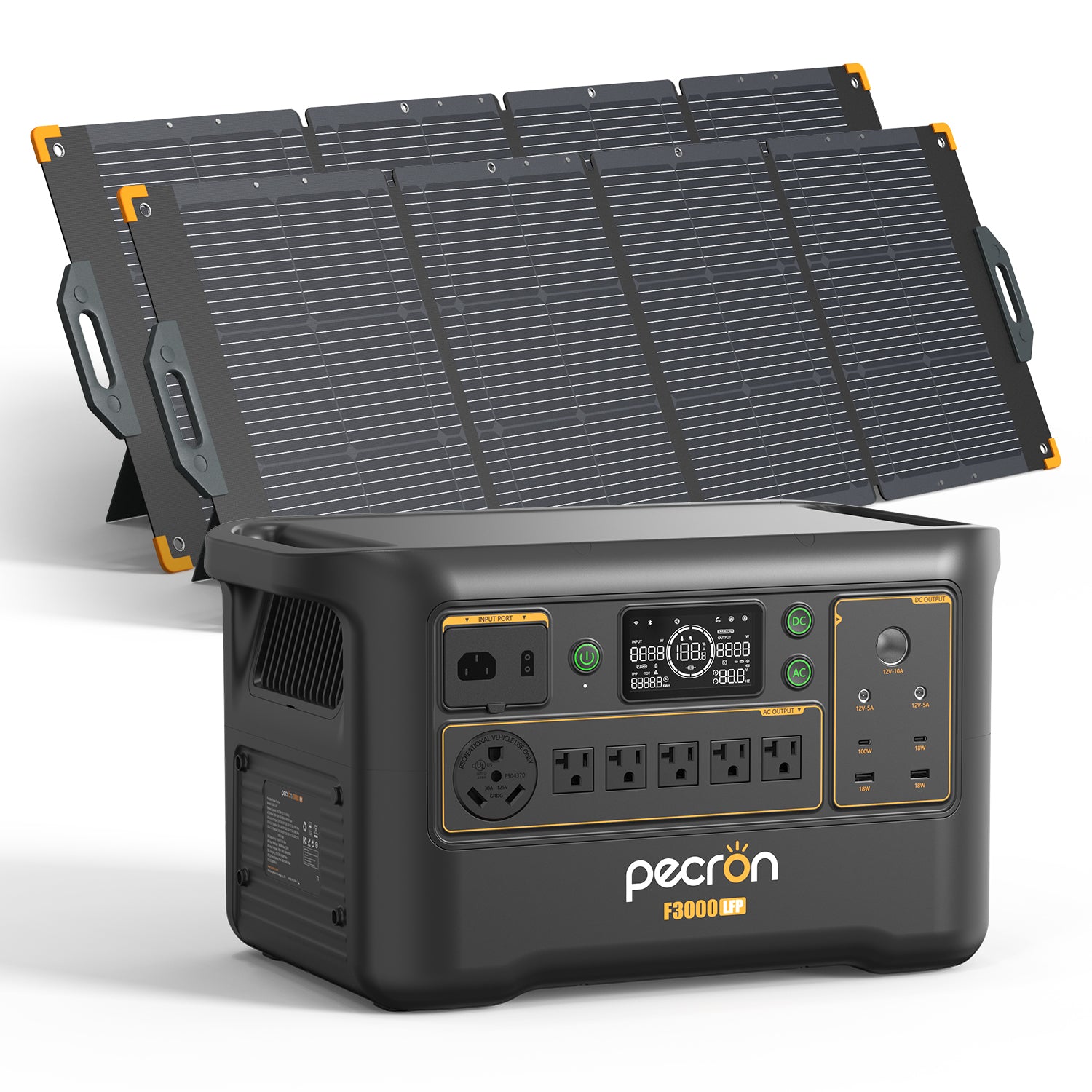
The U.S. product selector's F3000LFP+2*PV300 option (SKU F3000LFP-2*PV300) is one F3000LFP station and two named PV300 panels, without the separately selected cart. The station remains a 120 V, 3,600 W AC unit with 3,072 Wh of LiFePO4 nameplate capacity. Pecron states a 4,500 W surge for five seconds. Two panels change the solar package to 600 W of combined nameplate, not the battery size or the AC output. That difference is the reason to compare this option with the one-panel and station-only selections rather than treating them as the same box.
More panel nameplate, but not a recharge guarantee
At 600 W nominal, the two-panel set is still well below the F3000's listed 1,600 W maximum solar input. That is a comparison of nameplate numbers only; it does not promise that 600 W will be available or accepted in ordinary weather. The station has one XT60 solar input, with a documented 25–120 V window and 25 A maximum. The product listing and the model manual do not specify a complete two-panel cable and array plan for this exact option. A product title that groups two panels with a station is not a wiring diagram.
The linked PECRON panel manual calls its 300 W unit S300, not PV300, and gives nominal electrical figures of 36 V at operating point, 41.4 V open circuit, 8.3 A operating current, and 8.7 A short-circuit current, with MC4 connectors. The retailer option names PV300; the exact revision relationship remains unclear. Do not combine panels in series or parallel based only on these values, and do not assume an MC4-to-XT60 lead is included. Ask Pecron to identify the compatible cable and permitted connection for the exact panel revision before relying on the full supplied set. The manuals do not verify that detail.
The host is still the important purchase decision
For outage planning, the F3000's 3,072 Wh is stored energy on a label, not an AC runtime promise. Inverter losses, appliance cycles, and overlapping loads reduce what can be used. Its 3,600 W rated output is the ceiling to compare with simultaneous appliance draw; the short surge rating is not a general motor-start guarantee. It is a single 120 V source, so it should not be selected for 240 V equipment or described as a split-phase home system. A larger reserve or output requirement may point to a different host, not merely more panels.
The station weighs about 63.3 lb before panel equipment. Two portable panels add setup, storage, and handling needs, even when their folded package is easy to transport. A cart appears as a separate selector choice; the pictured no-cart configuration should not be read as proof that the cart is part of this SKU. The manuals do not give enough information here to quote a cart load limit or make a claim about carrying the panels on it.
Who benefits from the two-panel option
This option is most relevant to a buyer who needs the F3000's 120 V / 3,600 W / 3,072 Wh class and values a pair of included panels as a starting point for solar charging. The two panels may be easier to place independently than a single large panel, but neither the product facts nor the manual establish a supported split-array arrangement. If panel count itself matters, the seller's option identifies two; if the question is how much solar input the station can use, its published limit remains 1,600 W. Do not substitute the panel total for measured charging performance.
For questionnaire choices, 120 V, AC output, and the F3000 capacity/output thresholds are the meaningful host filters. Requiring at least two supplied panels favors this option over the one-panel SKU. Requiring every supplied panel to be confirmed together in one rated operating plan does not: the exact array/cable details are unknown, so an essential all-panels condition must fail rather than be inferred. The 2-panel option is not a solution for someone unwilling to verify that connection before use.
Compare before choosing
The one-panel option is the lower-complexity package if a single solar module is enough for your planned use; the station-only listing avoids buying any panel bundle. The four-panel F3000 selector option reaches 1,200 W nameplate, but it also needs a specifically documented array plan, not an arithmetic assumption. A buyer who needs more than the F3000's 3,600 W AC or 3,072 Wh reserve should compare the E3800LFP's published 4,200 W and 3,840 Wh instead. Whichever option fits, check your appliance's starting and sustained demand and obtain the current cable/wiring instructions for the exact panel revision.
Key details at a glance
| Nameplate battery capacity | 3072 Wh |
|---|---|
| Rated AC output | 3600 W |
| Manufacturer surge rating | 4500 W |
| Maximum solar input | 1600 W |
| Included panels, combined nameplate | 600 W |
| Maximum USB-C output per port | 100 W |
More specifications and setup details
| Listed weight | 63.3 lb |
|---|---|
| Compatible extra-battery expansion | Yes |
| 12 V DC output | 120 W |
| Maximum AC recharge input | 1800 W |
| AC outlet output | Yes |
| USB-C ports | 1 |
| USB-A ports | 2 |
| Solar input ports | 1 |
| Battery chemistry | LiFePO4 |
| Expansion battery in this package | No |
| Home Power Panel in this package | No |
| Separate station units in offer | 1 |
| Smart Transfer Switch in this package | No |
| Solar panels in exact offer | 2 |
Use the exact model’s instructions for operating limits, supplied equipment and version differences.
Sources for this assessment

A useful match starts with the loads that matter.
Use the finder for hard electrical requirements, then check appliance starting behavior, actual run time and the exact package in the full assessment.