
On this page
Your needs, this model
Does it fit your priorities?
Must the exact package include a cart?
The selected U.S. option is titled “F3000LFP+3*PV300 / With Cart”; cart capacity, weight and terrain limits are not stated.
Explore this need in the finder →Are at least 3 PV300-named panels and 900 W combined panel nameplate listed?
The selected option names 3 panels. 900 W is their nameplate sum, not measured charging power.
Explore this need in the finder →Can all supplied panels be verified as a supported array with this station?
No. The exact panel revision, array topology and cable are unknown. The host input ceiling alone does not establish wiring compatibility.
Explore this need in the finder →Pecron · three-panel F3000LFP option with cart
Pecron F3000LFP with three PV300 panels and cart review
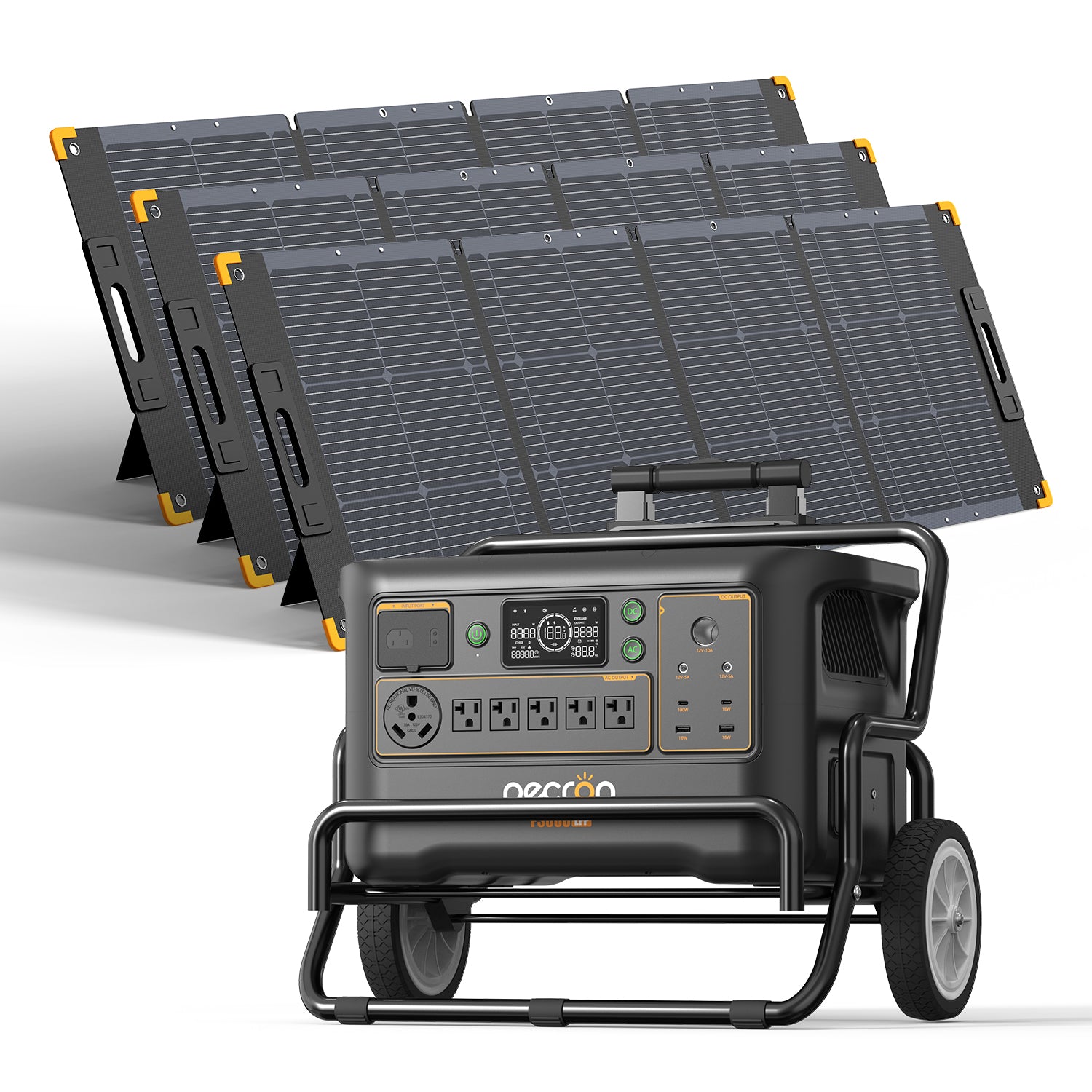
The exact selected option is “F3000LFP+3*PV300 / With Cart,” SKU F3000LFP+3*PV300+cart. The official U.S. product JSON identifies one F3000LFP, three PV300-named 300 W panels, and an included cart. The panel nameplate sum is 900 W by simple addition; the cart is a package accessory, not a change to station output or capacity. The offered combination differs from the no-cart three-panel F3000 profile specifically in that included transport equipment. Neither the cart’s rated load nor its weight and terrain limits are stated in the captured offer.
How to read the 900 W panel figure
The three panel labels add to 900 W of nominal nameplate. That is useful for comparing the offer with one- or two-panel selections, but is not stored energy, actual harvest, or a proven charge rate. The F3000LFP remains a 3,072 Wh LiFePO4 station, 3,600 W rated AC at 120 V. Its manual lists a 1,600 W maximum solar input, 25–120 V, and 25 A. The 900 W nominal total is below the maximum-watt figure; that alone does not prove the specific three-panel array operates together within every voltage and current limit.
Pecron’s selected offer calls the panels PV300. The separate panel page and linked manual use a PV300/S300 naming distinction, and the evidence does not confirm that this exact kit’s panels match the manual revision. Nor is the included station-side cable established. Because three sources must be connected to one input, the number of panels is not enough to infer connectors, wiring topology, or an approved adapter. Verify the exact kit instructions before relying on all three for charging.
The cart is for the station, not the solar setup
The product-page rendering shows a wheeled cart under the station and three folding-panel assemblies behind it. That image helps identify the selected bundle, but it is a manufacturer rendering rather than a sample inspection. It does not show that the panels are carried by the cart, and the listing does not publish the cart’s weight rating or safe route. The 63.3 lb station is heavy enough that a cart may be useful for repositioning on a suitable path. It is still important to plan how the panels and cable move and where they can be deployed. Do not assume the entire package becomes a one-piece rolling kit.
On the AC side, treat 3,600 W as a continuous ceiling and the 4,500 W surge figure as a short, five-second allowance. Motor start behavior can vary, and the station does not offer 240 V output in this selected plan. The 3,072 Wh number is battery nameplate capacity, not the energy that will reach an AC appliance. No runtime or recharge-time claim follows from the package name.
Who benefits from this selection?
It is a reasonable shortlist candidate for a fixed backup or workshop where an F3000 host is already appropriate, a larger listed panel set is desired, and the exact bundle’s cart inclusion is useful. The third panel adds named equipment versus the two-panel option, not certainty about sun-dependent output. A buyer who needs the solar array to be pre-verified, the exact cable in the box, a known cart capacity, or 240 V should not treat this listing as satisfying that essential need without further documentation.
In the ordinary finder, requiring an included cart will select this variant rather than the matching “Without Cart” profile; requiring three panels and at least 900 W of listed panel nameplate distinguishes its package tier. Raising the panel floor to 901 W excludes it. In advanced matching, a requirement that every supplied panel has a confirmed operating plan remains a no-match while the wiring/revision bridge is unknown. The cart is a separate comfort decision, not evidence of solar compatibility.
Alternatives
The no-cart F3000 with three PV300 panels keeps the same named panels and host ratings for a buyer who already owns suitable transport. The two-panel-with-cart option lists fewer panels but keeps the cart; compare which package choice is actually essential. If you need more battery capacity, the E3800LFP is a separate 3,840 Wh, 4,200 W 120 V station family, not a drop-in way to validate the F3000 array. Compare station output, the exact connection instructions, panel storage, and the cart’s published limits before choosing a higher bundle tier.
Key details at a glance
| Nameplate battery capacity | 3072 Wh |
|---|---|
| Rated AC output | 3600 W |
| Manufacturer surge rating | 4500 W |
| Maximum solar input | 1600 W |
| Included panels, combined nameplate | 900 W |
| Maximum USB-C output per port | 100 W |
More specifications and setup details
| Listed weight | 63.3 lb |
|---|---|
| Compatible extra-battery expansion | Yes |
| 12 V DC output | 120 W |
| Maximum AC recharge input | 1800 W |
| AC outlet output | Yes |
| USB-C ports | 1 |
| USB-A ports | 2 |
| Solar input ports | 1 |
| Battery chemistry | LiFePO4 |
| Expansion battery in this package | No |
| Home Power Panel in this package | No |
| Separate station units in offer | 1 |
| Smart Transfer Switch in this package | No |
| Solar panels in exact offer | 3 |
Use the exact model’s instructions for operating limits, supplied equipment and version differences.
Sources for this assessment

A useful match starts with the loads that matter.
Use the finder for hard electrical requirements, then check appliance starting behavior, actual run time and the exact package in the full assessment.