
On this page
Your needs, this model
Does it fit your priorities?
A 120 V F3000LFP is needed for at least 3,600 W AC and 3,072 Wh nameplate capacity.
The selected option retains one F3000LFP host rated for 120 V AC, 3,600 W and 3,072 Wh nameplate capacity.
Explore this need in the finder →Three listed PV300 modules and at least 900 W combined nameplate are essential.
The product selector names 3 PV300 panels; total listed panel nameplate is 900 W. This is not a recharge measurement.
Explore this need in the finder →Solar charging and the stated three panels suffice only if a verified all-panel array is not essential.
The station manual and seller option do not confirm the exact panel revision/cable and an all-panels-together input plan.
Explore this need in the finder →Pecron · three-panel F3000LFP package
Pecron F3000LFP with three PV300 panels review
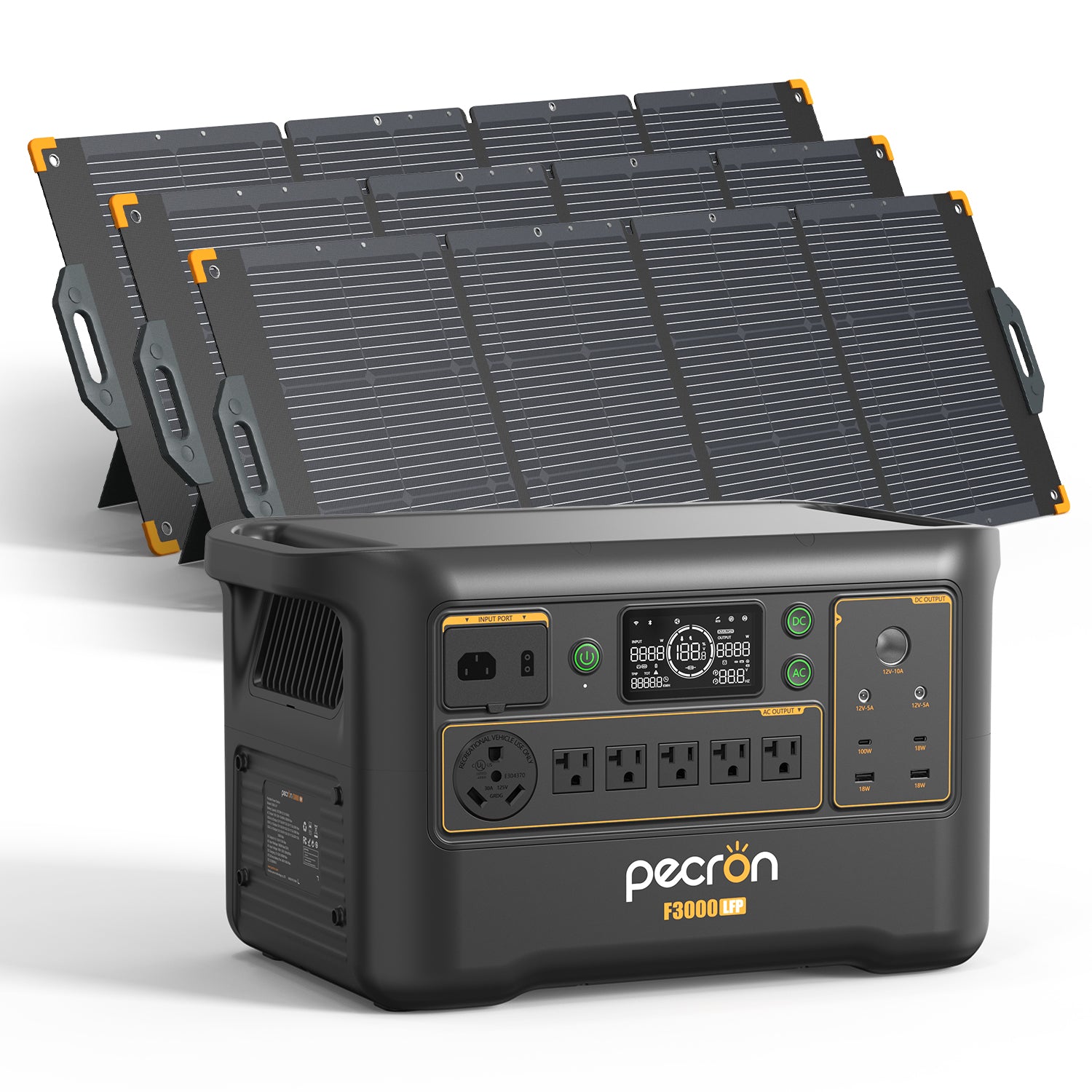
Pecron's U.S. F3000LFP selector labels this option F3000LFP+3*PV300 (SKU F3000LFP-3*PV300), without the cart. It identifies one F3000LFP power station and three PV300-named 300 W panels. The host does not change with the panel count: one 120 V station, 3,072 Wh nameplate capacity, and 3,600 W rated AC output. The solar nameplate sum is 900 W. That does not mean the station will draw 900 W continuously, and it does not answer whether all three modules can be connected safely to its single input.
Three panels make wiring the central question
The F3000 manual lists one XT60 solar input, 25–120 V, up to 25 A and 1,600 W. The linked PECRON panel manual for the 300 W unit identifies model S300 and lists nominal 36 V operating voltage, 41.4 V open-circuit voltage, 8.3 A operating current, and 8.7 A short-circuit current, with MC4 connectors. The offer says PV300; the page-to-manual identity bridge is not explicit, and the selected-option capture does not state its exact cable set or array topology. That is important because ordinary three-panel series and parallel calculations do not yield an obvious confirmed plan: three nominal open-circuit voltages would total 124.2 V, above the station's 120 V ceiling, while three nominal short-circuit currents would total 26.1 A, above its 25 A limit. Those sums are explanatory checks, not advice to wire the panels either way.
Panel tolerances and conditions also matter; a nominal-voltage calculation is not a safe design. A different layout could have its own constraints, but no official instruction in the reviewed sources establishes a permitted three-panel arrangement for this exact station and panel version. Do not connect the set by guessing at a combiner, series pair, or improvised cable. Ask the manufacturer for a current diagram and compatible lead; until then, the option's identity and quantity are known, while an all-three-panel operating plan remains unknown.
Use the station rating for load planning
The F3000's 3,072 Wh is nameplate battery capacity, not guaranteed AC energy at an appliance. The 3,600 W AC rating is the published continuous output ceiling, while 4,500 W is only a five-second surge figure. A motor's starting behavior, other loads running at once, temperature, and battery state affect the practical result. It is a one-station 120 V plan, not a 240 V solution. The extra panels neither increase the stored capacity nor create additional AC outlets or a second inverter.
At about 63.3 lb, the station itself is already a heavy object to lift. Three panels increase the amount of equipment to carry, lay out, protect from shade, and repack. The selector also has a cart choice, but the product image for this no-cart variant does not depict a trolley and does not establish the cart's capacity. Keep the panel package and its support hardware separate from the electrical specification when deciding whether one person can set it up.
Who this package may suit
It may interest someone who needs the F3000 host and values the seller's three-panel bundle, but it is not a confirmed ready-to-connect solar system based on the sources reviewed. If the essential request is simply a 120 V AC station with at least 3,072 Wh and 3,600 W, the host fits those published thresholds. If the ordinary question requires solar input, the station has a specified solar input. If the decision depends on the three panels working together as supplied, that condition is not established and must not be treated as a pass.
The package is a poor choice for a buyer who cannot pause to verify the cabling, who needs a documented array plan on day one, or who expects a 900 W constant harvest. The selector title is evidence that Pecron offers this combination; it is not enough to replace the panel and station manuals. The panel manual's model label also means that a buyer requiring a specific PV300 generation should have Pecron confirm which 300 W panel is shipped.
Alternatives and questionnaire tradeoffs
The one- and two-panel F3000 options keep the listed panel quantity lower, though they still need a verified cable route. The four-panel option has a larger 1,200 W nameplate total and could be tempting for faster replenishment, but it has the same documentation gap rather than a guaranteed advantage. If your load exceeds 3,600 W, uses 240 V, or needs more than 3,072 Wh nameplate capacity, changing the number of panels does not fix the host mismatch. Compare a different power station on those criteria first.
When selecting requirements, use the panel-count threshold only for the number of modules PECRON names in the box. Treat the all-panels-together constraint separately. If that is essential, this profile should be rejected until the exact station/panel/cable plan is documented. That is a more useful limit than pretending the option is either fully verified or nonexistent.
Key details at a glance
| Nameplate battery capacity | 3072 Wh |
|---|---|
| Rated AC output | 3600 W |
| Manufacturer surge rating | 4500 W |
| Maximum solar input | 1600 W |
| Included panels, combined nameplate | 900 W |
| Maximum USB-C output per port | 100 W |
More specifications and setup details
| Listed weight | 63.3 lb |
|---|---|
| Compatible extra-battery expansion | Yes |
| 12 V DC output | 120 W |
| Maximum AC recharge input | 1800 W |
| AC outlet output | Yes |
| USB-C ports | 1 |
| USB-A ports | 2 |
| Solar input ports | 1 |
| Battery chemistry | LiFePO4 |
| Expansion battery in this package | No |
| Home Power Panel in this package | No |
| Separate station units in offer | 1 |
| Smart Transfer Switch in this package | No |
| Solar panels in exact offer | 3 |
Use the exact model’s instructions for operating limits, supplied equipment and version differences.
Sources for this assessment

A useful match starts with the loads that matter.
Use the finder for hard electrical requirements, then check appliance starting behavior, actual run time and the exact package in the full assessment.