
On this page
Your needs, this model
Does it fit your priorities?
Must the exact package include a cart?
The selected U.S. option is titled “F3000LFP+4*PV300 / With Cart”; cart capacity, weight and terrain limits are not stated.
Explore this need in the finder →Are at least 4 PV300-named panels and 1200 W combined panel nameplate listed?
The selected option names 4 panels. 1200 W is their nameplate sum, not measured charging power.
Explore this need in the finder →Can all supplied panels be verified as a supported array with this station?
No. The exact panel revision, array topology and cable are unknown. The host input ceiling alone does not establish wiring compatibility.
Explore this need in the finder →Pecron · four-panel F3000LFP option with cart
Pecron F3000LFP with four PV300 panels and cart review
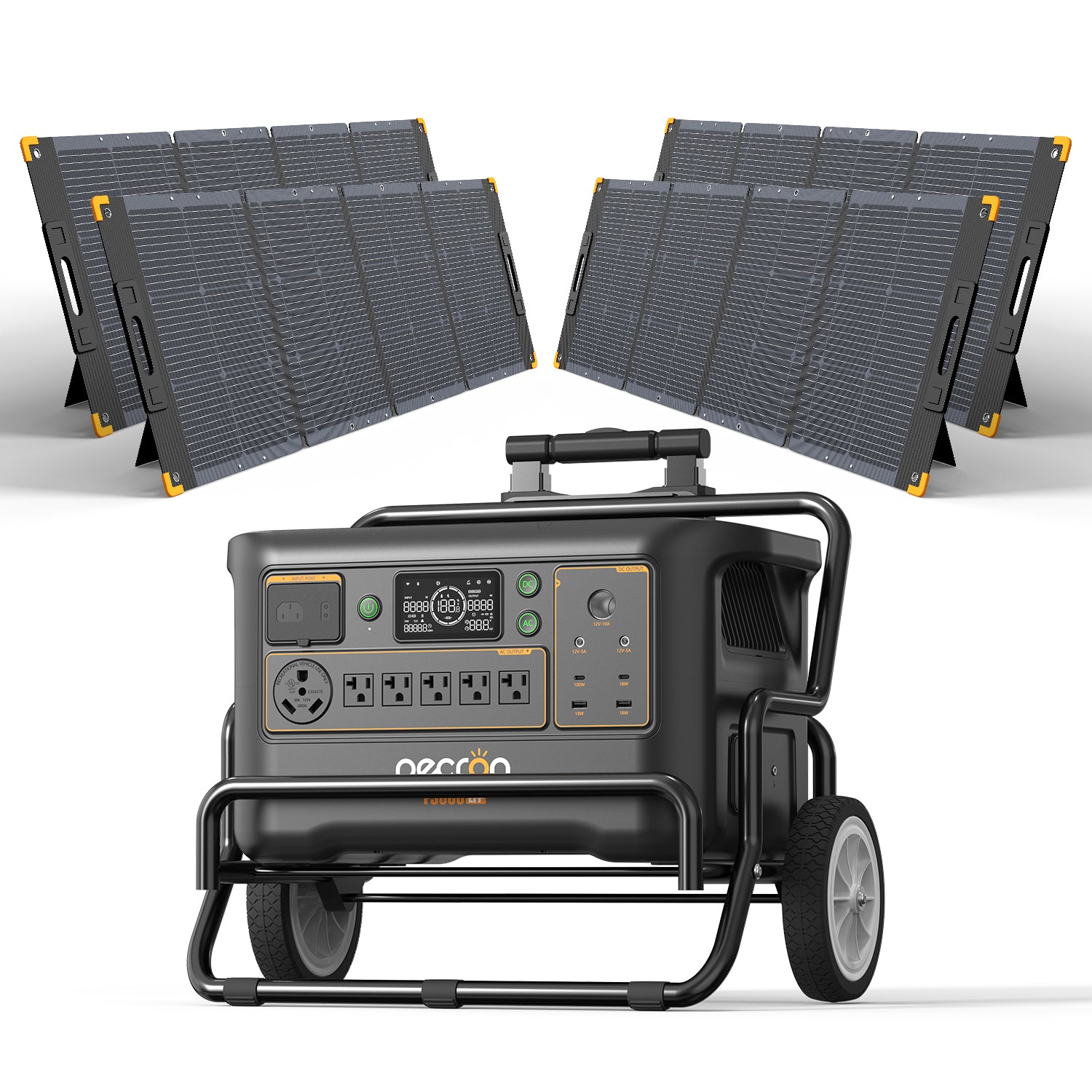
This is Pecron’s exact U.S. selected option “F3000LFP+4*PV300 / With Cart,” SKU F3000LFP+4*PV300+cart. It lists one F3000LFP station, four panels named PV300, and a cart. Four 300 W labels add to 1,200 W of panel nameplate. The cart separates this package from the no-cart four-panel profile; the number of panels separates it from lower bundle tiers. The cart is visibly included in the manufacturer’s selected-option rendering, but its capacity, weight, attachment details, and terrain rating remain unpublished in the saved offer evidence.
More solar equipment does not rewrite the station spec
The station itself remains a 120 V, 3,600 W AC model with 3,072 Wh nameplate storage. A brief 4,500 W surge rating is specified for five seconds, which is not a guarantee for every motor or compressor. The four panels add listed equipment, not battery capacity and not a measured recharge rate. The station manual specifies one solar input with a 25–120 V range, 25 A maximum, and 1,600 W maximum input. The 1,200 W panel-nameplate sum sits below that maximum-watt ceiling, but the source does not provide a verified array diagram for these exact four modules.
That missing bridge matters: the option names the panels PV300, while a linked Pecron document identifies a 300 W panel as S300. The archived evidence does not establish the exact panel revision in the selected package, the precise station-side lead supplied, or how four panels are intended to be connected. A watt total below a maximum does not settle open-circuit voltage or series/parallel current. Confirm the exact cable and manufacturer-approved panel layout before planning to use all four together. No recharge time is supported here.
Transport and setup are separate jobs
At about 63.3 lb, the F3000LFP is substantial even before the panel kit is accounted for. A cart may reduce repeated lifting of the station between nearby locations, but the source does not say it carries the four panels. The selected image is a promotional CGI showing the station on a wheeled frame with the panel assemblies arranged behind it; it is not a field demonstration. Do not infer total bundle weight, wheel performance, slope safety, or panel storage from this picture. Buyers who need to move the whole kit should ask about the cart’s capacity and dimensions and plan panel transport separately.
Four foldable panels also require an appropriate staging area and time to set up. The exact solar plan still matters even if the physical panels fit the site: all four may not form one confirmed electrical array with the included connection parts. If a panel-in-box requirement is essential, the offer lists four; if an all-panels-together requirement is essential, the current file set cannot verify that condition.
Who this package is for
Consider it if your loads justify the F3000’s 120 V output and capacity, you want four manufacturer-listed panels, and a cart is a useful included accessory for the station. It is less suitable for a buyer who wants a simple grab-and-go kit, a published total carried weight, a confirmed cart load rating, or a documented solar topology before paying. The cart does not add an inverter, increase the 3,072 Wh reserve, or make the 120 V unit a 240 V system.
The questionnaire treats cart inclusion separately from electrical requirements. Selecting “cart included” should distinguish this offer from its no-cart sibling. A 1,200 W minimum and a four-panel minimum fit the listed package; 1,201 W or five panels does not. A positive all-panels-together condition remains unsatisfied because exact electrical compatibility is unknown. That is intentionally stricter than merely observing a 1,600 W input ceiling.
Which alternative is more sensible?
The no-cart four-panel profile preserves the same station and panel count if you already have suitable transport. The three-panel-with-cart package gives up one listed panel while retaining the accessory. A two-panel offer with the cart may be a more manageable kit when your solar space is limited, though its connection instructions must still be checked. If the essential issue is more continuous output or storage rather than panels, compare the E3800LFP’s different 120 V host ratings. Make the choice around the actual loads, acceptable moving method, available setup area, and verified connection plan—not the largest number in a kit title.
Key details at a glance
| Nameplate battery capacity | 3072 Wh |
|---|---|
| Rated AC output | 3600 W |
| Manufacturer surge rating | 4500 W |
| Maximum solar input | 1600 W |
| Included panels, combined nameplate | 1200 W |
| Maximum USB-C output per port | 100 W |
More specifications and setup details
| Listed weight | 63.3 lb |
|---|---|
| Compatible extra-battery expansion | Yes |
| 12 V DC output | 120 W |
| Maximum AC recharge input | 1800 W |
| AC outlet output | Yes |
| USB-C ports | 1 |
| USB-A ports | 2 |
| Solar input ports | 1 |
| Battery chemistry | LiFePO4 |
| Expansion battery in this package | No |
| Home Power Panel in this package | No |
| Separate station units in offer | 1 |
| Smart Transfer Switch in this package | No |
| Solar panels in exact offer | 4 |
Use the exact model’s instructions for operating limits, supplied equipment and version differences.
Sources for this assessment

A useful match starts with the loads that matter.
Use the finder for hard electrical requirements, then check appliance starting behavior, actual run time and the exact package in the full assessment.