
On this page
Your needs, this model
Does it fit your priorities?
A 120 V user needs the F3000’s 3,600 W AC ceiling and 3,072 Wh nameplate reserve.
The selected option retains one F3000LFP host rated for 120 V AC, 3,600 W and 3,072 Wh nameplate capacity.
Explore this need in the finder →Four included panels with at least 1,200 W combined nameplate are required.
The product selector names 4 PV300 panels; total listed panel nameplate is 1200 W. This is not a recharge measurement.
Explore this need in the finder →Solar charging and four panels are useful, but every panel must not be assumed as one array.
The station manual and seller option do not confirm the exact panel revision/cable and an all-panels-together input plan.
Explore this need in the finder →Pecron · four-panel F3000LFP package
Pecron F3000LFP with four PV300 panels review
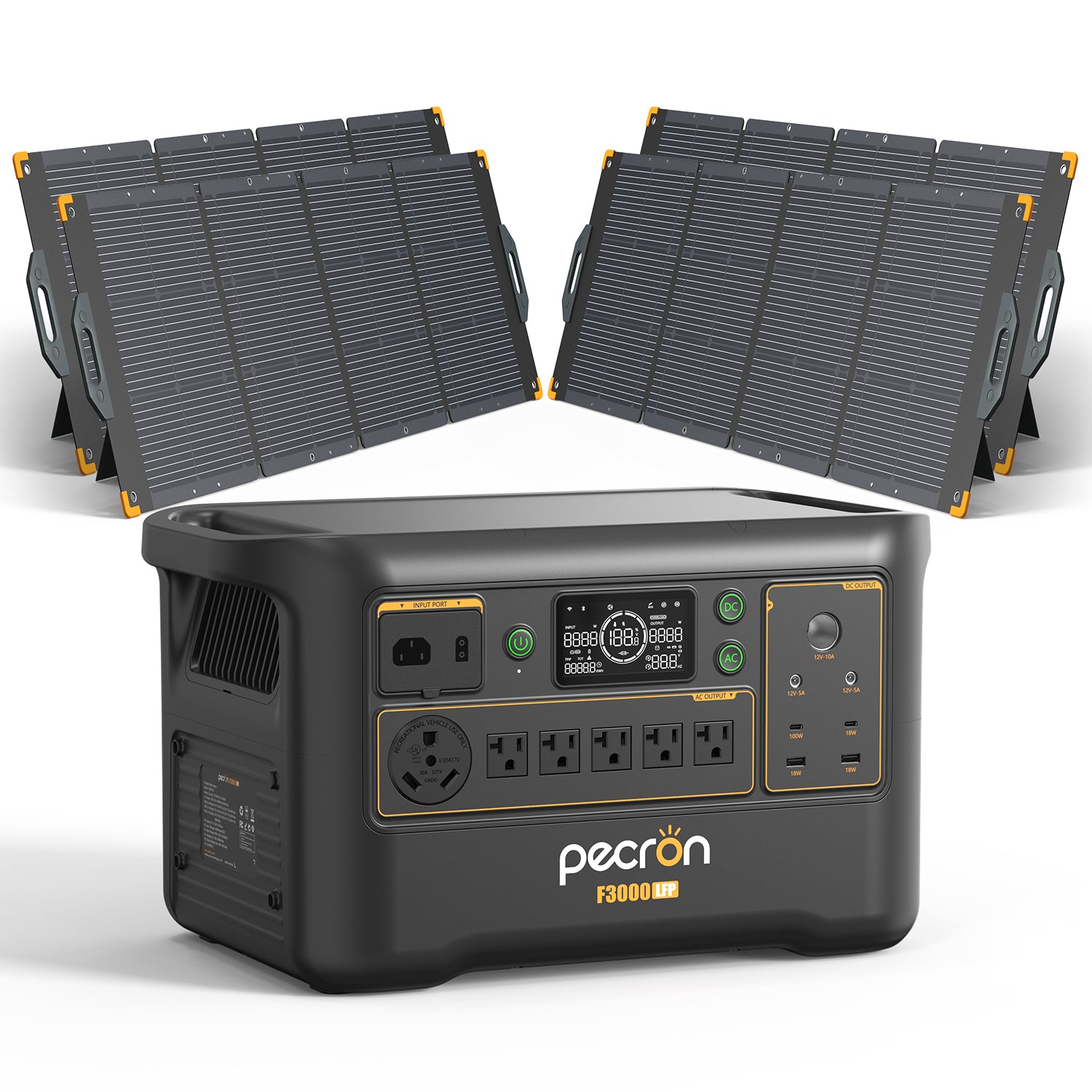
The U.S. F3000LFP product selector has a F3000LFP+4*PV300 choice (SKU F3000LFP-4*PV300), without the cart. It is still a single F3000LFP station; the selected bundle names four PV300 panels. At 300 W each, their nominal combined panel nameplate is 1,200 W. The station itself remains 3,072 Wh and 3,600 W AC at 120 V. Four panels do not add stored energy or raise that output limit.
A notable panel total, with a documentation gap
On paper, 1,200 W of panels is below the F3000's stated 1,600 W maximum solar input. That simple comparison is useful, but it is not enough to confirm that this particular four-panel array works. The station manual lists one XT60 solar input with a 25–120 V window and 25 A maximum. PECRON's linked panel manual for its 300 W module uses the model name S300 and lists 36 V operating voltage, 41.4 V open-circuit voltage, 8.3 A operating current, and 8.7 A short-circuit current with MC4 connectors. The seller option calls the panels PV300. The inspected offer and manuals do not bridge the exact panel revision, supply cable, or approved four-panel arrangement.
It is possible to calculate candidate series/parallel totals from those nominal figures, but the source material does not identify a supported configuration or account for panel tolerance and conditions. A 1,200 W arithmetic total is therefore not a wiring instruction. Obtain PECRON's current diagram and the correct cable details for the exact selected panel and station revision before treating every included module as a supported array. The facts here identify what the product page offers without filling the gap with a guess.
Handling and place in a backup plan
The station is listed at about 63.3 lb. The linked S300 manual lists one panel at 12.741 kg; if that manual applies to each of the four option panels, their component weight would total about 51 kg before cases or cables. Because the page option says PV300 and the linked manual says S300, that is only an estimate from a related manual, not a verified package weight. The same conditional sum with the station is roughly 175 lb, not one lift or a shipping-weight figure. A cart option is available on the page, but this no-cart option's image shows the station and panels rather than a trolley. No cart load limit or ability to carry the folded panels is asserted here.
For loads, the 3,600 W AC rating is the relevant published ceiling for simultaneous 120 V appliances. The 4,500 W surge number is specified for five seconds, not as a dependable motor-start result. The 3,072 Wh battery capacity is a nameplate value; usable AC energy and runtime depend on conversion and the actual load. If the need is a 240 V circuit, a larger battery, or higher AC power, four solar panels do not solve the station's limits. The F3000 is not a whole-home split-phase setup by virtue of its solar bundle.
When the four-panel package makes sense
This option may be worth investigating for a 120 V user who wants a larger listed panel quantity alongside the F3000 and can confirm the entire array before use. It is not a safe shortcut for someone who specifically needs an already documented four-panel system. The manufacturer has named the exact option, so its package identity and four-panel count are known; the supported all-panels-together plan is not. Those are different questions and should remain separate.
In the finder, a 120 V requirement and the F3000's AC/capacity thresholds can be evaluated from the station manual. Requiring at least four included panels selects this package's listed count; asking for a particular minimum solar input instead should use the station's 1,600 W ceiling, not the 1,200 W panel sum. Requiring that all supplied panels be confirmed in one plan must reject it until the cable and wiring are documented. If panel count is not important, the one- or two-panel choices reduce the accessory load; the station-only option avoids the bundle altogether.
Compare the host, not just the panel stack
The E3800LFP is a different 120 V station with 3,840 Wh and 4,200 W AC, plus a published solar input limit of 3,000 W across two inputs. It is heavier at about 87.3 lb, so its higher figures bring a real handling tradeoff. The four-panel F3000 option has 1,200 W of named panel equipment but only a 3,072 Wh, 3,600 W host. If the host figures fit your plan, verify the full bundle's connectors and array. If they do not, look at the appropriate station first rather than expecting extra panels to compensate.
Key details at a glance
| Nameplate battery capacity | 3072 Wh |
|---|---|
| Rated AC output | 3600 W |
| Manufacturer surge rating | 4500 W |
| Maximum solar input | 1600 W |
| Included panels, combined nameplate | 1200 W |
| Maximum USB-C output per port | 100 W |
More specifications and setup details
| Listed weight | 63.3 lb |
|---|---|
| Compatible extra-battery expansion | Yes |
| 12 V DC output | 120 W |
| Maximum AC recharge input | 1800 W |
| AC outlet output | Yes |
| USB-C ports | 1 |
| USB-A ports | 2 |
| Solar input ports | 1 |
| Battery chemistry | LiFePO4 |
| Expansion battery in this package | No |
| Home Power Panel in this package | No |
| Separate station units in offer | 1 |
| Smart Transfer Switch in this package | No |
| Solar panels in exact offer | 4 |
Use the exact model’s instructions for operating limits, supplied equipment and version differences.
Sources for this assessment

A useful match starts with the loads that matter.
Use the finder for hard electrical requirements, then check appliance starting behavior, actual run time and the exact package in the full assessment.