
On this page
Your needs, this model
Does it fit your priorities?
Must the exact package include a cart?
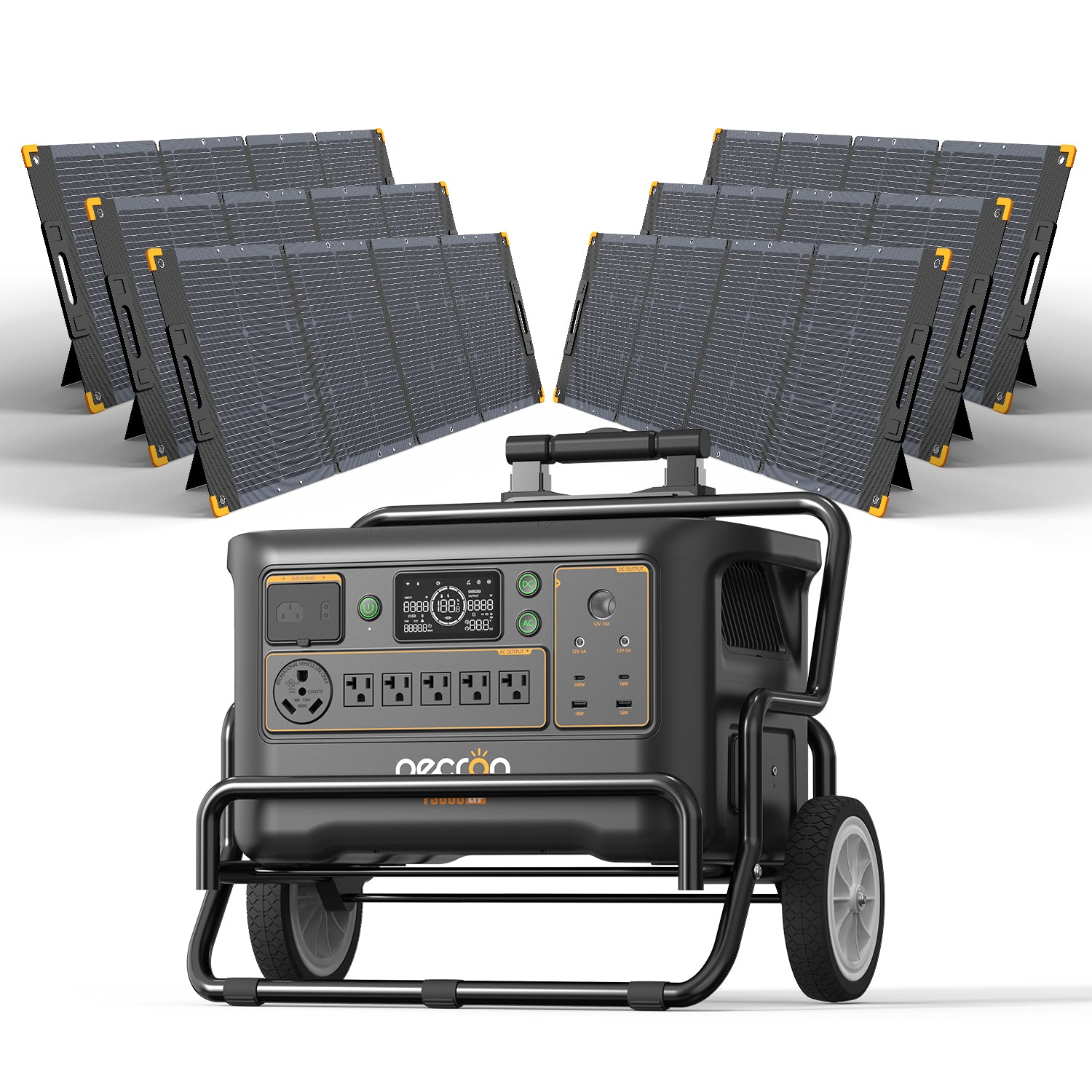
The selected U.S. option is titled “F3000LFP+6*PV300 / With Cart”; cart capacity, weight and terrain limits are not stated.
Explore this need in the finder →Are at least 6 PV300-named panels and 1800 W combined panel nameplate listed?
The selected option names 6 panels. 1800 W is their nameplate sum, not measured charging power.
Explore this need in the finder →Can all supplied panels be verified as a supported array with this station?
No. The exact panel revision, array topology and cable are unknown. The nameplate sum also exceeds the host input ceiling.
Explore this need in the finder →Pecron · six-panel F3000LFP option with cart
Pecron F3000LFP with six PV300 panels and cart review
The archived U.S. selected option is titled “F3000LFP+6*PV300 / With Cart,” SKU F3000LFP+6*PV300+cart. It identifies one F3000LFP station, six PV300-named panels, and an included cart. The package name implies 1,800 W of combined panel nameplate if each panel is the 300 W model represented by the existing manufacturer panel evidence. That figure needs particular care: the F3000 manual lists a 1,600 W maximum solar-input ceiling. The selected offer does not explain whether the panel bundle is intended for alternate use, over-paneling, or some other arrangement. It does not prove that all six can be connected together or that the station will accept 1,800 W.
The host and array limits are not the same number
F3000LFP remains a 120 V station rated for 3,600 W AC and 3,072 Wh of LiFePO4 nameplate storage. Its manual lists solar input of 25–120 V, up to 25 A, and 1,600 W maximum. The selected six-panel offer lists more panel nameplate than that maximum. Do not interpret the package title as permission to exceed the station limit, and do not translate the nameplate sum into actual harvest. The correct way to determine whether a six-panel array is supported is to obtain the exact manufacturer connection plan, including panel revision, voltage/current arrangement, and cables. Those details are not established in the saved selection evidence.
The naming remains a second reason for restraint. The selected offer says PV300; a separate linked Pecron manual identifies its 300 W module as S300. The evidence does not prove those are identical revisions. The station-side MC4-to-XT60 cable contents and a six-panel topology are also unknown. A strict requirement for all supplied panels to operate together should therefore reject this profile until the exact manual or an authoritative written compatibility statement closes the gap.
What the included cart does—and does not—answer
The option explicitly says “With Cart,” and its manufacturer CGI depicts the station on a wheeled frame. That supports cart inclusion, not a claim about its safe load or whole-kit transport. The F3000 station alone weighs about 63.3 lb. Cart weight, load limit, attachment method, wheel performance, and suitability for steps or uneven ground are not given. The six panels are separate folding assemblies in the rendering; the source does not say that the cart carries them. Plan storage and moving of the panels, station, and cable as separate tasks unless the manufacturer provides details.
For AC loads, the station’s 3,600 W rating is continuous output; its 4,500 W surge specification lasts five seconds. It may or may not start a particular motor under other load conditions. The 3,072 Wh nameplate capacity is not guaranteed AC energy delivered to appliances, so a runtime estimate would require actual load data. More panels do not increase either station figure.
Who might still consider the package?
A buyer might shortlist this offer if they already need the F3000 host, want the cart included, and are specifically investigating the manufacturer’s six-panel bundle while willing to verify its intended electrical configuration before use. It is not a good match for someone who expects a confirmed all-six array, a plug-and-play kit with proven cable contents, a 240 V output, or a known cart capacity without further documentation. The 1,800 W listed panel sum is not a supported-input guarantee.
In the finder, a cart requirement and a six-panel/1,800 W nameplate floor can identify this selection. A 1,801 W panel floor or a seven-panel minimum should exclude it. An essential all-panels-together rule also excludes it while the plan is unknown. For buyers who only need an F3000 with several panels and want a lower nameplate sum, the four-panel-with-cart option lists 1,200 W; that alternative still has unresolved connection details, so it is not automatically a verified array either.
Alternatives
The no-cart six-panel F3000 is the closest package comparison if you do not need the cart. It has the same essential 1,800 W nameplate-versus-1,600 W input issue. The four-panel-with-cart version lowers the listed panel count and watt sum but keeps the cart; its exact array remains unconfirmed. If your main need is station energy or AC output, compare another station configuration rather than assuming additional panels solve it. For this bundle, confirm the panel wiring and cart specifications in writing before treating the headline package as a complete operating plan.
Key details at a glance
| Nameplate battery capacity | 3072 Wh |
|---|---|
| Rated AC output | 3600 W |
| Manufacturer surge rating | 4500 W |
| Maximum solar input | 1600 W |
| Included panels, combined nameplate | 1800 W |
| Maximum USB-C output per port | 100 W |
More specifications and setup details
| Listed weight | 63.3 lb |
|---|---|
| Compatible extra-battery expansion | Yes |
| 12 V DC output | 120 W |
| Maximum AC recharge input | 1800 W |
| AC outlet output | Yes |
| USB-C ports | 1 |
| USB-A ports | 2 |
| Solar input ports | 1 |
| Battery chemistry | LiFePO4 |
| Expansion battery in this package | No |
| Home Power Panel in this package | No |
| Separate station units in offer | 1 |
| Smart Transfer Switch in this package | No |
| Solar panels in exact offer | 6 |
Use the exact model’s instructions for operating limits, supplied equipment and version differences.
Sources for this assessment

A useful match starts with the loads that matter.
Use the finder for hard electrical requirements, then check appliance starting behavior, actual run time and the exact package in the full assessment.