
On this page
Your needs, this model
Does it fit your priorities?
A one-host 120 V station rated for 3,600 W and 3,072 Wh is enough; a 240 V need must fail.
The selected option retains one F3000LFP host rated for 120 V AC, 3,600 W and 3,072 Wh nameplate capacity.
Explore this need in the finder →At least six panels and 1,800 W listed panel nameplate are required.
The product selector names 6 PV300 panels; total listed panel nameplate is 1800 W. This is not a recharge measurement.
Explore this need in the finder →Do not recommend this package when every supplied panel must be confirmed operating together.
The station manual and seller option do not confirm the exact panel revision/cable and an all-panels-together input plan.
Explore this need in the finder →Pecron · six-panel F3000LFP package
Pecron F3000LFP with six PV300 panels review
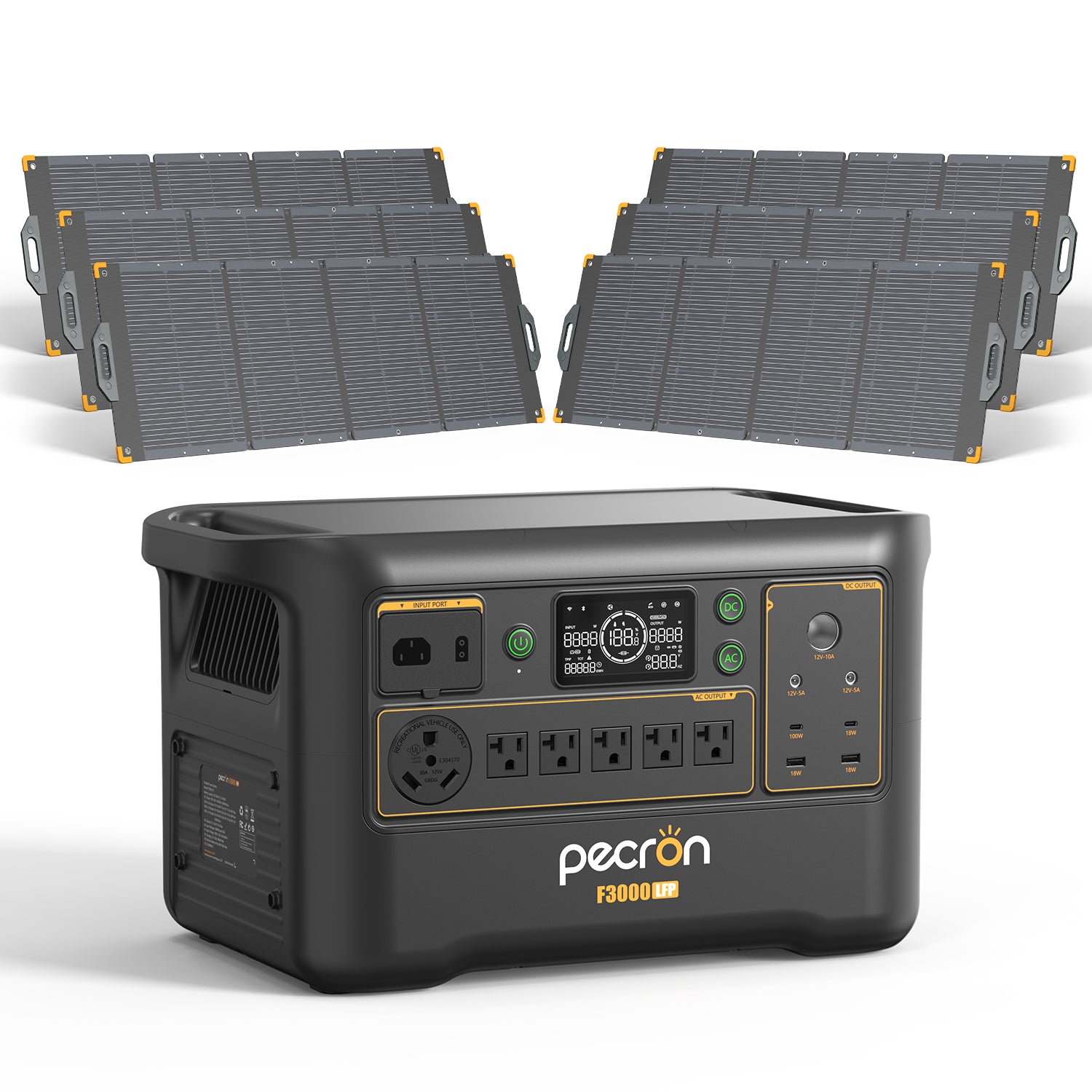
Pecron's U.S. F3000LFP selector lists a F3000LFP+6*PV300 option (SKU F3000LFP-6*PV300), without the cart. The station is one F3000LFP with 3,072 Wh nameplate capacity and 3,600 W AC output at 120 V. The option names six PV300 panels. At 300 W nominal each, their combined panel nameplate is 1,800 W, which is 200 W higher than the station manual's 1,600 W solar-input maximum. The panel total must not be mistaken for supported charging power.
The six-panel headline needs scrutiny
The manuals do not say whether this exact over-nameplate package is intended to be connected at once, whether the controller clips excess input, or what array layout and cable are supplied. Do not assume that a controller will safely limit an over-paneled array unless Pecron confirms it for the exact F3000 and panel revision. Do not wire six panels together based on the bundle title. The F3000 has one XT60 solar input with a 25–120 V voltage window and 25 A maximum; a combined nameplate exceeding 1,600 W does not erase those limits.
The separate 300 W PECRON panel manual identifies the panel as S300, listing nominal 36 V operating voltage, 41.4 V open-circuit voltage, 8.3 A operating current, and 8.7 A short-circuit current through MC4 connectors. The selected F3000 option calls its modules PV300, and the saved documentation does not establish a revision bridge or the exact MC4-to-XT60 cable. Even if a string arrangement looks plausible by arithmetic, panel tolerance and conditions matter. The six-panel bundle's identity is clear as a retail option; a safe all-six operating plan is not established by these documents.
More equipment is not more stored energy
Six modules add carrying, setup, storage, and weather exposure, but they do not increase the F3000's 3,072 Wh battery. The linked S300 manual lists one panel at 12.741 kg; if it applies to each of the six option panels, they would total about 76.4 kg before cases and leads. The option says PV300 while the manual says S300, so this is an estimate from the linked manual, not a verified package weight. Adding the station's listed 63.3 lb gives roughly 232 lb across separate parts, not a package or shipping-weight figure. The page offers a cart choice, but it does not establish the cart's safe capacity or whether it is intended for moving these panels too.
The station remains a single 120 V source rated for 3,600 W AC. Its 4,500 W surge rating is a five-second figure and does not guarantee that a compressor or pump will start. The capacity is nameplate energy, not a promised runtime. For a carefully sized backup location, those host ratings may be useful; six panels do not turn it into 240 V split phase or a grid-connected home system.
Who should consider the option
The six-panel selection is only worth considering for someone who specifically wants the listed bundle, has space to set out and store the panels, and can obtain written connection guidance from PECRON before operation. It is not the right pick for a buyer whose essential need is six confirmed modules charging the F3000 together at their published ratings, because that operating plan is missing. A 1,800 W included-panel nameplate requirement may be satisfied by the option's retail contents, but an all-six-array requirement is a separate and stricter condition and cannot be inferred from panel quantity.
Questionnaire answers should distinguish three things: whether the station has a solar input, whether a specific number of panels is listed in the package, and whether every supplied panel has a verified operating plan. This option can be assessed against the first two from the station manual and seller's exact selection. It must not pass the third until the actual array and cable are documented. A number in a product title is not enough to clear an essential electrical requirement.
Lower-count and higher-capacity alternatives
The F3000's one-, two-, three-, and four-panel selections use the same host and list less panel nameplate. Lower count does not automatically prove a supported array either, but the four-panel total is 1,200 W rather than 1,800 W, below the station's stated solar ceiling by nameplate arithmetic. A buyer needing a larger confirmed solar-input capability could compare the E3800LFP, whose manual lists up to 3,000 W across two solar inputs, while remembering its 87.3 lb station weight and its own cable requirements. If the F3000 output and capacity meet the need, buying fewer listed accessories or the station alone may be more straightforward than trying to use a six-panel package whose complete operating plan is not documented.
Key details at a glance
| Nameplate battery capacity | 3072 Wh |
|---|---|
| Rated AC output | 3600 W |
| Manufacturer surge rating | 4500 W |
| Maximum solar input | 1600 W |
| Included panels, combined nameplate | 1800 W |
| Maximum USB-C output per port | 100 W |
More specifications and setup details
| Listed weight | 63.3 lb |
|---|---|
| Compatible extra-battery expansion | Yes |
| 12 V DC output | 120 W |
| Maximum AC recharge input | 1800 W |
| AC outlet output | Yes |
| USB-C ports | 1 |
| USB-A ports | 2 |
| Solar input ports | 1 |
| Battery chemistry | LiFePO4 |
| Expansion battery in this package | No |
| Home Power Panel in this package | No |
| Separate station units in offer | 1 |
| Smart Transfer Switch in this package | No |
| Solar panels in exact offer | 6 |
Use the exact model’s instructions for operating limits, supplied equipment and version differences.
Sources for this assessment

A useful match starts with the loads that matter.
Use the finder for hard electrical requirements, then check appliance starting behavior, actual run time and the exact package in the full assessment.