
On this page
Your needs, this model
Does it fit your priorities?
Does the documented F3000LFP (U.S. standalone SKU F3000LFP, without cart) station plan meet 3,072 Wh and 3,600 W at 120 V without counting any unverified package additions?
The F3000LFP (U.S. standalone SKU F3000LFP, without cart) station itself is listed at 3,072 Wh and 3,600 W at 120 V. Any listed EP3800 modules or second-station arrangement is not added to a confirmed package capacity here.
Explore this need in the finder →Do you need 2 listed 300 W panel(s), 600 W nameplate total, as part of the exact offer?
The exact variant title and SKU list 2 PV300-named 300 W panels (600 W nameplate sum). That confirms package quantity and rating only; exact panel revision and approved combined wiring remain unknown.
Explore this need in the finder →Can the listed EP3800-48V pack(s) be counted as compatible included expansion capacity?
The selected option lists 1 EP3800-48V pack(s), but the exact F3000LFP (U.S. standalone SKU F3000LFP, without cart) compatibility and cable path remain unresolved. Use the station-only plan unless Pecron confirms this specific revision and supported capacity.
Explore this need in the finder →Pecron · F3000LFP · expansion pack · two panels and cart
A cart-included F3000 solar offer
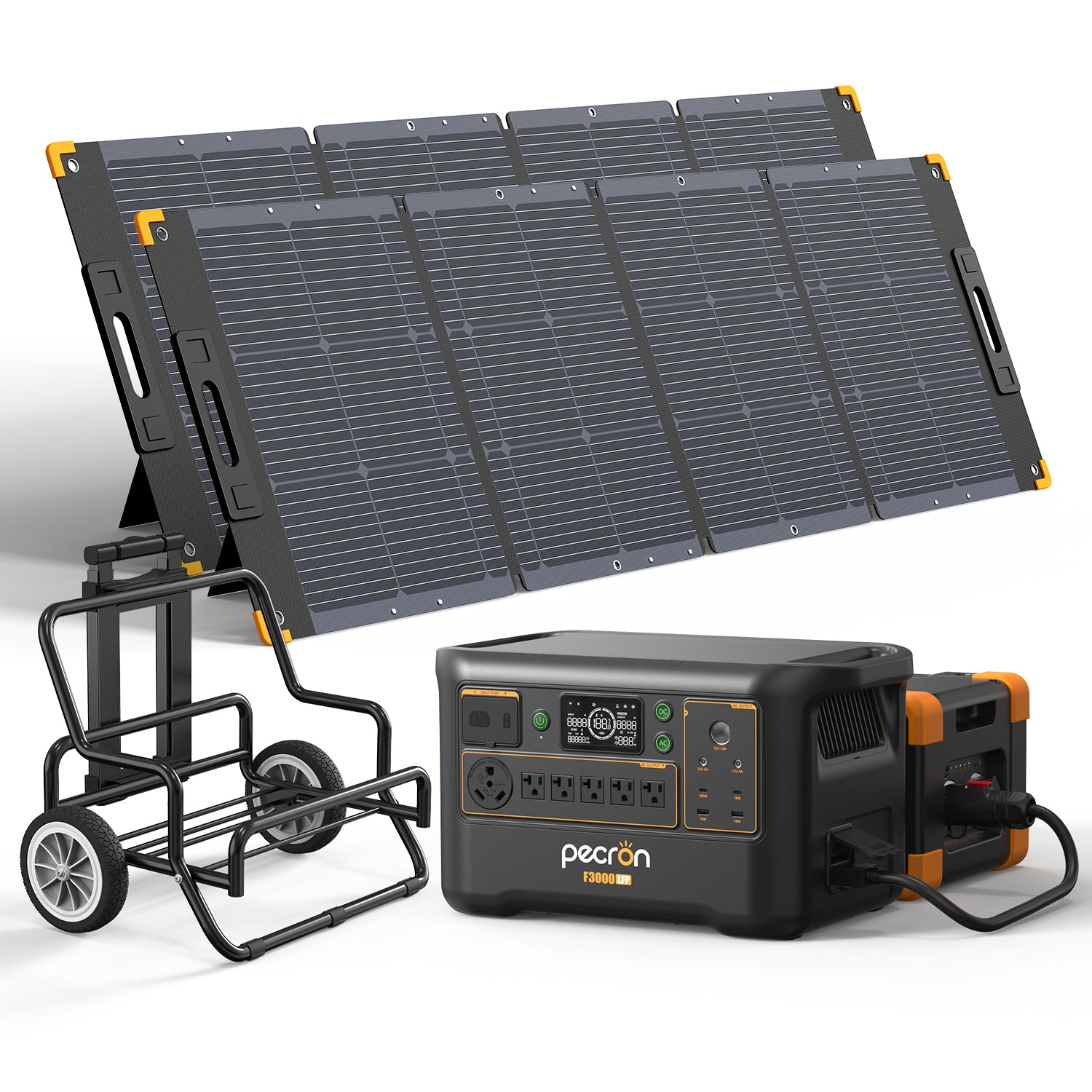
This exact variant names the F3000LFP, one EP3800-48V pack, two PV300-named 300 W panels and a cart. The cart is the straightforward difference from the no-cart selection and matters for a large station that is awkward to lift repeatedly. The F3000 alone is listed at about 63 lb; the pack and panels add more handling, but the source does not give their combined weight or the cart’s payload rating. A cart may help move equipment on a level surface, yet it does not establish safe stair, gravel or slope use. Confirm its dimensions and load limit if you expect to move the whole kit together.
The known electrical performance still comes from the F3000 station: 3,072 Wh, 3,600 W continuous AC at 120 V and a short-duration 4,500 W surge figure. The seller’s pack selection does not change the station’s inverter rating. Although the chosen option names one EP3800-48V, the available F3000 manual evidence does not resolve the compatibility of this pack revision, lead or expansion method. Treat the pack as a listed item, not a validated source of additional usable watt-hours. Ask Pecron for the exact connection diagram and supported total capacity before relying on it for extended runtime.
Two panels do not guarantee a 600 W charge
The option’s two panel labels add to 600 W of nameplate. The F3000 lists a maximum solar input of 1,600 W with a 25–120 V input range, but staying under the wattage ceiling is not the only requirement. The panels’ exact model revision and the supported electrical arrangement remain unknown. “PV300” in the option label and “S300” in related documentation are not interchangeable proof of the exact item. Confirm open-circuit voltage, operating current, connector, cable and the safe combined configuration. Even when the wiring is correct, nameplate output is not a guaranteed daily harvest; shade, season, angle and conversion losses matter.
The station-side solar lead is not confirmed as part of this exact selection. Ask whether it is included, which adapter is used and whether each panel has to be connected separately. Do not rely on the image to answer those questions. The rendering shows a product arrangement, not a wiring diagram. Keep the station protected from weather with ventilation, set the panels where they can be secured, and avoid routing leads where people or vehicles can damage them.
When the bundle is worth comparing
This is a plausible choice for a fixed backup location or a roomy camp setup where the owner values a supplied cart and wants two solar panels in the same order. It is less compelling for frequent car-to-campsite carrying or an installation where the added pack is the only way the energy budget works. Start with an appliance list: continuous watts, startup watts and watt-hours per day. If the F3000’s base 3,072 Wh does not cover the plan, do not treat the EP3800 as a solution until compatibility and total supported capacity are written down.
Buyers seeking a simpler and more certain solar setup may prefer the two-panel F3000 selection without the expansion pack. If they want a cart but not the expansion uncertainty, compare the cart-included station-and-panel options. If a higher individual AC rating is more important than mobility, an E3800LFP may be a better station to evaluate, though it is heavier. None of these choices creates a verified 240 V plan unless the exact configuration says so.
Questionnaire fit
The finder can require a 120 V AC station, two supplied panels and a cart. It will not count the EP3800 as a compatible included expansion battery or claim that all supplied panels work together, because both the pack-revision bridge and panel wiring are unresolved. That means a buyer whose plan depends on the extra storage will not receive a misleading match. The selected offer was marked available in the archived source snapshot; that is not a current stock guarantee. Check the exact U.S. SKU, included leads, cart specification and written pack compatibility before paying.
Key details at a glance
| Nameplate battery capacity | 3072 Wh |
|---|---|
| Rated AC output | 3600 W |
| Manufacturer surge rating | 4500 W |
| Maximum solar input | 1600 W |
| Included panels, combined nameplate | 600 W |
| Maximum USB-C output per port | 100 W |
More specifications and setup details
| Listed weight | 63.3 lb |
|---|---|
| Compatible extra-battery expansion | Yes |
| 12 V DC output | 120 W |
| Maximum AC recharge input | 1800 W |
| AC outlet output | Yes |
| USB-C ports | 1 |
| USB-A ports | 2 |
| Solar input ports | 1 |
| Battery chemistry | LiFePO4 |
| Home Power Panel in this package | No |
| Separate station units in offer | 1 |
| Smart Transfer Switch in this package | No |
| Solar panels in exact offer | 2 |
Use the exact model’s instructions for operating limits, supplied equipment and version differences.
Sources for this assessment

A useful match starts with the loads that matter.
Use the finder for hard electrical requirements, then check appliance starting behavior, actual run time and the exact package in the full assessment.