
On this page
Your needs, this model
Does it fit your priorities?
Does the documented F3000LFP (U.S. standalone SKU F3000LFP, without cart) station plan meet 3,072 Wh and 3,600 W at 120 V without counting any unverified package additions?
The F3000LFP (U.S. standalone SKU F3000LFP, without cart) station itself is listed at 3,072 Wh and 3,600 W at 120 V. Any listed EP3800 modules or second-station arrangement is not added to a confirmed package capacity here.
Explore this need in the finder →Do you need 2 listed 300 W panel(s), 600 W nameplate total, as part of the exact offer?
The exact variant title and SKU list 2 PV300-named 300 W panels (600 W nameplate sum). That confirms package quantity and rating only; exact panel revision and approved combined wiring remain unknown.
Explore this need in the finder →Can the listed EP3800-48V pack(s) be counted as compatible included expansion capacity?
The selected option lists 1 EP3800-48V pack(s), but the exact F3000LFP (U.S. standalone SKU F3000LFP, without cart) compatibility and cable path remain unresolved. Use the station-only plan unless Pecron confirms this specific revision and supported capacity.
Explore this need in the finder →Pecron · F3000LFP with two PV300-named panels · no cart
The F3000 remains the verified part
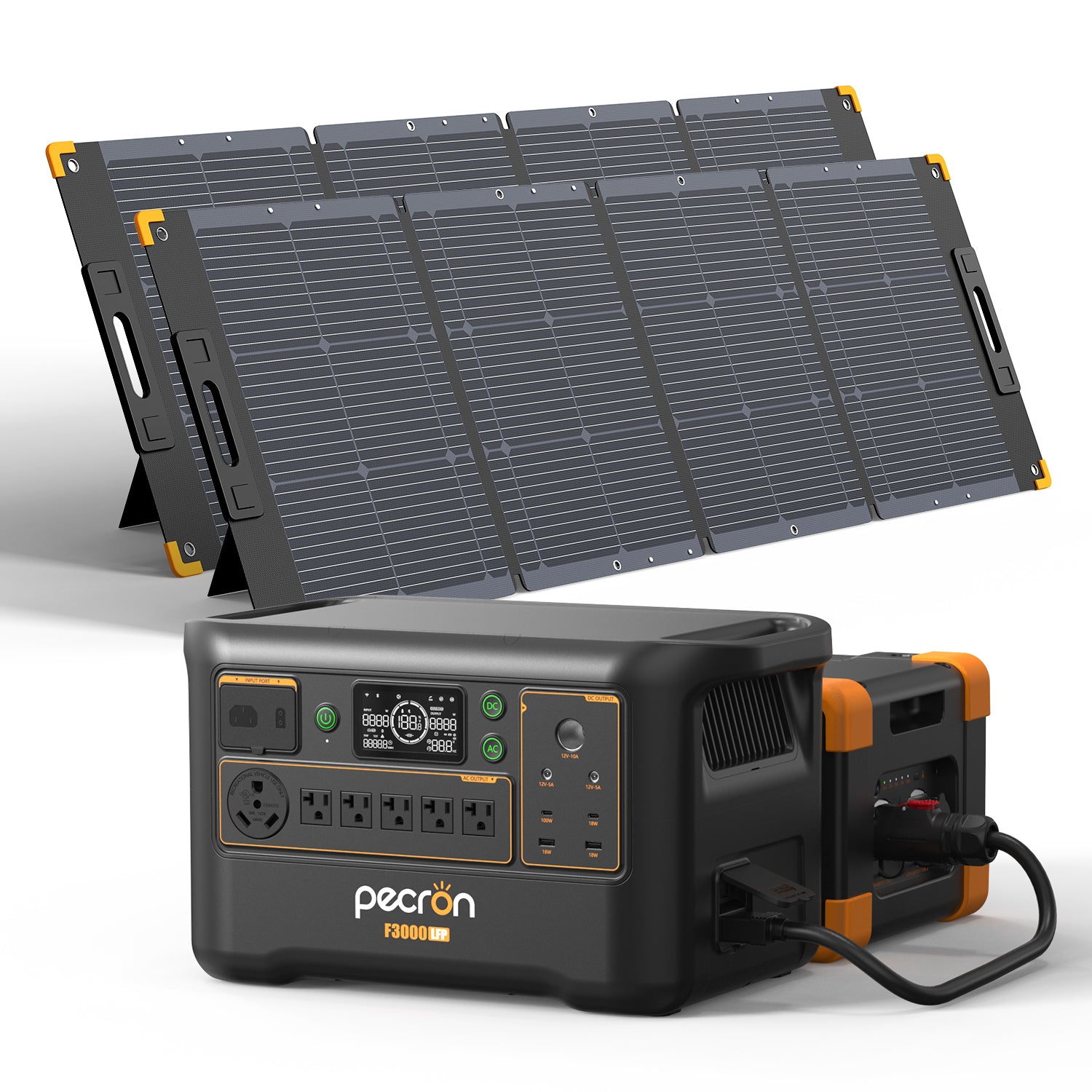
This selected U.S. option pairs one F3000LFP with two PV300-named 300 W panels and one EP3800-48V pack; it does not list a cart. The F3000 itself is a 3,072 Wh LiFePO4 station rated for 3,600 W continuous AC output at 120 V. Pecron states a 4,500 W surge figure for a short period. That is a substantial base station for a home, cabin or workshop load plan, but the rating does not tell you how long a particular appliance can run. Use the nameplate capacity as a starting point and allow for inverter losses, appliance cycles and reserve.
The selected product title identifies one EP3800-48V pack. That identity matters for shopping, but the exact F3000/EP3800 connection and added-capacity plan remain unconfirmed in the saved manuals. The F3000’s own manual lists its supported station operation and contains an expansion-model conflict. For a practical recommendation, do not add the pack’s advertised capacity to the F3000’s 3,072 Wh or count it as a compatible included battery. Obtain Pecron’s written confirmation of the exact station revision, pack, connecting lead and supported combined capacity first.
Solar output is limited by both components
The two panels sum to 600 W of listed nameplate, while the F3000’s maximum solar input is 1,600 W. Their paper total sits below that ceiling, but the exact panel variant and array wiring are not settled. The sales option says PV300; related panel literature uses an S300 name, so it is unsafe to treat every panel detail as known. The model’s solar input is 25–120 V and 25 A maximum according to the saved F3000 evidence. Confirm the actual panel open-circuit voltage and current at the expected temperatures, the connector type and the included adapter before connecting the set. Two panel count does not prove that the two can be electrically combined on this station.
The station’s input ceiling is not a daily-energy estimate. Real solar collection depends on shade, orientation, season, weather and charging conditions. A buyer who wants panels ready for an outage should confirm whether the proper station-side lead comes in this bundle; the captured documentation does not settle all cable contents. Keep the panels secured and the power station out of direct weather. A product image illustrates the manufacturer’s package, not its exact electrical connections.
Handling and package choice
The F3000 body is listed at about 63 lb before any extra pack or panels. This exact option has no cart, which may be a deciding drawback if you will relocate it often. The expansion unit’s mass is not included in that station-only weight, and the total kit weight is unknown. A fixed garage or cabin installation is a more natural use than carrying the complete bundle between a vehicle and a tent. Check the route and lifting plan rather than assuming the panels or pack attach to the station.
For backup, separate essential loads from high-wattage loads. Add the appliances that will run at the same time, check each starting demand, and compare with 3,600 W continuous output. Then estimate daily energy use; a refrigerator cycling through a day is different from running a 3,000 W heater continuously. This package may give you panel hardware to recharge, but the usable array arrangement is not yet verified, and the EP3800 should not be counted as extra energy without a confirmed connection plan.
Who it suits and what it will not prove
Consider the bundle if you need the F3000’s known 120 V output, want two named solar panels and are willing to resolve the expansion pack’s compatibility before using it. If you only need known station performance, compare the standalone F3000 or the two-panel F3000 package without an EP3800. If mobility is essential, compare a cart-included selection; if 240 V is essential, this one-station option does not meet that requirement.
The questionnaire recognizes the selected panel count and the F3000’s base solar capability. It will reject a requirement for a compatible included EP3800 because that specific bridge remains open, and it will not call the panels a confirmed together-working array. This distinction protects buyers who need an essential capacity or charging condition. The saved U.S. product data showed this option available at capture time; availability can change, so confirm the exact selection and seller contents.
Key details at a glance
| Nameplate battery capacity | 3072 Wh |
|---|---|
| Rated AC output | 3600 W |
| Manufacturer surge rating | 4500 W |
| Maximum solar input | 1600 W |
| Included panels, combined nameplate | 600 W |
| Maximum USB-C output per port | 100 W |
More specifications and setup details
| Listed weight | 63.3 lb |
|---|---|
| Compatible extra-battery expansion | Yes |
| 12 V DC output | 120 W |
| Maximum AC recharge input | 1800 W |
| AC outlet output | Yes |
| USB-C ports | 1 |
| USB-A ports | 2 |
| Solar input ports | 1 |
| Battery chemistry | LiFePO4 |
| Home Power Panel in this package | No |
| Separate station units in offer | 1 |
| Smart Transfer Switch in this package | No |
| Solar panels in exact offer | 2 |
Use the exact model’s instructions for operating limits, supplied equipment and version differences.
Sources for this assessment

A useful match starts with the loads that matter.
Use the finder for hard electrical requirements, then check appliance starting behavior, actual run time and the exact package in the full assessment.