
On this page
Your needs, this model
Does it fit your priorities?
Must the exact package include a cart?
The selected U.S. option is titled “F3000LFP+PV300 / With Cart”; cart capacity, weight and terrain limits are not stated.
Explore this need in the finder →Are at least 1 PV300-named panels and 300 W combined panel nameplate listed?
The selected option names 1 panels. 300 W is their nameplate sum, not measured charging power.
Explore this need in the finder →Can all supplied panels be verified as a supported array with this station?
No. The exact panel revision, array topology and cable are unknown. The host input ceiling alone does not establish wiring compatibility.
Explore this need in the finder →Pecron · one-panel F3000LFP option with cart
Pecron F3000LFP with one PV300 panel and cart review
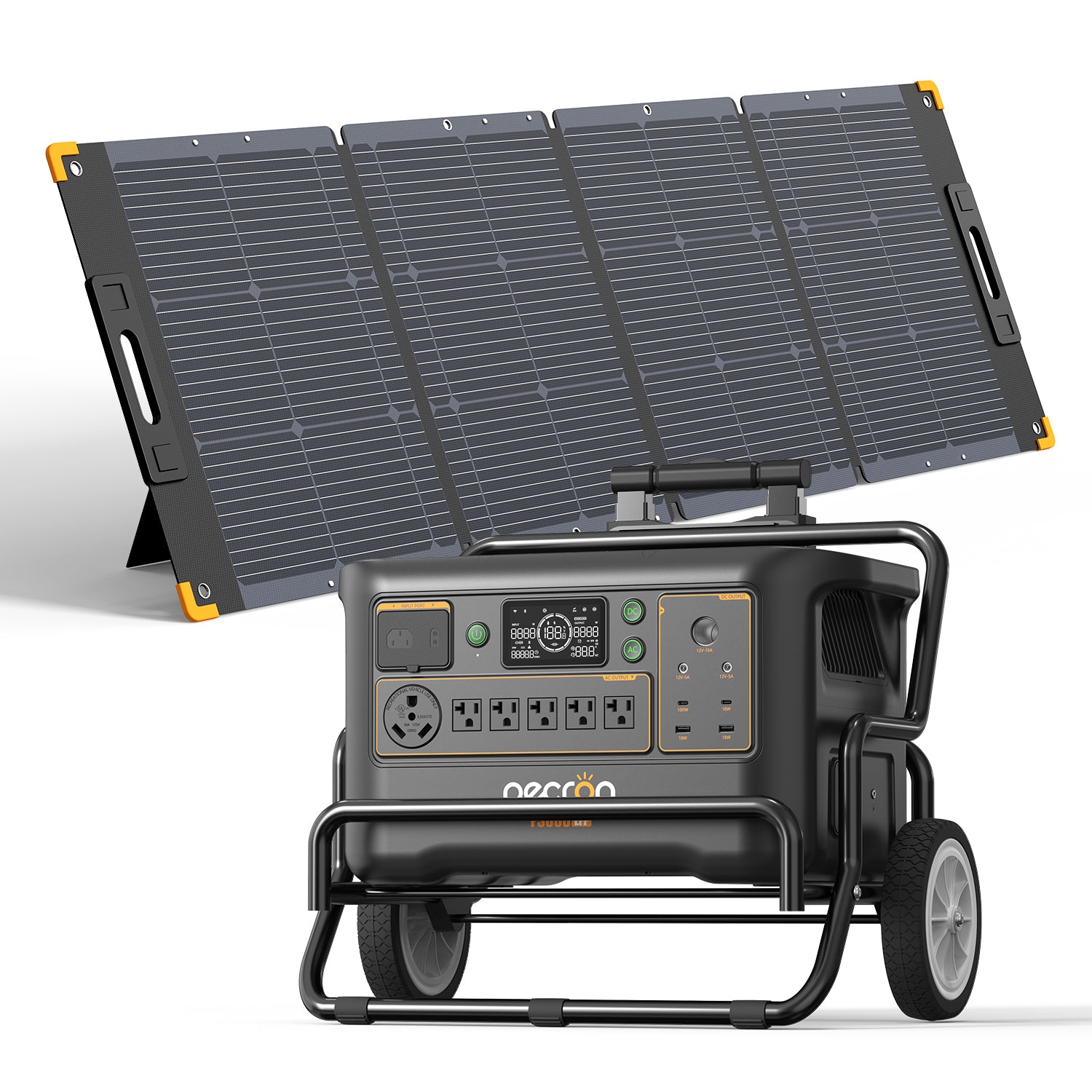
The exact U.S. Solar Generator selection is titled “F3000LFP+PV300 / With Cart” (SKU F3000LFP+PV300+Cart). It pairs one F3000LFP with one manufacturer-named PV300 panel and a transport cart. That is a meaningful package difference from the otherwise similar no-cart, one-panel option: the station remains a 3,072 Wh LiFePO4 unit rated for 3,600 W AC at 120 V, while the page adds a cart to the purchase. The selected source and its product rendering do not give the cart’s weight, rated load, attachment method, or permitted terrain. “Cart included” should not be stretched into a claim that it makes every move safe or effortless.
The station is still a large 120 V battery
The F3000LFP is a heavy, stationary-style power source rather than a small camping battery. Its listed station-only weight is about 63.3 lb, so wheels may make repositioning between a storage location and a nearby work area more practical than lifting the bare unit. The included cart does not change the station’s voltage, inverter rating, or nameplate capacity. It is not a split-phase system and does not become suitable for 240 V equipment merely because a cart or solar panel is bundled.
For loads, use the 3,600 W continuous AC rating as a ceiling for the station’s output, not a promise that any appliance will start. The manual’s 4,500 W surge value is specified for only five seconds; a motor’s startup behavior and other simultaneous loads still matter. The 3,072 Wh nameplate figure is not usable AC energy. Without measured draw and conversion losses, there is no defensible refrigerator-runtime estimate to attach to this configuration.
One panel is a small charging companion
The option names one PV300 panel, or 300 W of listed panel nameplate. It does not add battery capacity. One panel can be a supplemental source when the station is parked in a sunny location, but clouds, shade, angle, temperature, and losses make actual harvest variable. The station’s manual lists a single solar input with a 25–120 V range, 25 A maximum, and 1,600 W maximum input. Those limits describe the station input, not the expected output from this one-panel kit.
There is an unresolved naming bridge: the seller option calls the panel PV300, but the separate linked Pecron manual identifies its 300 W panel as S300. The saved material does not prove that the selected PV300 is the exact S300 revision, or which MC4-to-XT60 lead arrives in this package. Do not infer cable contents or a measured charge rate from the panel count. Confirm the approved lead and current connection instructions before treating the kit as ready to use.
Where the cart helps—and what remains unknown
The official variant image visibly shows an F3000LFP on a wheeled frame alongside one folding panel. It is manufacturer CGI, not evidence from a hands-on test. The image supports the cart-included package identity, but cannot establish a load limit, brake, wheel material, fit tolerances, stability, or whether the panel itself rides on the cart. If your route includes steps, gravel, slopes, or a vehicle lift, check the cart’s current specifications rather than extrapolating from the rendering. The station and panel remain heavy components to plan around.
Who should consider this exact selection?
It suits someone who has already chosen the F3000’s 120 V output and roughly 3 kWh reserve, wants a single listed panel, and would value a bundled cart for short moves on a suitable surface. It is not a good match for a buyer who requires a documented panel-to-station cable, verified all-panel electrical plan, 240 V output, or a cart with a known capacity before purchase.
In the ordinary finder, the “cart included” choice distinguishes this selection from the no-cart F3000 option. Requiring a panel in the package also fits the selected offer, while a two-panel minimum does not. Advanced solar requirements should stay conservative: the offer confirms a panel name and count, not a verified operating array or recharge time. If the cart is optional, compare this with the no-cart one-panel profile and decide whether the accessory’s unknown details justify the package difference.
Alternatives and tradeoffs
The no-cart F3000LFP with one PV300 is the closest alternative; its core station and one-panel selection are the same, but the captured option is explicitly “Without Cart.” The two-panel F3000 option increases listed panel nameplate to 600 W, yet keeps the same unresolved panel revision and connection questions. If your actual need is more station capacity or output rather than easier repositioning, compare the E3800LFP’s separately reviewed 120 V, 3,840 Wh and 4,200 W station configuration instead. Choose the cart bundle for the accessory you can verify, not for an assumed charging advantage.
Key details at a glance
| Nameplate battery capacity | 3072 Wh |
|---|---|
| Rated AC output | 3600 W |
| Manufacturer surge rating | 4500 W |
| Maximum solar input | 1600 W |
| Included panels, combined nameplate | 300 W |
| Maximum USB-C output per port | 100 W |
More specifications and setup details
| Listed weight | 63.3 lb |
|---|---|
| Compatible extra-battery expansion | Yes |
| 12 V DC output | 120 W |
| Maximum AC recharge input | 1800 W |
| AC outlet output | Yes |
| USB-C ports | 1 |
| USB-A ports | 2 |
| Solar input ports | 1 |
| Battery chemistry | LiFePO4 |
| Expansion battery in this package | No |
| Home Power Panel in this package | No |
| Separate station units in offer | 1 |
| Smart Transfer Switch in this package | No |
| Solar panels in exact offer | 1 |
Use the exact model’s instructions for operating limits, supplied equipment and version differences.
Sources for this assessment

A useful match starts with the loads that matter.
Use the finder for hard electrical requirements, then check appliance starting behavior, actual run time and the exact package in the full assessment.