
On this page
Your needs, this model
Does it fit your priorities?
A one-host 120 V F3000 plan needs at least 3,600 W AC and 3,072 Wh nameplate storage.
The selected option retains one F3000LFP host rated for 120 V AC, 3,600 W and 3,072 Wh nameplate capacity.
Explore this need in the finder →At least one PV300-named panel and 300 W combined listed nameplate are essential.
The product selector names 1 PV300 panel; total listed panel nameplate is 300 W. This is not a recharge measurement.
Explore this need in the finder →Solar input is required, but the full supplied-panel wiring is not.
The station manual and seller option do not confirm the exact panel revision/cable and an all-panels-together input plan.
Explore this need in the finder →Pecron · one-panel F3000LFP package
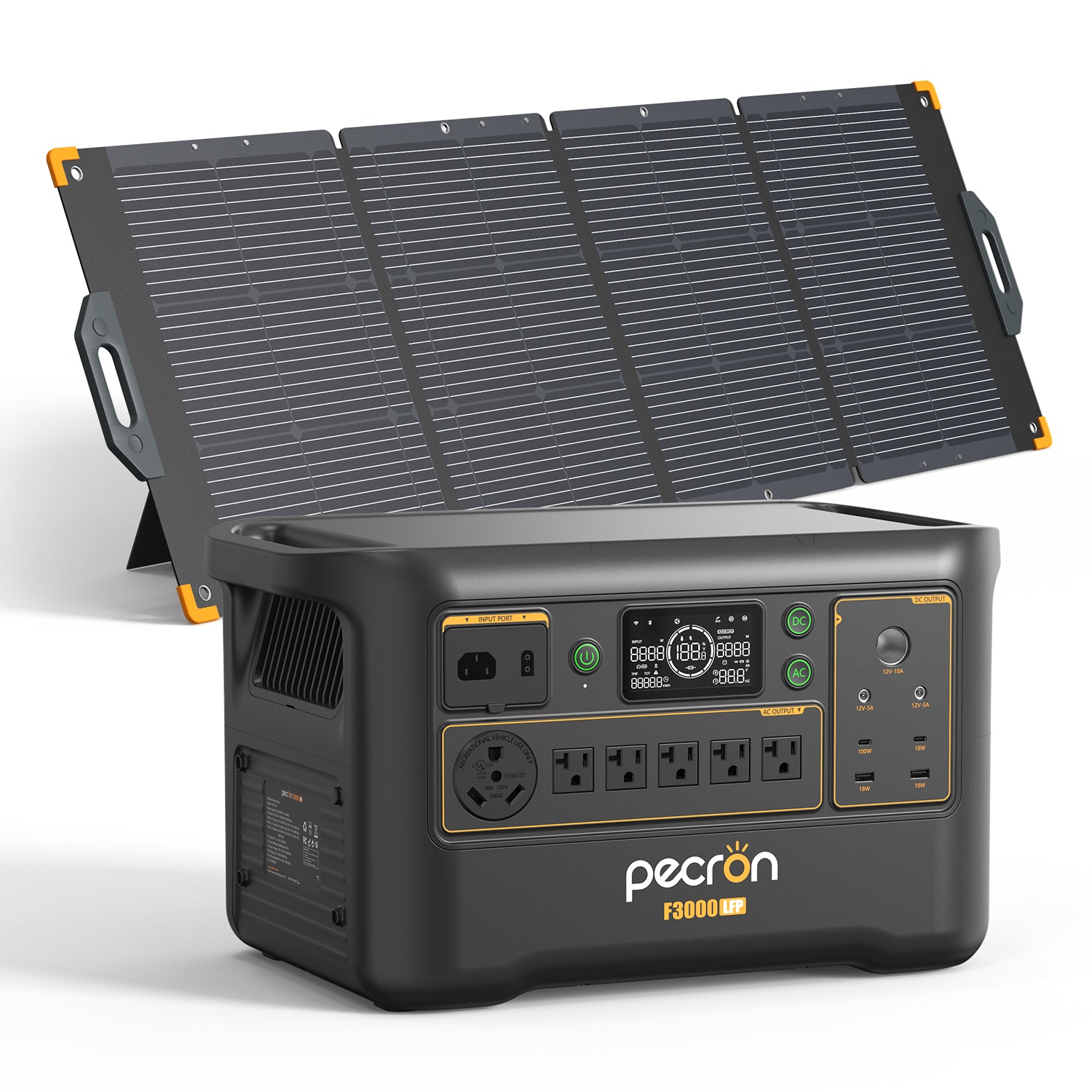
Pecron F3000LFP with one PV300 panel review
This is the U.S. F3000LFP selector option named F3000LFP+PV300 (SKU F3000LFP-PV300), without the cart. The package keeps the same single 120 V station as the standalone F3000: 3,072 Wh of LiFePO4 nameplate capacity, 3,600 W rated AC output, and a 4,500 W surge figure specified for five seconds. The selected option adds one manufacturer-named 300 W panel. That panel does not add battery capacity, raise the inverter rating, or guarantee a particular recharge time.
A large battery with a modest solar companion
One 300 W panel is a relatively small charging source beside a 3,072 Wh battery. It may be useful for topping up during a longer stay when sunlight and a safe place to set up are available, but it is not a promise of daily recovery or continuous off-grid operation. Clouds, shade, panel angle, temperature, and conversion losses all reduce real harvest. The station's XT60 solar input is listed for 25–120 V, up to 25 A and 1,600 W. The F3000 manual describes those limits; the offer's panel count does not mean the station will draw 300 W all day.
There is a source distinction worth keeping visible. The selected option calls its panel PV300, while the separate linked PECRON panel manual identifies the 300 W panel as S300. That manual lists 36 V operating voltage, 41.4 V open-circuit voltage, 8.3 A operating current, 8.7 A short-circuit current, and MC4 connectors. The documents do not establish whether the PV300 offer is the same revision as the S300 manual. Nor does the captured option establish the exact MC4-to-XT60 cable supplied. Treat the package quantity and rating as listed facts, not as proof of every connection detail; use a manufacturer-approved cable and current instructions.
What this station can and cannot run
The F3000 is a substantial 120 V source for loads whose combined draw stays within 3,600 W. Its five-second surge rating can matter to a short motor start, but it does not make every compressor or pump compatible: starting behavior depends on the appliance, other loads, and battery state. Nameplate 3,072 Wh is not the energy that will reach AC loads after conversion. There is no responsible way to turn that figure into a guaranteed refrigerator runtime without a measured appliance draw and operating conditions.
At about 63.3 lb for the station alone, it is more suited to a fixed backup spot, workshop, or vehicle setup where a person can plan its movement than repeated lifting into a car. The one-panel package still requires room and setup time for the panel. A separate cart option appears on the same product page, but this review does not attribute an unverified load rating or included cart to the no-cart SKU. The product page's combined AC-plus-solar input descriptions also disagree; this assessment relies on the manual's separate 1,600 W solar limit and makes no combined charging-time promise.
Who should consider this selection
It suits someone who already needs the F3000's 120 V output and roughly 3 kWh nameplate reserve, and wants one listed panel rather than an assumed larger array. It is a poor fit for 240 V equipment, a user who expects the panel to refill the battery quickly, or anyone who requires a documented plug-and-play cable and all-panel operating plan before buying. In the ordinary choices, select 120 V and AC only if those match the load; the F3000 does not become split-phase by adding solar. If a panel in the box is essential, this selected option lists one, whereas the standalone F3000 does not. A requirement for more than one included panel rules this exact package out.
The unresolved array and cable details also matter to a strict solar requirement. The station itself accepts solar, and the offer names one panel, but the exact accessory path and panel-revision bridge are not established in the available manuals. If every supplied panel must be confirmed as a supported array before the recommendation can be considered, this package should not pass that condition.
Alternatives in the same decision
The station-only F3000 is the cleaner choice if you have your own panel plan and do not want a listed panel bundled into the selected option. The two-panel F3000 option adds 600 W of nominal panel nameplate, but has the same host limits and the same need to verify wiring. If your plan needs a larger battery or inverter, the E3800LFP is a different 120 V station rated at 3,840 Wh and 4,200 W; its higher figures do not solve the F3000 panel-cable uncertainty. Choose by the actual voltage, sustained load, reserve, weight, and verified array requirements rather than by the panel bundle's largest headline number.
Key details at a glance
| Nameplate battery capacity | 3072 Wh |
|---|---|
| Rated AC output | 3600 W |
| Manufacturer surge rating | 4500 W |
| Maximum solar input | 1600 W |
| Included panels, combined nameplate | 300 W |
| Maximum USB-C output per port | 100 W |
More specifications and setup details
| Listed weight | 63.3 lb |
|---|---|
| Compatible extra-battery expansion | Yes |
| 12 V DC output | 120 W |
| Maximum AC recharge input | 1800 W |
| AC outlet output | Yes |
| USB-C ports | 1 |
| USB-A ports | 2 |
| Solar input ports | 1 |
| Battery chemistry | LiFePO4 |
| Expansion battery in this package | No |
| Home Power Panel in this package | No |
| Separate station units in offer | 1 |
| Smart Transfer Switch in this package | No |
| Solar panels in exact offer | 1 |
Use the exact model’s instructions for operating limits, supplied equipment and version differences.
Sources for this assessment

A useful match starts with the loads that matter.
Use the finder for hard electrical requirements, then check appliance starting behavior, actual run time and the exact package in the full assessment.