
Your needs, this model
Does it fit your priorities?
Will one 120 V F3000 cover a 3,600 W load and 3,072 Wh reserve?
The base F3000 is rated at 3,600 W and 3,072 Wh; its 4,500 W peak is stated for five seconds.
Explore this need in the finder →Is one 1,600 W, 25–120 V XT60 input enough solar?
The product page and V2 manual list up to 1,600 W through XT60; the panel depends on the selected package.
Explore this need in the finder →Do you need an expansion route but can confirm the exact pack model first?
Pecron describes expansion but names EP3000 and EP3800 in different current-page contexts. Confirm the compatible pack/revision.
Explore this need in the finder →Pecron · 3,072 Wh 120 V station
Pecron F3000LFP review
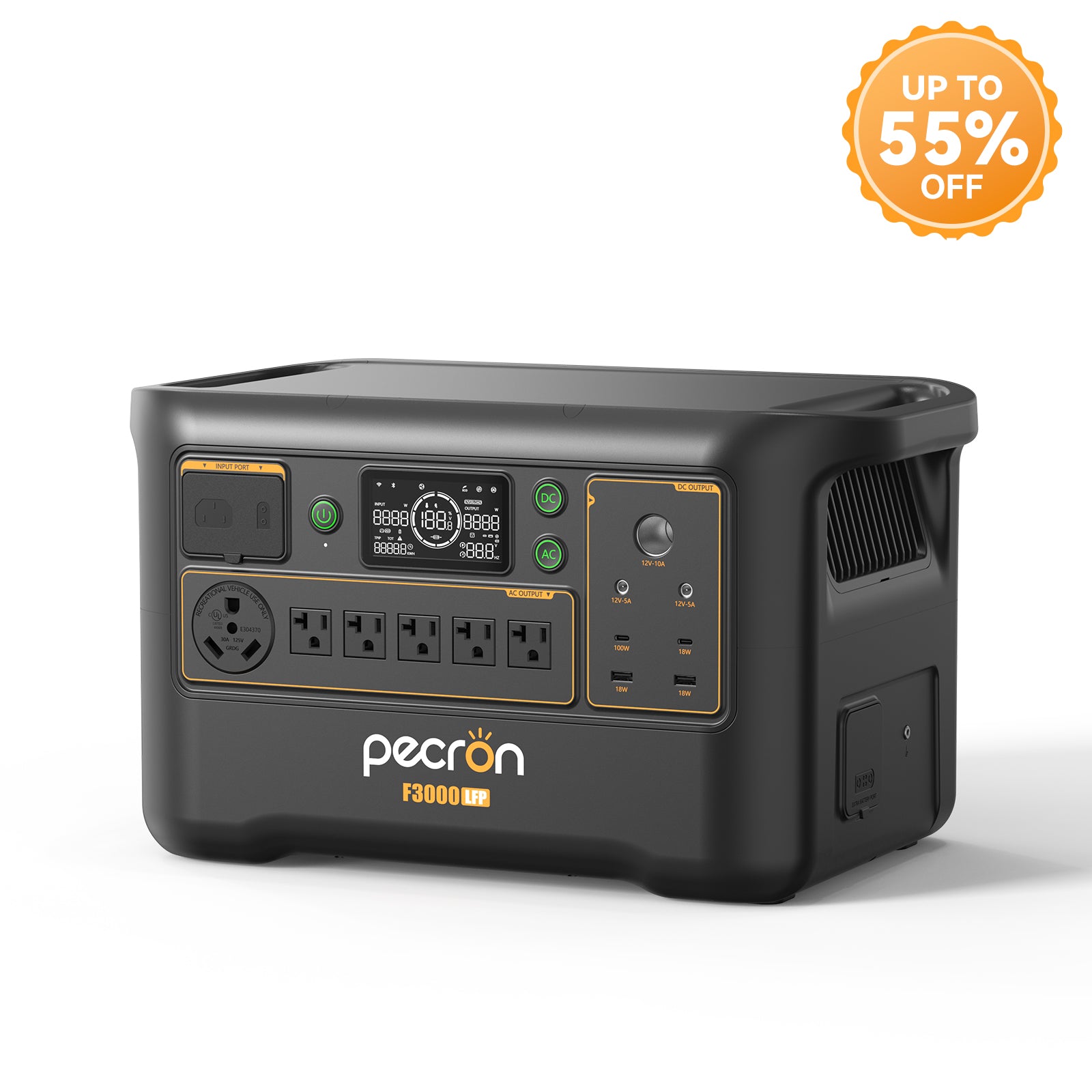
The F3000LFP brings 3,072 Wh of LiFePO4 storage and a 3,600 W pure-sine inverter to a single-station 120 V setup. At about 63.3 lb, it is a large battery that can be moved but is not convenient to lift repeatedly. The current base U.S. option is a station-only selection; the product page has separate solar-panel, cart and expansion choices. The station is a credible candidate for a workshop or a carefully sized home-backup kit, but it is not a single-unit 240 V source.
Output and runtime are different questions
Pecron specifies 3,600 W rated output and a 4,500 W surge figure for five seconds, not an unlimited motor-start allowance. The manual's 100–120 V AC rating and the product page's listed 30 A output are useful for matching equipment, but you must still check the specific outlet, cord and appliance. The station has 13 listed output ports, including a 100 W USB-C port, USB-A outputs, 12 V/10 A output and AC. A maximum for one port or inverter should not be treated as a promise that all outputs can reach their individual ceilings together.
Its battery has 3,072 Wh of nameplate energy, about the same capacity as the E3600LFP. That gives a more meaningful energy reserve than the smaller F1000, but actual AC energy delivered depends on inverter losses, temperature, device behavior and the battery's starting state. The maker's “3,500+ cycles to 80%” and runtime/charge-time claims are published specifications; no independent cycle test or appliance runtime measurement is represented here. Make a load list before choosing between 3,072 Wh and a larger backup system.
Solar, AC charging and two important caveats
The F3000LFP accepts up to 1,600 W through its XT60 solar input, over a published 25–120 V range and 25 A maximum. Pecron lists 1,800 W AC input and an option to charge from AC plus solar. Its detailed specification table says 2,800 W maximum combined input and roughly 1.5 hours under that combined mode, while the feature summary advertises 3,200 W and 1.3 hours. Because these figures conflict on the same product page, do not plan around the higher combined-input number without confirming it for the exact unit and manual revision. Solar panels and a trolley are separate selected offers; the station-only SKU does not imply either is in the box.
The product page's description says the F3000 can expand with two EP3000-48V packs, but the current package selector also exposes EP3800-48V combinations. These packs have different nominal capacity, so the article does not promise an expanded total. Expansion support is a real option; the exact compatible pack, cable and maximum capacity need to match the station revision and current manual. Pecron's manual library describes an F3000LFP V2 manual, which is a reminder to identify the label on the actual unit before adding an expansion pack.
What the standalone page does not establish
The selected F3000 base option is marked separately from panel and expansion packages. Do not assume a solar panel, 30 A charging lead or trolley is included just because a promotion shows it. The exact U.S. page lists a 24 V car input, 12 V/10 A output, Wi-Fi/Bluetooth app control, adjustable charging rate and manufacturer-described UPS functionality. It also lists a 2+3-year warranty; confirm how Pecron defines and activates that term. For equipment that cannot tolerate a transfer interval, verify the manual and test it rather than using the UPS label as a guarantee.
Read the official [F3000LFP manual](https://cdn.shopify.com/s/files/1/0509/5263/4556/files/PECRON_F3000_LFP_user_manual_100V_120V_V2-20260310.pdf?v=1777365085) before setting up the solar input or adding batteries. The manual lists charging between 32–113°F and discharging between 14–113°F; keep the machine ventilated and within its stated limits. A 30 A AC output does not make it appropriate to feed a household panel without transfer hardware and a qualified installer.
F3000 versus nearby Pecron options
The F3000 is for a user who values 3,600 W of 120 V inverter output and a high 1,600 W solar ceiling in a 3,072 Wh chassis. The E3600LFP shares its capacity and rated output but lists up to 2,400 W of solar input, more wireless-charging capability and a different expansion story; it is heavier at about 79 lb. The E3800LFP adds 768 Wh and raises output to 4,200 W, though its weight approaches 87 lb. The F5000LFP adds a single-station 240 V plan, much greater capacity and more extensive electrical requirements.
If your equipment is ordinary 120 V and a high load matters more than maximizing solar input, the F3000 may be the more balanced large station. If 240 V is essential, it is the wrong one-unit model. If the plan depends on fast combined charging or a certain extra-battery module, resolve the product-page discrepancies first. The station is a better match when its conservative, confirmed 120 V and 1,600 W solar plan satisfies the need without relying on a sale bundle or an uncertain expansion component.
Key details at a glance
| Nameplate battery capacity | 3072 Wh |
|---|---|
| Rated AC output | 3600 W |
| Manufacturer surge rating | 4500 W |
| Maximum solar input | 1600 W |
| Included panels, combined nameplate | 0 W |
| Maximum USB-C output per port | 100 W |
| Listed weight | 63.3 lb |
| Compatible extra-battery expansion | Yes |
| 12 V DC output | 120 W |
| Maximum AC recharge input | 1800 W |
| AC outlet output | Yes |
| USB-C ports | 1 |
| USB-A ports | 2 |
| Solar input ports | 1 |
| Battery chemistry | LiFePO4 |
| Expansion battery in this package | No |
| Home Power Panel in this package | No |
| Separate station units in offer | 1 |
| Smart Transfer Switch in this package | No |
| Solar panels in exact offer | 0 |
Use the exact model’s instructions for operating limits, supplied equipment and version differences.
Sources for this assessment

A useful match starts with the loads that matter.
Use the finder for hard electrical requirements, then check appliance starting behavior, actual run time and the exact package in the full assessment.