
On this page
Your needs, this model
Does it fit your priorities?
Does one F5000LFP need to provide 240 V AC at up to 7,200 W from a 5,120 Wh station?
Pecron lists one F5000LFP at 240 V and up to 7,200 W, with 5,120 Wh nameplate capacity; confirm the load and electrical plan.
Explore this need in the finder →Must the exact F5000 offer include at least 2 PV300 panels?
The selected U.S. SKU names 2 PV300 panels, each listed at 300 W; 600 W is combined nameplate arithmetic, not actual harvest.
Explore this need in the finder →Is station solar input useful even if a confirmed all-2-panel cable and array plan is not essential?
The F5000 accepts solar input and the exact option identifies its panel count, but kit-specific cable and all-panels wiring are not established.
Explore this need in the finder →Pecron · 5,120 Wh station with two PV300 panels
Pecron F5000LFP with two PV300 panels review
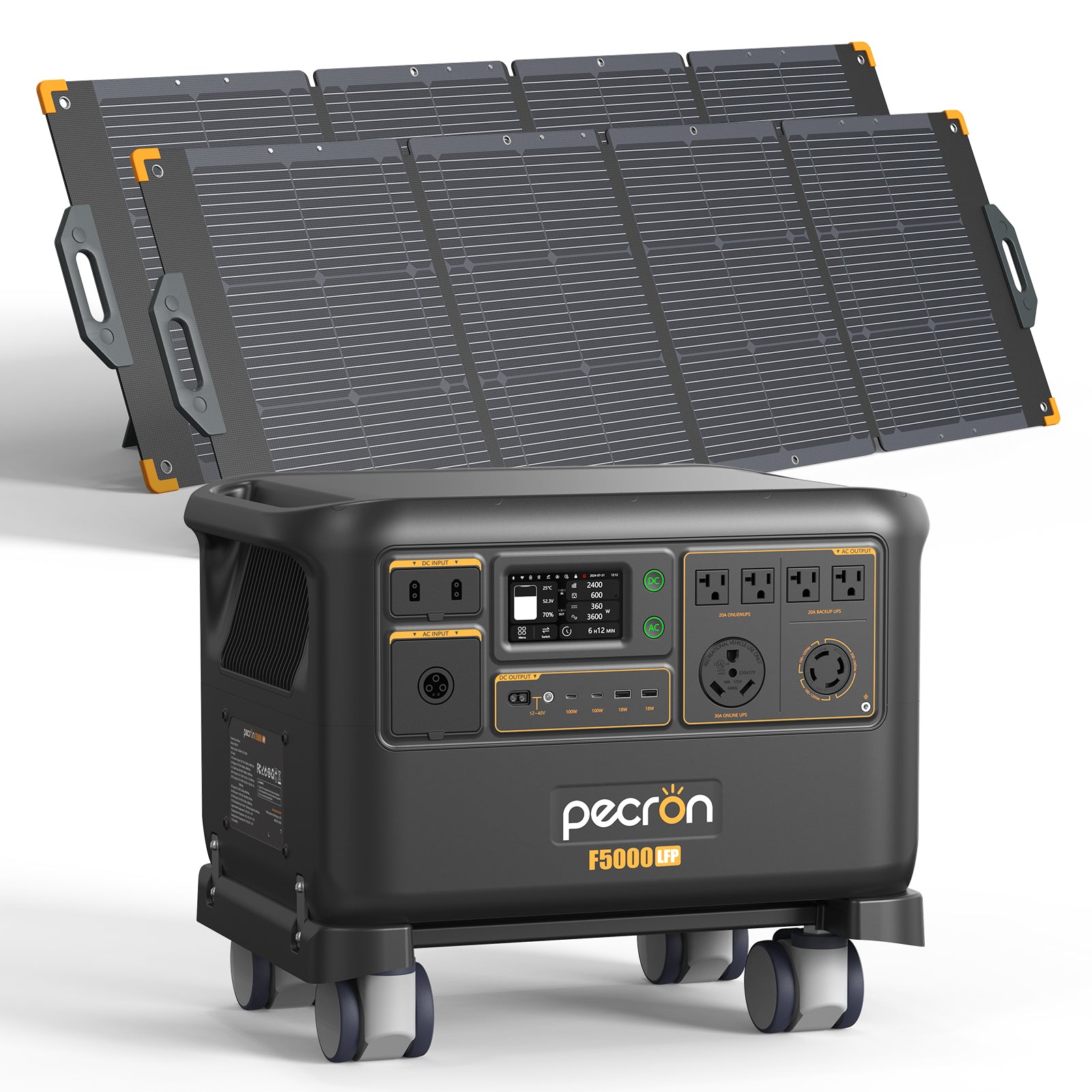
This is the F5000LFP option named for two PV300 panels, not a different inverter or a larger-battery version of the station. It combines Pecron’s 5,120 Wh LiFePO4 unit with two manufacturer-listed 300 W panels, or 600 W of combined panel nameplate. The panels change what is in the package; they do not turn the F5000 into a 6,000 Wh system or raise its AC output. The U.S. page was marked PRE-ORDER in the October 25, 2026 capture, so that snapshot is not a promise about current delivery.
The station is the reason to choose this package
One F5000LFP is unusual among portable stations because Pecron lists both 120 V and 240 V output from one unit. The 240 V rating reaches 7,200 W; the 120 V section is described as two output groups, each rated up to 3,600 W, with a TT-30R identified on the product page. Those are group and station limits, not permission to draw the full number from any one receptacle. Map the actual circuits and loads before making a home-backup plan. Pecron also says the 240 V output has a floating neutral in battery mode. A transfer arrangement or hardwired load deserves qualified electrical review rather than an improvised cord connection.
The 5,120 Wh figure is nameplate energy, not a measured usable AC total. It is a substantial reserve for planned loads, but it does not tell you how long a refrigerator, pump, heater, or other appliance will run without knowing that appliance’s draw and the conversion losses. The unit alone is about 123.9 lb according to Pecron. This is not a small station for a tent or a one-hand carry; its scale makes more sense in a planned backup location or a vehicle-based setup where it can stay put.
Two panels are a defined package, not a recharge guarantee
Pecron’s separate PV300 page calls each panel a four-fold 300 W design and lists 36 V operating voltage, 8.3 A operating current, and 41.4 V open-circuit voltage, all with stated tolerances. It gives a net panel weight of about 12.74 kg (28.1 lb) and a folded size around 636 × 789 × 49 mm. Two panels therefore add 600 W of combined nameplate and roughly 56 lb of panel mass by those rounded component figures. The arithmetic does not predict daily energy: cloud, shade, angle, heat, and conversion loss all matter. The F5000’s single-station solar ceiling is much higher, at 5,800 W, but this two-panel package does not approach it on nameplate power.
The greater limitation is connection evidence. The product option names two PV300 panels and the station page lists solar input, but Pecron’s linked panel user document labels its 300 W panel S300. The product page and the selected package use PV300; I do not silently treat that manual label as a confirmed revision match. The station’s input is listed as XT60, while the PV300 page describes MC4 connectors. The exact bundle cable and a supported wiring arrangement for both panels together are not established in the saved manufacturer instructions. Do not buy this package assuming that a particular adapter, series/parallel configuration, or full-array charging rate is included. Confirm those details with Pecron before relying on solar as an essential part of a backup plan.
Who should choose the two-panel version?
This option is the most restrained PV300 bundle in the F5000 listing. It suits someone who already has a reason to choose the F5000’s unusually high 240 V output and wants two matching foldable panels in the same manufacturer offer, while accepting that setup and wiring details need confirmation. It is less compelling if the station will spend most of its life on mains power: the standalone F5000 preserves the same battery and inverter without the extra panels. At the other end, the four- and six-panel listings add more panel nameplate, but also more equipment to store, set out, and verify. More panels do not increase the station’s battery reserve.
The ordinary questions that matter are not just “Do you want solar?” Ask whether 240 V is actually required from one station, whether 5,120 Wh and the F5000’s load limits fit the equipment, and whether a panel really has to arrive in the box. If the complete PV300 array must be proven to work together, this package cannot yet be confirmed for that essential condition. If the requirement is only that the offer include two panels and the station itself accept solar input, those facts are supported. Either way, don’t confuse a 600 W panel nameplate with 600 W of continuous harvest or a faster recharge promise.
Bottom line
The F5000LFP with two PV300 panels is a specific high-output station-and-panel offer, not a finished off-grid system with every connection detail documented. Its strong case is the combination of one-station 120/240 V capability, a 5,120 Wh battery, and two 300 W panels in the selected package. Its weak point is practical scale: the station is heavy, the panels add about 56 lb, and the exact all-panels wiring and included adapter remain unknown. Choose it for the F5000’s electrical plan first; treat the solar bundle as a useful but still-to-be-verified accessory package.
Key details at a glance
| Nameplate battery capacity | 5120 Wh |
|---|---|
| Rated AC output | 7200 W |
| Maximum solar input | 5800 W |
| Included panels, combined nameplate | 600 W |
| Maximum USB-C output per port | 100 W |
| Listed weight | 123.9 lb |
More specifications and setup details
| Compatible extra-battery expansion | Yes |
|---|---|
| Maximum AC recharge input | 3600 W |
| Manufacturer UPS transfer figure | 20 ms |
| Total rated DC output | 800 W |
| AC outlet output | Yes |
| USB-C ports | 2 |
| USB-A ports | 2 |
| Solar input ports | 2 |
| Battery chemistry | LiFePO4 |
| Expansion battery in this package | No |
| Home Power Panel in this package | No |
| Separate station units in offer | 1 |
| Smart Transfer Switch in this package | No |
| Solar panels in exact offer | 2 |
Use the exact model’s instructions for operating limits, supplied equipment and version differences.
Sources for this assessment

A useful match starts with the loads that matter.
Use the finder for hard electrical requirements, then check appliance starting behavior, actual run time and the exact package in the full assessment.