
On this page
Your needs, this model
Does it fit your priorities?
Does one F5000LFP need to provide 240 V AC at up to 7,200 W from a 5,120 Wh station?
Pecron lists one F5000LFP at 240 V and up to 7,200 W, with 5,120 Wh nameplate capacity; confirm the load and electrical plan.
Explore this need in the finder →Must the exact F5000 offer include at least 4 PV300 panels?
The selected U.S. SKU names 4 PV300 panels, each listed at 300 W; 1200 W is combined nameplate arithmetic, not actual harvest.
Explore this need in the finder →Is station solar input useful even if a confirmed all-4-panel cable and array plan is not essential?
The F5000 accepts solar input and the exact option identifies its panel count, but kit-specific cable and all-panels wiring are not established.
Explore this need in the finder →Pecron · 5,120 Wh station with four PV300 panels
Pecron F5000LFP with four PV300 panels review
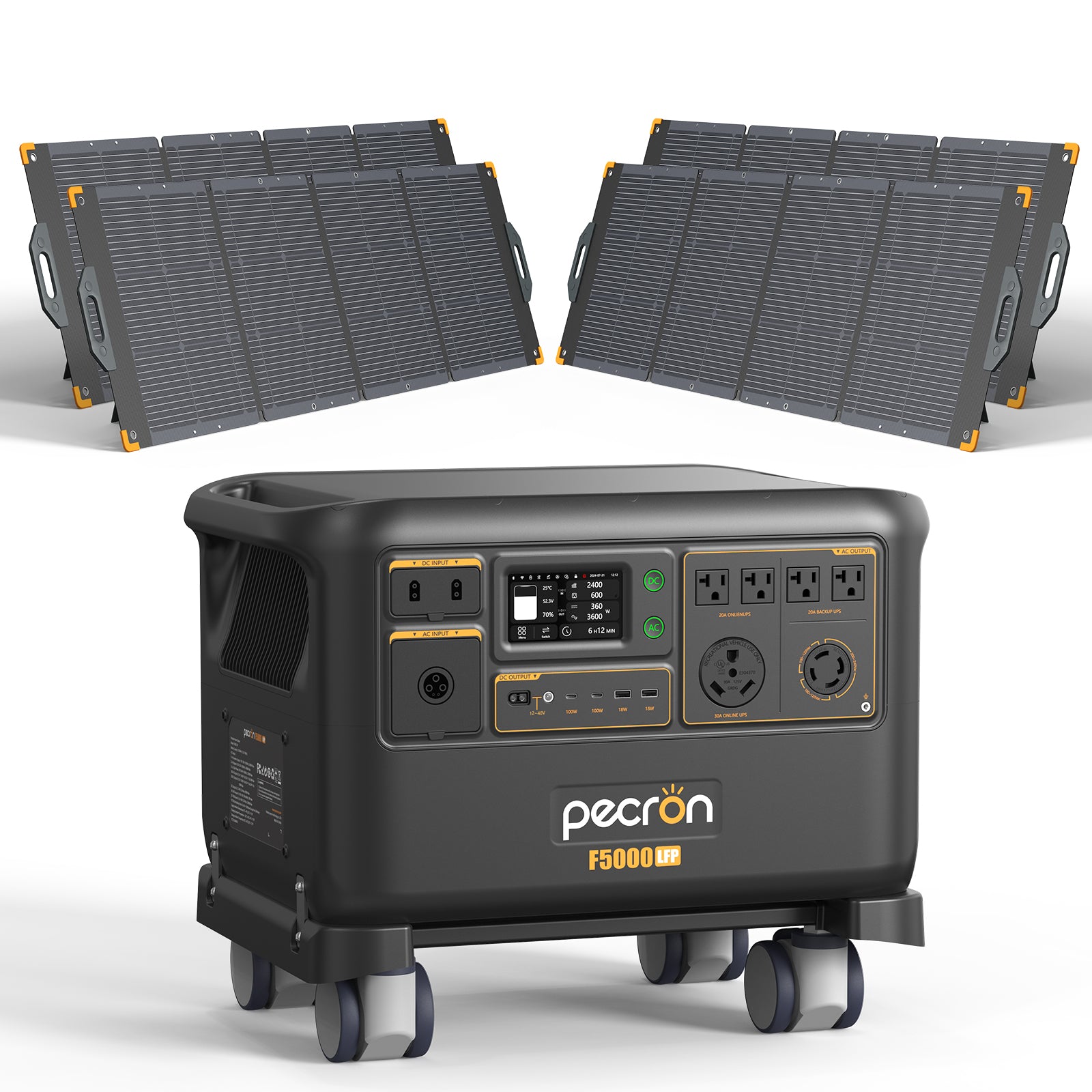
The F5000LFP-4*PV300 selection pairs one Pecron F5000LFP station with four PV300-named panels. That is 1,200 W of combined manufacturer panel nameplate, not 1,200 W of guaranteed charging and not a larger battery. The station remains a 5,120 Wh, 120/240 V model; the solar panel count changes the supplied package. In Pecron’s U.S. product capture on October 25, 2026, the page carried PRE-ORDER language. A listing snapshot should not be mistaken for a shipping commitment.
Four panels make the station’s scale more obvious
At 123.9 lb before counting any separate solar equipment, the F5000 is a heavy, wheeled backup unit rather than a casual carry. Pecron lists each PV300 at about 12.74 kg (28.1 lb), four-fold, with a folded footprint around 636 × 789 × 49 mm and an unfolded size around 2,362 × 787 mm. Four panels add roughly 112 lb using the manufacturer’s rounded panel mass; the arithmetic sum of the listed station and panel figures is about 236 lb before cables, packaging, and other accessories. That is a component estimate, not a package shipping weight. It makes a fixed or vehicle-based plan more plausible than a remote campsite where everything must be carried by hand.
The practical attraction is a larger panel pool than the two-panel offer. At 300 W nameplate per PV300, four panels total 1,200 W on paper. This could offer more opportunity to collect energy during a long stay with good sun and a suitable placement area. The station has a single-unit solar-input ceiling of 5,800 W, so this panel total is below that headline ceiling. But an input rating is not an expected harvest number, and the F5000’s 5,120 Wh battery is unchanged. Shade, angle, season, heat, and conversion losses can make actual input substantially lower than panel nameplate. Pecron’s figures should not be turned into an estimated daily recharge without a real operating test and conditions.
Do not infer the wiring from the bundle name
Pecron’s F5000 listing documents two solar inputs, an input-voltage window of 30–180 V, and a current limit of 25 A. Its PV300 product page identifies each panel as 36 V operating, 41.4 V open circuit, and 8.3 A operating, with tolerances. Those numbers are useful boundaries, not an all-four wiring diagram. The product-page option establishes the selected count, and the page identifies its panels as PV300; the separately linked 300 W manual uses the name S300. It does not document the exact F5000 bundle’s connector set or a confirmed four-panel array topology. The panel page refers to MC4 connectors, while the station input is XT60. The exact adapter/cable contents and the permitted combined wiring remain unknown here.
That gap matters. Four panels are not automatically useful together simply because the station accepts solar or because 1,200 W is under the station’s input ceiling. A series string changes voltage; parallel wiring changes current. Staying within the station’s maximum voltage and current requires the actual panel revision, temperature limits, and connection plan. Ask Pecron for the exact cable and wiring instructions for this selected kit before depending on the complete array. If a confirmed all-four operating plan is essential, this configuration should not yet pass that requirement.
The F5000 still sets the AC decision
The station’s defining advantage over smaller 120 V units is its single-device 240 V output, listed up to 7,200 W. For 120 V loads, Pecron describes two 3,600 W output groups and lists a TT-30R. Don’t read the total rating as what any single outlet can supply; circuit distribution and connected appliances must fit the actual outlet limits. The manufacturer also notes a floating neutral on 240 V output in battery mode, so home integration needs a properly designed transfer approach and qualified electrical guidance. The larger solar bundle does not change those electrical facts, add outlets, or provide more stored energy.
This is therefore a poor match for someone who simply wants a panel to top off a lightweight weekend station. The four-panel package addresses a different question: does the buyer already need the F5000 and want a larger set of folded PV300 panels supplied alongside it? A standalone F5000 is the cleaner choice if the panels are unnecessary or if the buyer already has a verified solar array. The two-panel selection is easier to store; six panels raise the nameplate total again but add more mass and handling. Those comparisons are about package size and included hardware, not measured performance or a claim that any option is better value.
Bottom line
The four-PV300 selection adds a meaningful 1,200 W of listed panel nameplate to the F5000 package, but it does not make the large station lighter, more capacious, or independently verified as a four-panel charging system. It fits a planned backup location with room for the panels and a buyer willing to confirm the exact wiring and cable. The major tradeoff is logistics: four panels weigh about as much as another portable station, while their combined use remains undocumented. Buy it for the F5000’s 240 V and high-output role; treat the four-panel array as a capability to verify rather than a guaranteed recharge rate.
Key details at a glance
| Nameplate battery capacity | 5120 Wh |
|---|---|
| Rated AC output | 7200 W |
| Maximum solar input | 5800 W |
| Included panels, combined nameplate | 1200 W |
| Maximum USB-C output per port | 100 W |
| Listed weight | 123.9 lb |
More specifications and setup details
| Compatible extra-battery expansion | Yes |
|---|---|
| Maximum AC recharge input | 3600 W |
| Manufacturer UPS transfer figure | 20 ms |
| Total rated DC output | 800 W |
| AC outlet output | Yes |
| USB-C ports | 2 |
| USB-A ports | 2 |
| Solar input ports | 2 |
| Battery chemistry | LiFePO4 |
| Expansion battery in this package | No |
| Home Power Panel in this package | No |
| Separate station units in offer | 1 |
| Smart Transfer Switch in this package | No |
| Solar panels in exact offer | 4 |
Use the exact model’s instructions for operating limits, supplied equipment and version differences.
Sources for this assessment

A useful match starts with the loads that matter.
Use the finder for hard electrical requirements, then check appliance starting behavior, actual run time and the exact package in the full assessment.