
On this page
Your needs, this model
Does it fit your priorities?
Does the offer need a one-station 240 V, 7,200 W and 5,120 Wh plan with at least 4 named PV500 panels in the box?
The exact selected SKU lists one F5000LFP with 4 PV500 panel(s); station ratings are independent of the panel count. The option represents 2,000 W of panel nameplate by arithmetic, not a verified all-panel harvest.
Explore this need in the finder →Can you rely on all 4 PV500 panels working together in a verified solar-input plan?
No all-panel array or PV500 electrical/cable plan was documented in the captured official materials. Treat that requirement as unknown until Pecron confirms it.
Explore this need in the finder →Would a 2,000 W PV500 nameplate total mean the F5000 has a larger battery or AC output?
No. This is the panel bundle count (4×500 W by panel-page rating); the host remains 5,120 Wh with up to 7,200 W at 240 V.
Explore this need in the finder →Pecron · F5000LFP with four PV500 panels
Pecron F5000LFP with four PV500 panels review
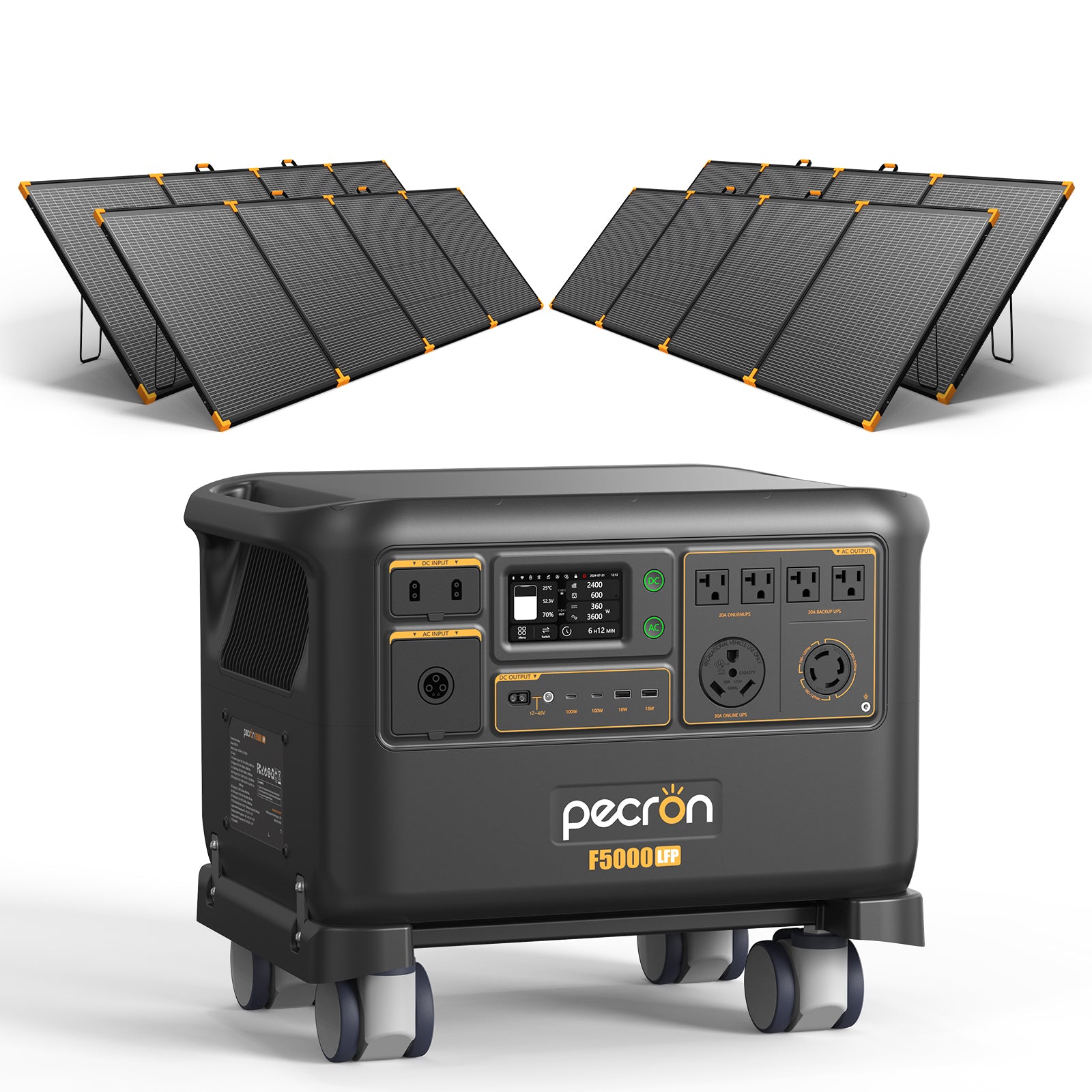
Pecron’s exact selected option “F5000LFP+ PV500*4” pairs one F5000LFP station with four PV500 panels. The offer has its own U.S. variant number and selected SKU. Pecron identifies the PV500 as a 500 W bifacial portable panel, so four panel labels total 2,000 W of nameplate power. This is an arithmetic description of the listed components, not a claim that the station will accept 2,000 W at every moment. It does not expand the station’s battery or inverter.
A home-backup-sized station, still one battery
The F5000LFP is the substantial part of this choice. Pecron specifies 5,120 Wh of LiFePO4 storage, up to 3,600 W at 120 V, and up to 7,200 W at 240 V from one unit. The exact appliance list and a safe wiring arrangement decide whether those figures are useful; nameplate watts alone do not establish how long a load can run. Four PV500s are still only a charging accessory set, not a second battery or a larger output system.
Pecron lists the station at about 123.9 lb before any package additions. The PV500 page captured for this review does not list panel weight or folded footprint, so I would not compare the four-panel kit using a made-up combined weight or storage measurement. The supplied image makes the scale difference visible: several folding panels stand alongside one wheeled F5000. Treat that image as promotional product art. A four-panel deployment needs a place to lay out and face several units toward the sun, but exact ground area and setup time are not established here.
What the four-panel level changes
At 2,000 W of combined panel nameplate, this is the middle option between the two-panel and six-panel PV500 bundles. That may suit a buyer who wants materially more nominal panel capacity than the 1,000 W package but does not want the largest six- or eight-panel grouping. It can make sense for a stationary backup corner, a long-term campsite, or a work location where multiple panels can be set up without blocking paths. These are use-case fits based on the count and station scale, not claims about measured charging performance.
Do not interpret “four panels” as a validated two-per-port or four-in-series wiring instruction. The F5000 manual identifies two XT60 solar inputs, an operating window of 30 to 180 V, a 25 A limit, and 3,200 W maximum per input; Pecron’s page states a lower 5,800 W maximum for the standalone station than the 6,400 W it lists with a compatible added battery. The PV500’s own voltage and current values are not present in the captured panel product materials. The bundle title and image verify the count, but neither tells you whether one, two, or four PV500 panels can safely share an input or how to connect them.
Verify the kit before making solar essential
The F5000 manual packing list includes two XT60-to-MC4 charging leads for the station. That is not enough to prove a four-panel set is ready to connect: the PV500 connector remains unknown, and a multi-panel adapter or cable arrangement may be required. The same manual says solar operation should respect the input voltage/current limits. A four-panel array can be a good reason to request the exact Pecron wiring diagram; it is not a reason to invent a parallel harness or assume a bundle image depicts every wire.
If solar charging is a general preference, the station has a published solar input. If the buyer needs all four included panels working as one supported array, the unresolved bridge is material and the exact option should not pass that strict requirement. The product can still be reviewed as a confirmed seller-listed package, with its technical solar path clearly left open. Ask for PV500 specifications and a diagram matching the exact four-panel SKU before committing to the solar plan.
Who should compare this package?
Choose it for the F5000’s 240 V and high-output capabilities if those meet a documented load plan, and consider the four-panel count when you actually have the space and time to stage that much gear. The 2,000 W panel total does not raise the 5,120 Wh capacity, and there is no estimate of harvest or charge time. The unit’s weight may dominate your portability decision more than the panel count. This is not the best default for a frequently moved campsite unless there is a clear transport and deployment plan.
Compared with two PV500s, this version adds two panels and doubles the labeled panel wattage; compared with six, it asks for two fewer panels. If the use-case needs fewer components, a single-panel option may be simpler. If a complete array is non-negotiable, first obtain written wiring details. Questionnaire choices for a 240 V outlet, 7,200 W output, 5,120 Wh capacity, and four panels in the offer are supported. A requirement that the entire panel set be confirmed to work together is not yet supported by the captured evidence.
Key details at a glance
| Nameplate battery capacity | 5120 Wh |
|---|---|
| Rated AC output | 7200 W |
| Maximum solar input | 5800 W |
| Included panels, combined nameplate | 2000 W |
| Maximum USB-C output per port | 100 W |
| Listed weight | 123.9 lb |
More specifications and setup details
| Compatible extra-battery expansion | Yes |
|---|---|
| Maximum AC recharge input | 3600 W |
| Manufacturer UPS transfer figure | 20 ms |
| Total rated DC output | 800 W |
| AC outlet output | Yes |
| USB-C ports | 2 |
| USB-A ports | 2 |
| Solar input ports | 2 |
| Battery chemistry | LiFePO4 |
| Expansion battery in this package | No |
| Home Power Panel in this package | No |
| Separate station units in offer | 1 |
| Smart Transfer Switch in this package | No |
| Solar panels in exact offer | 4 |
Use the exact model’s instructions for operating limits, supplied equipment and version differences.
Sources for this assessment

A useful match starts with the loads that matter.
Use the finder for hard electrical requirements, then check appliance starting behavior, actual run time and the exact package in the full assessment.