
On this page
Your needs, this model
Does it fit your priorities?
Does one F5000LFP need to provide 240 V AC at up to 7,200 W from a 5,120 Wh station?
Pecron lists one F5000LFP at 240 V and up to 7,200 W, with 5,120 Wh nameplate capacity; confirm the load and electrical plan.
Explore this need in the finder →Must the exact F5000 offer include at least 6 PV300 panels?
The selected U.S. SKU names 6 PV300 panels, each listed at 300 W; 1800 W is combined nameplate arithmetic, not actual harvest.
Explore this need in the finder →Is station solar input useful even if a confirmed all-6-panel cable and array plan is not essential?
The F5000 accepts solar input and the exact option identifies its panel count, but kit-specific cable and all-panels wiring are not established.
Explore this need in the finder →Pecron · 5,120 Wh station with six PV300 panels
Pecron F5000LFP with six PV300 panels review
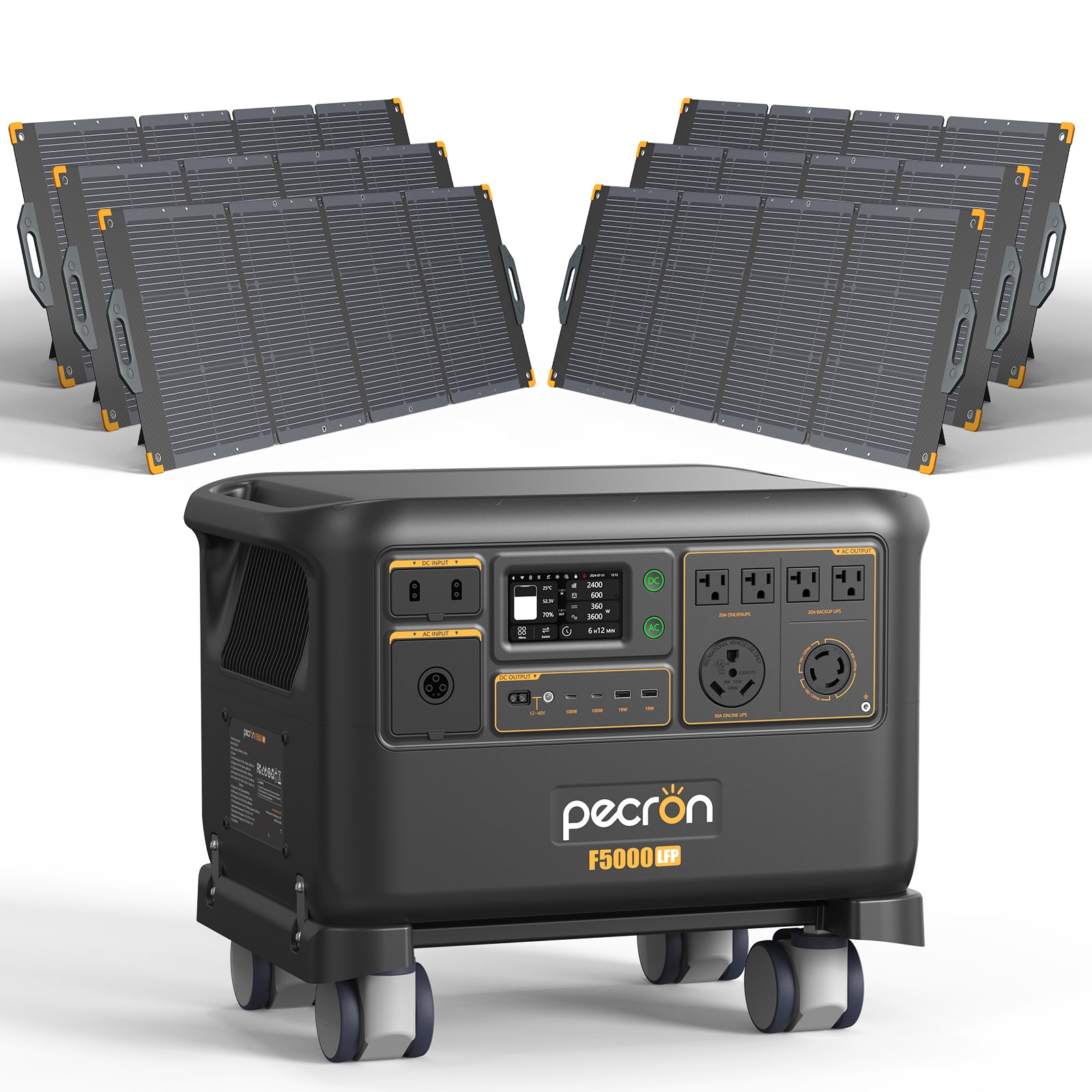
This selected Pecron package combines one F5000LFP station with six PV300-named portable panels. The panel nameplate arithmetic is 1,800 W total at 300 W each; it is not a field charging result. The station itself remains a 5,120 Wh LiFePO4 unit with 120/240 V output and the same inverter ratings as the standalone F5000. The U.S. product page was marked PRE-ORDER in the October 25, 2026 source capture, so fulfillment timing remains a separate question.
A high-capacity station, but a large solar kit too
Pecron lists a single F5000LFP at about 123.9 lb. Its PV300 page says each four-fold panel weighs around 12.74 kg (28.1 lb), folds to about 636 × 789 × 49 mm, and unfolds to approximately 2,362 × 787 mm. Six panels therefore add roughly 169 lb using the rounded individual weight. Adding those values to the station yields about 292.5 lb for the listed station and panel components, before cables, packaging, and any other accessory. That is not a shipping weight or a claim that one person should move the system at once. It is a useful warning that this option needs a storage and setup plan before it is treated as portable.
Six panels also demand substantial open area. The unfolded area is not a single footprint—the panels can be positioned separately—but there must be room for each to face the sun without shading the others. The large station may make sense for a backup location or a carefully arranged vehicle base. It is much less attractive if the plan is frequent lifting, fast campsite moves, or relying on compact storage. The built-in trolley shown in product art does not make a set of panels easy to carry, and the image is not proof of a tested setup.
Panel count and solar-input limits are not the same thing
The six-panel SKU identifies a package with 1,800 W of PV300 panel nameplate, while Pecron lists the F5000’s single-unit solar input at up to 5,800 W, 30–180 V and 25 A. This figure is a ceiling for the station input, not a guarantee of six-panel compatibility or of 1,800 W in ordinary conditions. The individual PV300 page lists 36 V operating voltage, 41.4 V open circuit, and 8.3 A operating current, each subject to tolerances. Those per-panel figures cannot establish how six panels may be combined safely, especially without the exact cable and wiring instructions for this offer.
There is also a naming boundary in the manufacturer’s material: the selected station option and separate product page call the 300 W panel PV300, but a linked panel user document is labeled S300. The page’s SKU and PV300 description support the identity of the panels in this offer; they do not make every S300 document detail a confirmed revision bridge. The solar page refers to MC4 connectors, while F5000’s solar input is XT60. The current option listing does not establish which adapter ships in this kit or whether the six panels can all be used simultaneously within station limits. If that is essential, ask the manufacturer for a written exact bundle wiring plan before buying. Unknown wiring should not be treated as a successful six-panel operating configuration.
Choose this only after choosing the station
The F5000 is selected for its unusual single-station output: up to 7,200 W at 240 V and 3,600 W for each of its described 120 V output groups. A TT-30R is listed, but the aggregate group figure does not mean one outlet can provide all the station’s output. Pecron says the 240 V output has a floating neutral while on battery. A transfer-switch or home backup application needs an actual load plan and qualified electrical design, not only a large output number. Neither the panels nor their count increase the 5,120 Wh battery capacity.
The six-panel package is most defensible when the F5000 already fits a real 120/240 V load plan and the buyer has room, transport, and support for a much larger panel set. The standalone F5000 avoids panels entirely; the two- or four-panel packages ask for less storage and handling. Those smaller options still need their own cable confirmation, so a lower count is not automatically a fully verified array. If the intended job is just occasional solar top-up, a smaller station with a documented panel system may be more practical. Compare by the complete known plan—voltage, load, battery, weight, included panel count, and wiring—not the maximum solar-input headline alone.
Bottom line
Six PV300 panels make this the largest panel-count option in the F5000 PV300 family and provide 1,800 W of combined nameplate on paper. The station’s storage and 120/240 V output remain those of one F5000. The scale is the central tradeoff: approximately 169 lb of panels alongside a 124 lb station, plus no confirmed all-panel wiring or exact bundle cable. It belongs in a planned stationary or vehicle-supported backup setup, not a lightweight portable-power shortlist. Confirm the six-panel connection and shipping contents first; if the station itself is the priority, the base F5000 review describes what it can do without relying on an unverified solar array.
Key details at a glance
| Nameplate battery capacity | 5120 Wh |
|---|---|
| Rated AC output | 7200 W |
| Maximum solar input | 5800 W |
| Included panels, combined nameplate | 1800 W |
| Maximum USB-C output per port | 100 W |
| Listed weight | 123.9 lb |
More specifications and setup details
| Compatible extra-battery expansion | Yes |
|---|---|
| Maximum AC recharge input | 3600 W |
| Manufacturer UPS transfer figure | 20 ms |
| Total rated DC output | 800 W |
| AC outlet output | Yes |
| USB-C ports | 2 |
| USB-A ports | 2 |
| Solar input ports | 2 |
| Battery chemistry | LiFePO4 |
| Expansion battery in this package | No |
| Home Power Panel in this package | No |
| Separate station units in offer | 1 |
| Smart Transfer Switch in this package | No |
| Solar panels in exact offer | 6 |
Use the exact model’s instructions for operating limits, supplied equipment and version differences.
Sources for this assessment

A useful match starts with the loads that matter.
Use the finder for hard electrical requirements, then check appliance starting behavior, actual run time and the exact package in the full assessment.