
On this page
Your needs, this model
Does it fit your priorities?
Does the offer need a one-station 240 V, 7,200 W and 5,120 Wh plan with at least 6 named PV500 panels in the box?
The exact selected SKU lists one F5000LFP with 6 PV500 panel(s); station ratings are independent of the panel count. The option represents 3,000 W of panel nameplate by arithmetic, not a verified all-panel harvest.
Explore this need in the finder →Can you rely on all 6 PV500 panels working together in a verified solar-input plan?
No all-panel array or PV500 electrical/cable plan was documented in the captured official materials. Treat that requirement as unknown until Pecron confirms it.
Explore this need in the finder →Would a 3,000 W PV500 nameplate total mean the F5000 has a larger battery or AC output?
No. This is the panel bundle count (6×500 W by panel-page rating); the host remains 5,120 Wh with up to 7,200 W at 240 V.
Explore this need in the finder →Pecron · F5000LFP with six PV500 panels
Pecron F5000LFP with six PV500 panels review
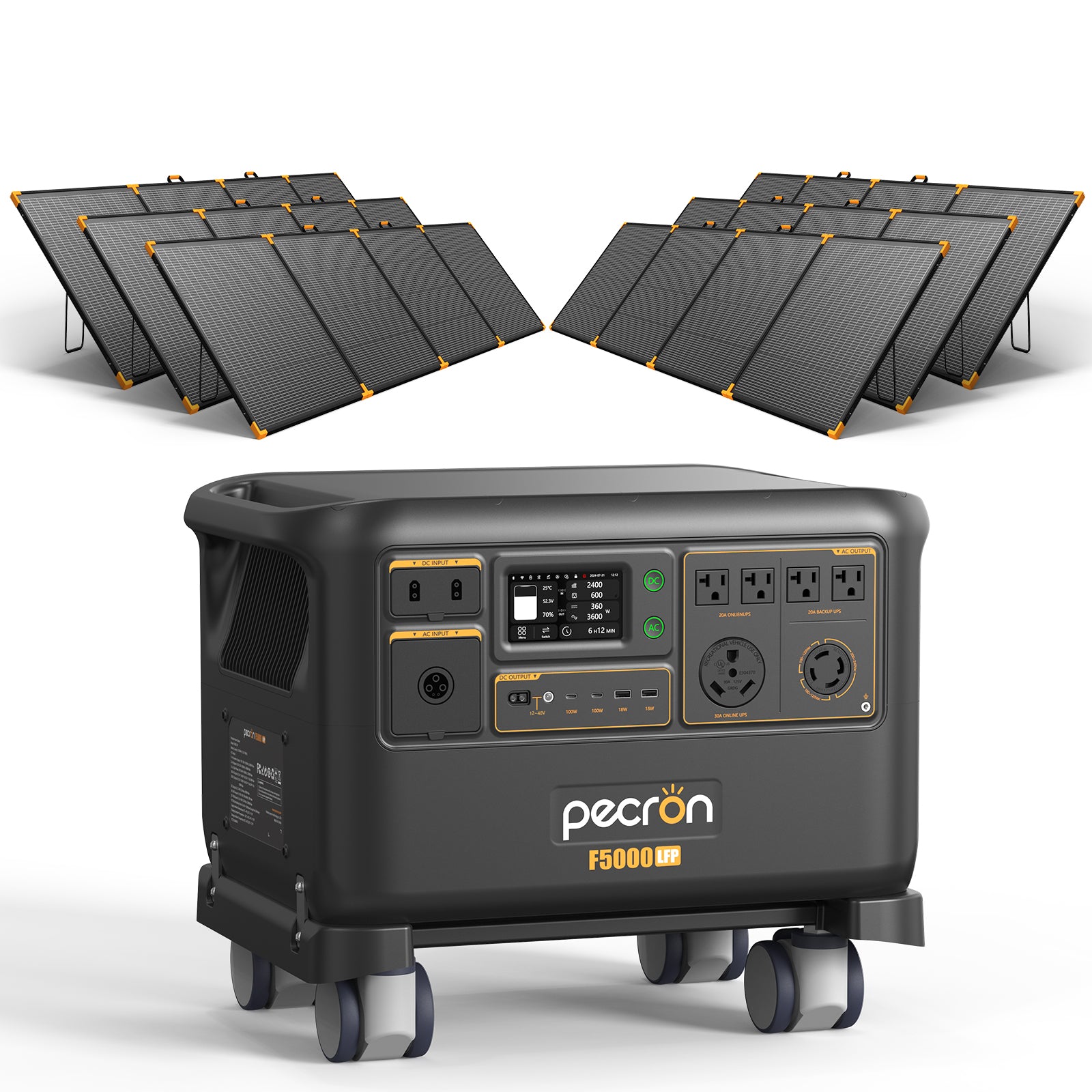
This exact F5000LFP option names six PV500 panels and has retailer SKU F5000LFP-PV500*6. It is one F5000LFP with a large solar-panel set, not six panels added to the battery’s storage rating. The official PV500 page calls each unit a 500 W bifacial panel, giving a combined nameplate total of 3,000 W by arithmetic. The image for this selected option shows the F5000 with a six-panel layout, but it remains a manufacturer illustration rather than an on-site demonstration or wiring plan.
The appeal is substantial solar gear beside a high-output host
The F5000LFP offers 5,120 Wh of storage and Pecron lists up to 7,200 W at 240 V, with up to 3,600 W at 120 V. That output can cover loads that exceed the range of smaller portable stations, but it does not make this a whole-home installation by itself. The reviewable profile contains one station; it does not include a home power panel or transfer switch. Design the backup circuits and output-voltage requirements before deciding that the dual-voltage headline is enough.
The station weighs about 123.9 lb on its own. Six separate panels imply a more involved deployment than the two- or four-panel choices, even though panel weights and folded dimensions are not published in the PV500 material captured here. This is much more natural for a fixed backup location or a site with vehicle access and a planned sunny area than for an improvised weekend pack. The selected graphic shows multiple folding panel assemblies around the station, but cannot establish the exact floor area, packing volume, or time needed to position them.
Three kilowatts is a label total, not an operating promise
Three thousand watts of combined PV500 nameplate makes this the larger of the six-panel and lower-count solar choices, while the eight-panel option reaches 4,000 W by the same arithmetic. The value is helpful when you compare the amount of solar hardware listed in each package, but actual harvest depends on conditions and the station’s electrical input limits. It is not a forecast that six panels will charge a 5,120 Wh battery in a particular number of hours.
Pecron’s standalone F5000 page lists a 5,800 W solar ceiling and 6,400 W only when a compatible expansion battery is present. The manual describes two XT60 inputs with a 30–180 V range, 25 A maximum, and up to 3,200 W per input. Those are station limits, not a PV500 configuration recommendation. The captured PV500 page does not publish the panel’s open-circuit voltage, operating voltage, current, or connector. Without those values and a supplier-approved array diagram, you cannot safely infer that six panels can be grouped onto the station’s two inputs simply because 3,000 W is below the 5,800 W overall ceiling.
What must be confirmed before a critical solar plan
The station manual does list two single-port XT60-to-MC4 solar charging leads in its packing list. That confirms those station-side leads for the F5000; the panel-end connector and any required combining cables remain unknown for this selected PV500 set. Ask Pecron to identify the PV500 connector, series/parallel wiring, per-input panel limits, and whether the six supplied units can operate together on this exact option. Until then, keep the all-panels-together requirement unset rather than treating the retailer bundle title as proof of a tested array.
If solar charging itself is not a strict buying condition, the F5000’s documented AC output and capacity can still be assessed on their own. If solar panels in the box are required, the selected listing verifies six named 500 W panels. If the essential goal is a supported three-kilowatt array, the evidence is insufficient, so this configuration should not pass that need yet. The difference between a known package identity and unknown technical hookup matters.
Who is the six-panel version for?
It is worth comparing when you want an F5000-based 240 V plan and can dedicate a location to a large panel set. The 3,000 W nominal panel total gives more labeled solar capacity than the one-, two-, and four-panel packages, but the bundle still has one 5,120 Wh station. If storage duration is the weak point, examine the manufacturer’s separately specified expansion batteries instead of assuming panels increase the battery. If mobility is the weak point, moving from four panels to six increases setup burden without making the station lighter or raising its AC output.
For questionnaire choices, the exact offer supports an included-panel threshold of six and 3,000 W nameplate, plus the F5000’s listed outlet and storage needs. A 240 V or 7,200 W essential need should still be checked against the appliance and circuit plan. Do not treat the six-panel title as proof of a working all-panel solar system; get the panel electrical data and wiring confirmation first. That is the key decision point separating a useful package description from a dependable solar operating plan.
Key details at a glance
| Nameplate battery capacity | 5120 Wh |
|---|---|
| Rated AC output | 7200 W |
| Maximum solar input | 5800 W |
| Included panels, combined nameplate | 3000 W |
| Maximum USB-C output per port | 100 W |
| Listed weight | 123.9 lb |
More specifications and setup details
| Compatible extra-battery expansion | Yes |
|---|---|
| Maximum AC recharge input | 3600 W |
| Manufacturer UPS transfer figure | 20 ms |
| Total rated DC output | 800 W |
| AC outlet output | Yes |
| USB-C ports | 2 |
| USB-A ports | 2 |
| Solar input ports | 2 |
| Battery chemistry | LiFePO4 |
| Expansion battery in this package | No |
| Home Power Panel in this package | No |
| Separate station units in offer | 1 |
| Smart Transfer Switch in this package | No |
| Solar panels in exact offer | 6 |
Use the exact model’s instructions for operating limits, supplied equipment and version differences.
Sources for this assessment

A useful match starts with the loads that matter.
Use the finder for hard electrical requirements, then check appliance starting behavior, actual run time and the exact package in the full assessment.