
On this page
Your needs, this model
Does it fit your priorities?
Does the offer need a one-station 240 V, 7,200 W and 5,120 Wh plan with at least 8 named PV500 panels in the box?
The exact selected SKU lists one F5000LFP with 8 PV500 panel(s); station ratings are independent of the panel count. The option represents 4,000 W of panel nameplate by arithmetic, not a verified all-panel harvest.
Explore this need in the finder →Can you rely on all 8 PV500 panels working together in a verified solar-input plan?
No all-panel array or PV500 electrical/cable plan was documented in the captured official materials. Treat that requirement as unknown until Pecron confirms it.
Explore this need in the finder →Would a 4,000 W PV500 nameplate total mean the F5000 has a larger battery or AC output?
No. This is the panel bundle count (8×500 W by panel-page rating); the host remains 5,120 Wh with up to 7,200 W at 240 V.
Explore this need in the finder →Pecron · F5000LFP with eight PV500 panels
Pecron F5000LFP with eight PV500 panels review
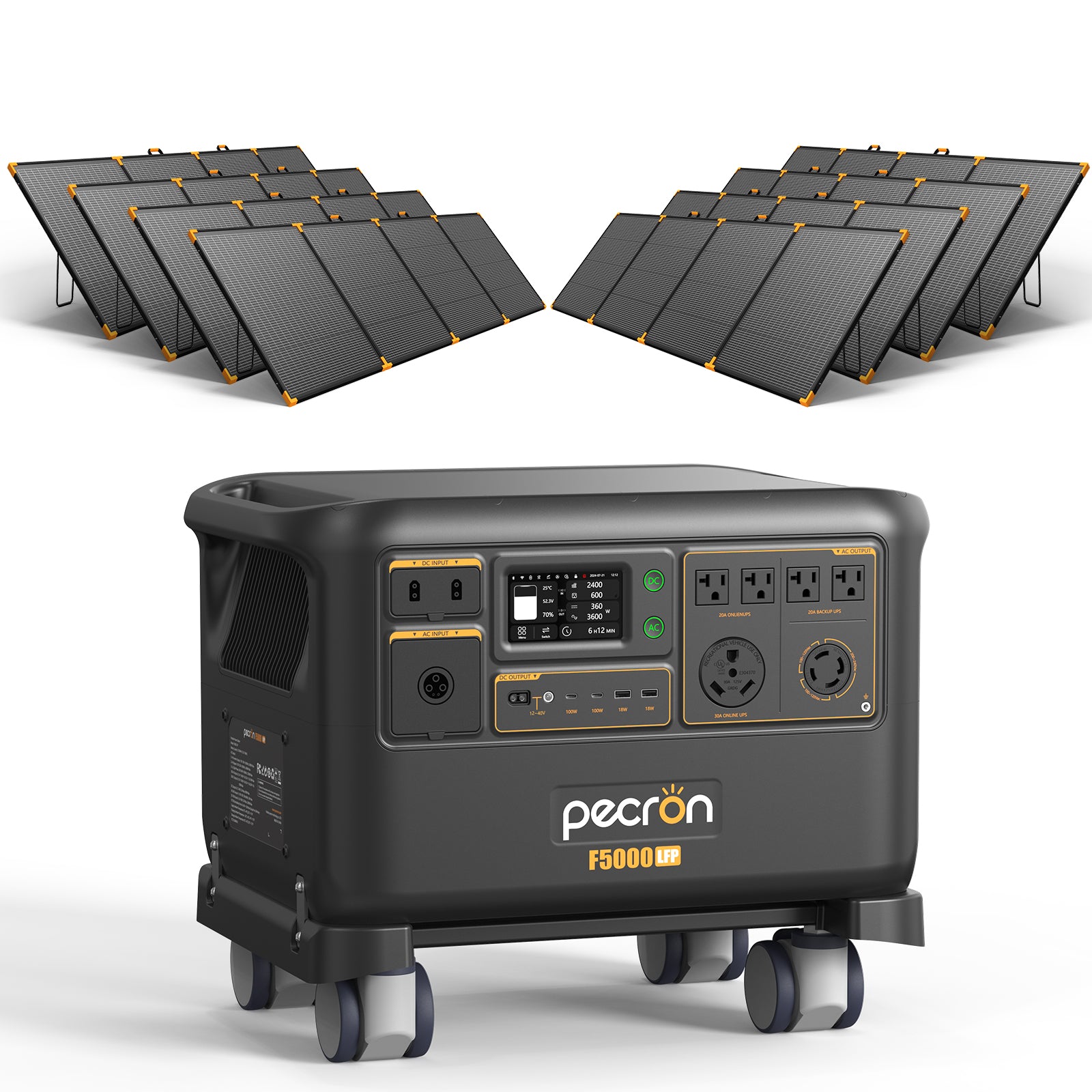
The selected “F5000LFP+ PV500*8” option is the highest-count PV500 package in the archived F5000 U.S. option set. It pairs one F5000LFP with eight PV500 panels; the selected SKU and retailer variant ID distinguish it from the single-, two-, four-, and six-panel versions. Pecron calls the PV500 a 500 W bifacial portable panel, so the offer represents 4,000 W of combined panel nameplate arithmetic. That is the listed panel capacity, not an expected station input or a measured result.
Be honest about the size of the installation
The F5000 is already a large station: Pecron lists 5,120 Wh of capacity, 7,200 W maximum at 240 V and 3,600 W at 120 V, with a station weight of about 123.9 lb before accessories. Eight folding panels add a major deployment requirement even though the manufacturer materials captured for this package do not give their individual weights or folded dimensions. A permanent sunny area, a practical route for moving the equipment, and a place to keep the panels when packed away are more important than the product image’s clean presentation. This is a stationary or vehicle-assisted choice, not a lightweight camping kit.
The eight-panel count may appeal to someone who wants more nominal solar hardware from the outset than the 4-panel or 6-panel F5000 options. It does not change the battery capacity, provide additional AC outlets, or raise the station’s 240 V rating. If you need more hours under load, capacity planning and compatible battery expansion are separate decisions. If you need a 240 V device to run, confirm its required supply and circuit arrangement rather than assuming that the panel bundle solves household integration.
More nameplate watts do not solve missing array details
Pecron’s product page lists 5,800 W maximum solar input for one F5000LFP and up to 6,400 W with a compatible extra battery; the manual shows two XT60 input ports with up to 3,200 W each, within a 30–180 V and 25 A window. This package has no FP5000 battery in its selected title, so the 5,800 W standalone ceiling is the one to compare. Its 4,000 W panel label total sits below that overall figure, but that alone does not demonstrate compatibility. Panel open-circuit voltage, current, connector, and the supported wiring of eight panels onto two inputs determine whether a real array meets the per-port constraints.
The PV500 page captured here identifies its model, 500 W rating, bifacial design, and IP67 label, but does not publish those electrical values or a bundle-specific diagram. The F5000 manual’s packing list names two XT60-to-MC4 station charging leads. Those are useful station accessories, yet they do not verify the PV500 connector or eight-panel combiner cables. Do not infer a safe series string or parallel combination from the panel count, the station’s headline ceiling, or the illustration. Ask Pecron for the exact PV500 data sheet and a wiring plan for this specific eight-panel option before making solar charging essential.
Where the questionnaire should draw a line
The exact offer supports a requirement for a panel in the package, a minimum of eight listed panels, or a 4,000 W total panel nameplate threshold. The F5000 itself also has a documented solar input, but the strict requirement “all supplied panels must be confirmed to work together” remains unresolved. In that case, this profile should not be recommended until the manufacturer documents the arrangement. This distinction is especially important here: a large nameplate sum can look compelling while the connection plan is still the deciding technical fact.
The ordinary voltage and AC questions remain independent of the panel quantity. Selecting 240 V and a 7,200 W minimum may identify the station’s output class; it does not imply that the buyer has an interconnection kit or permission to energize house circuits. A maximum station-weight requirement should use the published 123.9 lb station figure. Total package weight cannot be confirmed because the PV500 weight is unknown. Capacity and output should not be inflated by counting the eight solar panels.
Who should consider the eight-panel package?
Consider it only after you have both a suitable fixed or vehicle-accessible space and a confirmed electrical plan for the panel array. It is the most expansive PV500 choice in this exact option family, not the automatic best pick. One, two, or four panels may be easier to stage; six panels offer a middle ground; and a bare F5000 can be compared if you want the station first and will source compatible solar equipment later. Those alternatives all retain the same base station output and storage when no expansion battery is included.
The purchase decision is therefore two-part: do the F5000’s 5,120 Wh and dual-voltage output fit the actual load, and can Pecron confirm that this eight-panel package can be assembled within the F5000 input limits? The first question has published ratings to evaluate. The second does not yet have a complete answer in the captured public product materials. Until it does, regard eight PV500s as a verified listed package with an unverified all-panel operating arrangement—not as a guaranteed 4,000 W charging system.
Key details at a glance
| Nameplate battery capacity | 5120 Wh |
|---|---|
| Rated AC output | 7200 W |
| Maximum solar input | 5800 W |
| Included panels, combined nameplate | 4000 W |
| Maximum USB-C output per port | 100 W |
| Listed weight | 123.9 lb |
More specifications and setup details
| Compatible extra-battery expansion | Yes |
|---|---|
| Maximum AC recharge input | 3600 W |
| Manufacturer UPS transfer figure | 20 ms |
| Total rated DC output | 800 W |
| AC outlet output | Yes |
| USB-C ports | 2 |
| USB-A ports | 2 |
| Solar input ports | 2 |
| Battery chemistry | LiFePO4 |
| Expansion battery in this package | No |
| Home Power Panel in this package | No |
| Separate station units in offer | 1 |
| Smart Transfer Switch in this package | No |
| Solar panels in exact offer | 8 |
Use the exact model’s instructions for operating limits, supplied equipment and version differences.
Sources for this assessment

A useful match starts with the loads that matter.
Use the finder for hard electrical requirements, then check appliance starting behavior, actual run time and the exact package in the full assessment.