
On this page
Your needs, this model
Does it fit your priorities?
Does the F5000LFP host cover your one-station 240 V load?
Pecron lists the host at up to 7,200 W in the dual-phase 240 V mode; expansion batteries do not increase that output rating.
Explore this need in the finder →Must at least 3 FP5000-48V expansion batteries be included in the selected option?
The exact selected option title and SKU name 3 FP5000-48V unit(s). The package's exact total storage is not specified.
Explore this need in the finder →Can the 120 V operating plan meet your rated-output floor?
The F5000 listing describes two 120 V output groups rated at 3,600 W each; check the actual outlet and circuit limits.
Explore this need in the finder →Pecron · three FP5000-48V expansion-battery option
Pecron F5000LFP with three FP5000-48V batteries review
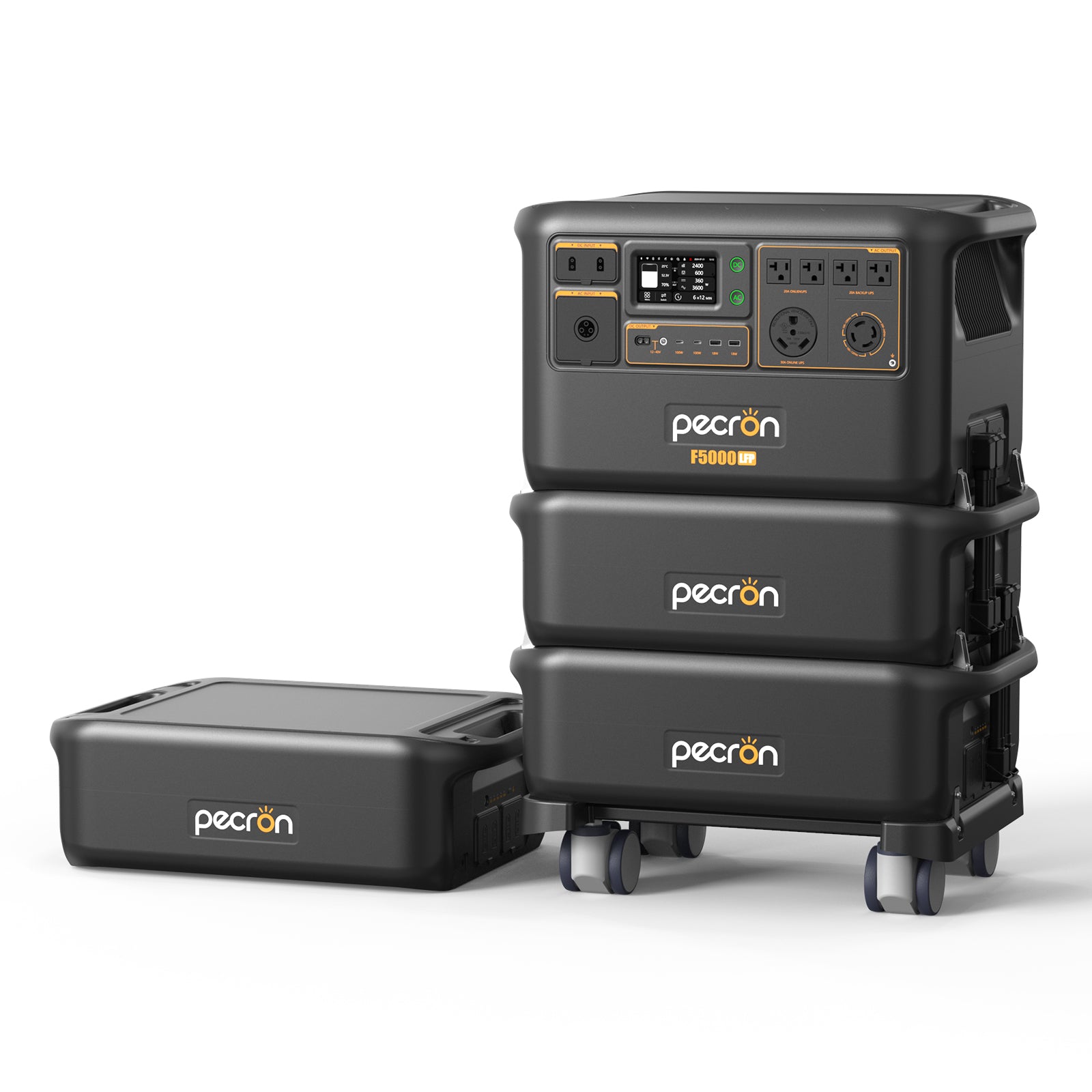
This selected U.S. offer is the F5000LFP host with three FP5000-48V units in the retailer’s option title and SKU. The count makes this a different package decision from the single- and double-battery variants even though the central power station remains the same. It is a specialist, stationary backup configuration whose storage expansion should be planned together with the physical layout and electrical installation.
Why choose three rather than simply “more”?
The practical reason to select an exact three-pack bundle is that you have determined, from an equipment inventory and outage plan, that three compatible expansion modules belong in the initial purchase. The option title tells you the quantity being selected; it does not give a capacity-per-module table. Pecron describes the base F5000LFP as 5,120 Wh and the full family as expandable up to 35.8 kWh, but the archived exact-option data does not list this three-pack configuration’s combined watt-hours. The difference between a named three-unit offer and a measurable energy system matters. Do not infer a number from the “5000” label or assume the family’s maximum applies to this package.
For a real backup plan, begin with the loads that must run at the same time and how long they must run. Add motor starting behavior and seasonal usage, and leave room for conversion losses and recharging. The F5000’s own 5,120 Wh base figure is published; the complete package’s capacity and usable energy remain unconfirmed. If your essential requirement is “at least X watt-hours,” this profile should not be treated as meeting it until Pecron supplies a package-specific figure. The questionnaire keeps that unknown from being treated as a pass.
Do not confuse stored energy with output power
Pecron rates the host for 120-volt output in two 3,600 W groups and dual-phase 200–240-volt output up to 7,200 W. Three expansion batteries do not create three inverters, change the outlet pattern, or multiply the continuous output. A pump, compressor, or heating load still needs to fit the station’s voltage and per-outlet limits. Confirm what runs simultaneously and use the official manual rather than reading the total system rating as a promise for any single socket.
The 240-volt backup path requires particular care. Pecron describes a floating neutral on battery output and UPS behavior tied to the incoming AC neutral arrangement. That makes transfer-switch selection and grounding an installation question, not a DIY backfeed exercise. A qualified electrician should review your panel and the exact transfer equipment; the product’s battery count does not make a household connection safer or more compatible.
Think through the site as well as the load
The F5000 station is listed at approximately 123.9 lb, with a wheeled base. That figure is for the station, not the whole three-pack system. Pecron’s captured option data does not establish the expansion units’ weight, total package weight, or exact arrangement. The manufacturer render associated with the selected option is a promotional illustration; count the units from the exact SKU, not from the staged picture. Decide where each component can sit, how it can be moved, and how the expansion cables are routed before ordering. A three-pack bundle is a poor fit if equipment must be carried up stairs or repeatedly packed into a vehicle.
Solar is another separate decision. The station manual describes two XT60 inputs with published electrical limits, but the listing does not include PV500 panels in this selected option. The page’s general F5000 solar-input maximum is not an exact array recipe, and an expansion battery count alone does not specify the approved panel connection or charging behavior. Confirm panel electrical values, adapters, and wiring with the manufacturer for the exact system.
Recommendation
Choose the three-pack option only if the F5000’s single-station output and 120/240-volt arrangement suit your loads, you specifically want three FP5000-48V units in the order, and you can verify total storage and system weight before relying on them. If one expansion unit is enough, the one-pack listing avoids buying unused hardware; if the plan requires four or six, compare those exact options rather than ordering multiple accessory records by guesswork. If you cannot get a package-specific capacity figure, choose a configuration whose total energy is actually specified. The F5000 may be powerful, but a large bundle is not a substitute for transparent system-level sizing.
Key details at a glance
| Rated AC output | 7200 W |
|---|---|
| Maximum solar input | 5800 W |
| Included panels, combined nameplate | 0 W |
| Maximum USB-C output per port | 100 W |
| Compatible extra-battery expansion | Yes |
| Maximum AC recharge input | 3600 W |
More specifications and setup details
| Manufacturer UPS transfer figure | 20 ms |
|---|---|
| Total rated DC output | 800 W |
| AC outlet output | Yes |
| USB-C ports | 2 |
| USB-A ports | 2 |
| Solar input ports | 2 |
| Battery chemistry | LiFePO4 |
| Expansion battery in this package | Yes |
| Home Power Panel in this package | No |
| Separate station units in offer | 1 |
| Smart Transfer Switch in this package | No |
| Solar panels in exact offer | 0 |
| Included expansion batteries | 3 units |
Use the exact model’s instructions for operating limits, supplied equipment and version differences.
Sources for this assessment

A useful match starts with the loads that matter.
Use the finder for hard electrical requirements, then check appliance starting behavior, actual run time and the exact package in the full assessment.