
On this page
Your needs, this model
Does it fit your priorities?
Does the F5000LFP host cover your one-station 240 V load?
Pecron lists the host at up to 7,200 W in the dual-phase 240 V mode; expansion batteries do not increase that output rating.
Explore this need in the finder →Must at least 4 FP5000-48V expansion batteries be included in the selected option?
The exact selected option title and SKU name 4 FP5000-48V unit(s). The package's exact total storage is not specified.
Explore this need in the finder →Can the 120 V operating plan meet your rated-output floor?
The F5000 listing describes two 120 V output groups rated at 3,600 W each; check the actual outlet and circuit limits.
Explore this need in the finder →Pecron · four FP5000-48V expansion-battery option
Pecron F5000LFP with four FP5000-48V batteries review
The four-battery option is for buyers who have already committed to Pecron’s F5000LFP platform and want four FP5000-48V expansion units included in the selected configuration. Its exact U.S. SKU differs from the one-, two-, three-, and six-unit listings. That matters at checkout, but it does not change the host station’s outlet set or convert the package into a different rated-power model.
A large system needs a verified energy plan
Four named expansion batteries suggest a package chosen for longer reserve than the station alone, but the precise total cannot be responsibly stated from the archived option record. Pecron identifies the F5000LFP host as a 5,120 Wh unit and describes expansion up to 35.8 kWh across the product family. The exact four-unit listing does not provide a battery module watt-hour rating or a combined storage figure. No runtime estimate follows from the number four by itself. If you need to support refrigeration, a well pump, or another essential load, check the applicable safety guidance and get an exact system specification before treating this package as a solution.
The useful pre-purchase exercise is a load schedule: device voltage, running watts, startup demand, hours per day, and which appliances may overlap. The F5000 is rated up to 7,200 W in its dual-phase 240-volt mode, while the base station has a 5,120 Wh nameplate. Those numbers describe different limits. The battery options address storage expansion; the station’s AC power rating still governs what can be started and operated. A four-pack package is not a way around a surge limit or an undersized branch circuit.
Plan the outlet and transfer arrangement
Pecron lists two 120-volt output groups rated up to 3,600 W each and a 200–240-volt dual-phase output rated up to 7,200 W. Treat the figures as group/system ratings and check the particular outlet’s marking and load. The product page and F5000 manual also call out a floating neutral in 240-volt battery operation. For household connection, the transfer switch, neutral bond, grounding, and panel interface require a proper electrical design. Do not plug the station into a building receptacle or improvise a backfeed cord. Have a qualified electrician verify the exact installation.
The manual documents two XT60 solar inputs and their voltage and current limits, but this selected option is not a panel bundle. A general statement about higher solar input with an added battery is not a configuration-specific charging diagram. If a four-pack system is intended for solar recovery, ask which port combination, array values, and cables Pecron approves for the full setup. Do not infer panel compatibility from the product illustration or the expansion-battery connector.
Space, weight, and delivery are part of fit
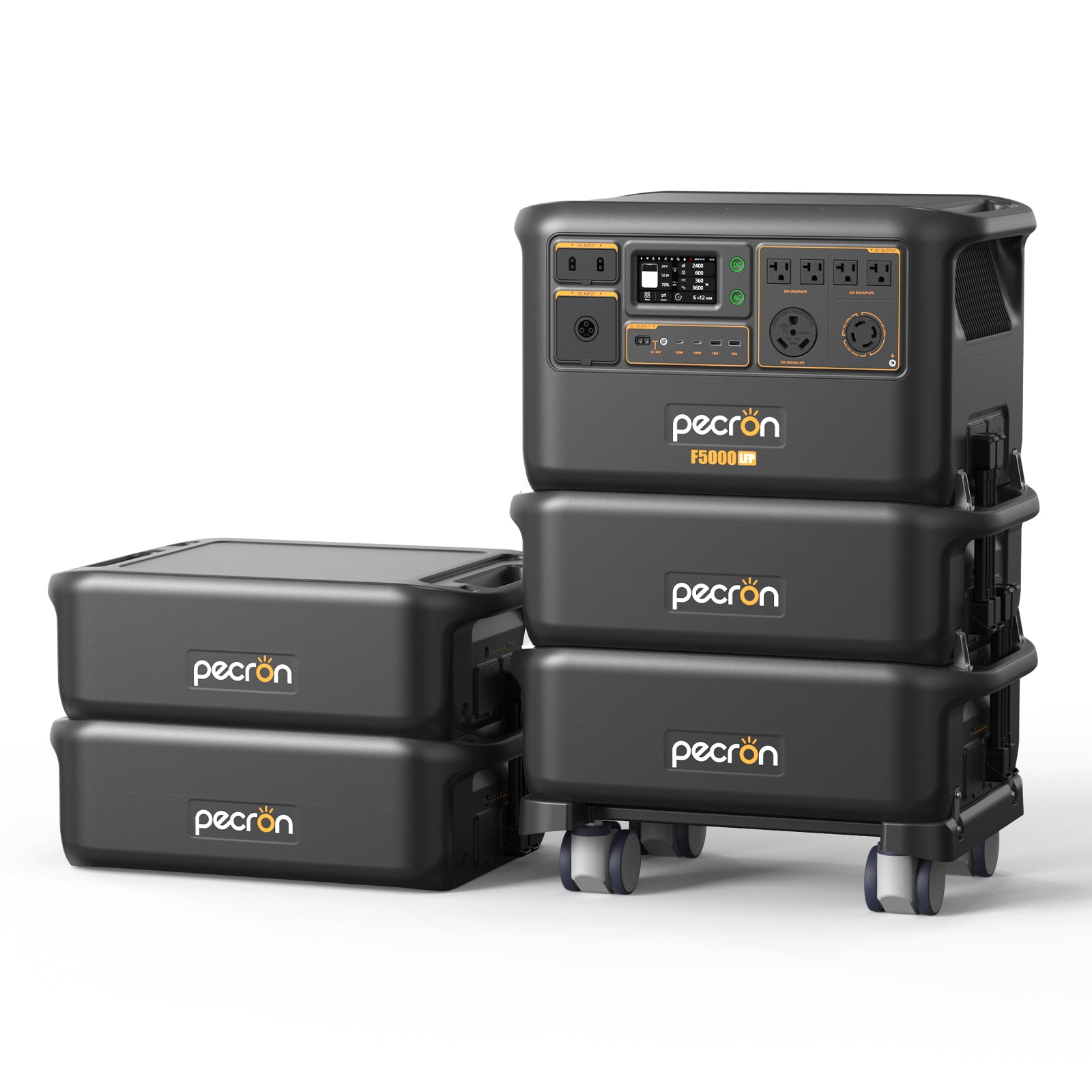
The station itself is listed around 123.9 lb and uses a wheeled base. The combined mass and dimensions of the station with four FP5000-48V units are unknown in the captured listing. The selected-option image is an official CGI/render tied to the exact option, not a verified shipping inventory photograph. It is useful for recognizing the product family; rely on the SKU for the chosen count and confirm the shipment’s parts list and handling requirements with the seller. This is equipment for a planned fixed location, not a portable camp power box in the everyday sense.
Also distinguish a supported accessory from a complete electrical installation. The captured F5000 manual covers the station’s expansion/cascade constraints, but it is not a separate FP5000-48V battery specification sheet. The selected option does not answer every question about individual battery chemistry, capacity, protective limits, cable inventory, or how the four units are configured. Those unknowns should remain open in your purchase decision.
Who should pass on this package?
Choose this exact four-unit option if the product page’s four-pack quantity matches a written reserve plan and you can verify the resulting capacity, installation, and space. Compare it with the three-pack version if one less module is enough, or the six-pack configuration if the approved system plan calls for the family’s highest supported count. Do not pay for expansion you cannot safely install or use. If you only need the F5000’s 120/240-volt output and do not yet know your storage requirement, the base unit or a better-documented system may be the more rational choice. The four-pack name is clear; the exact system-level storage specification is not.
Key details at a glance
| Rated AC output | 7200 W |
|---|---|
| Maximum solar input | 5800 W |
| Included panels, combined nameplate | 0 W |
| Maximum USB-C output per port | 100 W |
| Compatible extra-battery expansion | Yes |
| Maximum AC recharge input | 3600 W |
More specifications and setup details
| Manufacturer UPS transfer figure | 20 ms |
|---|---|
| Total rated DC output | 800 W |
| AC outlet output | Yes |
| USB-C ports | 2 |
| USB-A ports | 2 |
| Solar input ports | 2 |
| Battery chemistry | LiFePO4 |
| Expansion battery in this package | Yes |
| Home Power Panel in this package | No |
| Separate station units in offer | 1 |
| Smart Transfer Switch in this package | No |
| Solar panels in exact offer | 0 |
| Included expansion batteries | 4 units |
Use the exact model’s instructions for operating limits, supplied equipment and version differences.
Sources for this assessment

A useful match starts with the loads that matter.
Use the finder for hard electrical requirements, then check appliance starting behavior, actual run time and the exact package in the full assessment.