
On this page
Your needs, this model
Does it fit your priorities?
Does the F5000LFP host cover your one-station 240 V load?
Pecron lists the host at up to 7,200 W in the dual-phase 240 V mode; expansion batteries do not increase that output rating.
Explore this need in the finder →Must at least 6 FP5000-48V expansion batteries be included in the selected option?
The exact selected option title and SKU name 6 FP5000-48V unit(s). The package's exact total storage is not specified.
Explore this need in the finder →Can the 120 V operating plan meet your rated-output floor?
The F5000 listing describes two 120 V output groups rated at 3,600 W each; check the actual outlet and circuit limits.
Explore this need in the finder →Pecron · six FP5000-48V expansion-battery option
Pecron F5000LFP with six FP5000-48V batteries review
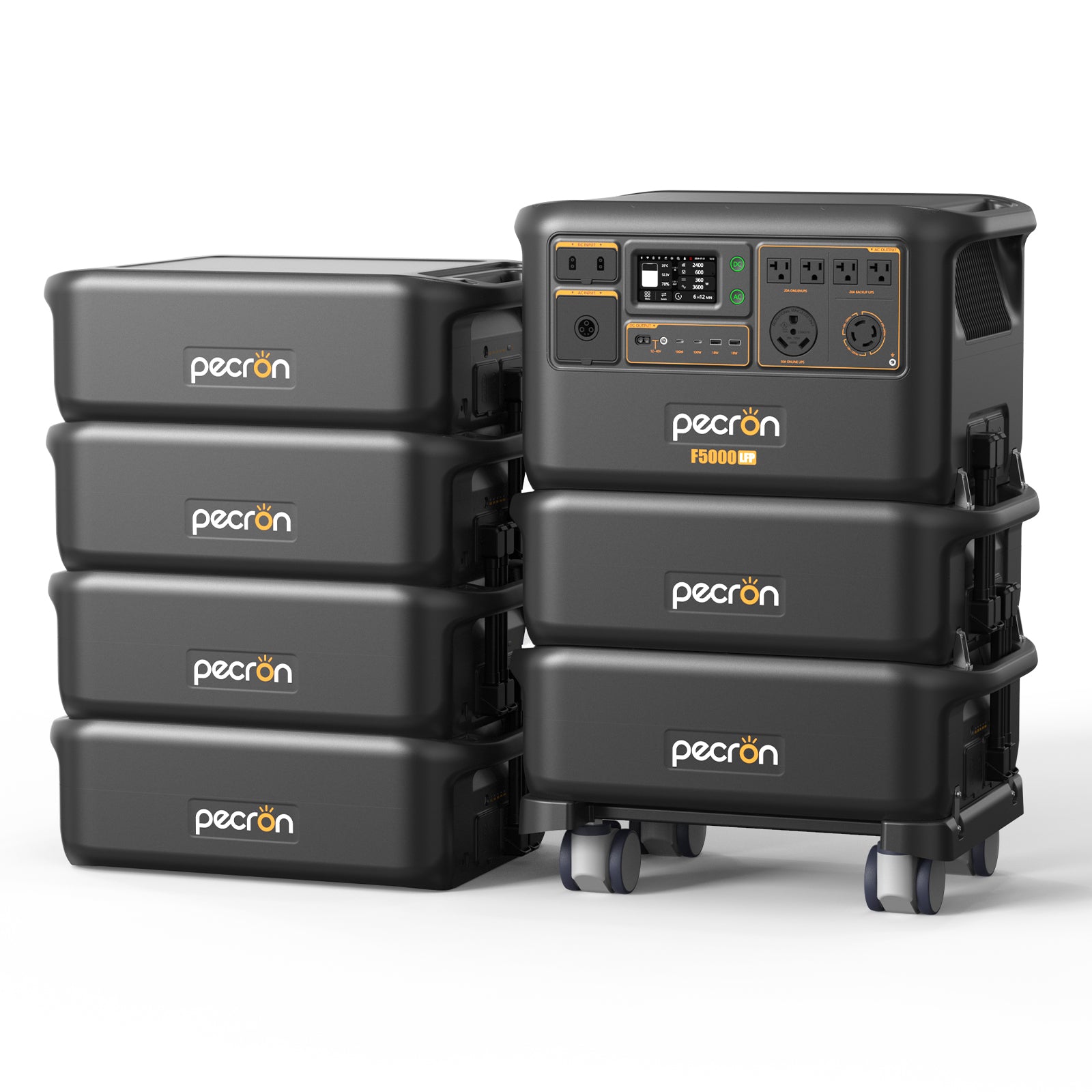
This is the largest expansion-count option in the captured U.S. F5000LFP selector: one F5000LFP host paired in the retailer SKU with six FP5000-48V expansion-battery units. It is a very different order from the standalone station or the one-pack entry. The official product page’s family description says expansion can reach up to 35.8 kWh, and the F5000 manual addresses a six-pack expansion system. But the exact selected-option record does not list the per-pack capacity or a configuration-specific total. Treat the maximum as a family claim, not a complete specification for this particular checkout selection.
Maximum count is not the same as maximum usefulness
Six expansion units are sensible only if a fixed-site backup plan needs that many compatible modules and the installed system can make use of them. Start with the loads that must remain available, the period they must run, expected AC/USB/DC draw, and how the station can recharge. The F5000LFP host itself is listed at 5,120 Wh, but that does not establish the total usable energy of this package. Ask Pecron for the exact six-pack system rating, usable storage, and allowed operating configuration. Without those answers, a runtime calculation, cost-per-kilowatt-hour comparison, or claim that this bundle covers a particular outage would be speculation.
The six-pack listing is also not a six-station array. It remains one F5000LFP host with its listed 120-volt groups and 200–240-volt output. Pecron rates the 120-volt groups at up to 3,600 W each and the dual-phase 240-volt mode at up to 7,200 W. Expansion increases the system’s energy reserve only to the extent the approved battery modules add it; it does not multiply the inverter rating or change which receptacle can carry a load. Check appliance starting draw, circuit rating, and the actual outlet map separately.
Home backup has a serious installation boundary
The F5000 page and manual describe floating-neutral behavior at 240 volts on battery, with UPS behavior dependent on the incoming AC neutral arrangement. A large battery system does not remove the need for transfer equipment and a correctly designed grounding/neutral scheme. Do not backfeed a panel or connect the system to household wiring through an improvised cord. Have a qualified electrician evaluate the particular transfer switch, loads, grounding, clearances, and local requirements. A setup this large deserves planning before purchase, not after delivery.
Space and movement are also material. The host station alone is approximately 123.9 lb and sits on wheels; the full six-unit system weight and footprint are not listed in the exact-option capture. The official render associated with the selected option is a product illustration, not a scale plan or shipping inventory record. Verify how the components arrive, where they can safely operate, what the cable routing requires, and whether the floor and access path are suitable. Do not assume six add-on modules are easy to store or move because the station rolls.
Charging needs a separate specification check
The station manual documents two solar inputs with a 30–180 V window and a maximum rating per port; the selected six-battery offer includes no PV500 panels in its option title. The page describes an increased solar input ceiling with additional battery hardware, but it does not give a complete six-pack solar array recipe for this exact configuration. Do not assume that the panel-family watts add linearly or that an array can be split between ports in a particular way. Confirm voltage, current, connector type, cable list, and charge behavior for the full system with the manufacturer.
Recommendation
Consider this SKU only if you have a documented need for the maximum six FP5000-48V count, can verify the exact system capacity and compatibility, and are prepared for the space, weight, electrical work, and delivery logistics. If you simply need high 240-volt output, the base F5000 may already provide the relevant power rating. If you need more storage but are uncertain about the right number of packs, pause and get a load-based package recommendation rather than guessing at six. The official selector makes the included count clear; it does not answer every system-level question that should precede a high-stakes backup purchase.
Key details at a glance
| Rated AC output | 7200 W |
|---|---|
| Maximum solar input | 5800 W |
| Included panels, combined nameplate | 0 W |
| Maximum USB-C output per port | 100 W |
| Compatible extra-battery expansion | Yes |
| Maximum AC recharge input | 3600 W |
More specifications and setup details
| Manufacturer UPS transfer figure | 20 ms |
|---|---|
| Total rated DC output | 800 W |
| AC outlet output | Yes |
| USB-C ports | 2 |
| USB-A ports | 2 |
| Solar input ports | 2 |
| Battery chemistry | LiFePO4 |
| Expansion battery in this package | Yes |
| Home Power Panel in this package | No |
| Separate station units in offer | 1 |
| Smart Transfer Switch in this package | No |
| Solar panels in exact offer | 0 |
| Included expansion batteries | 6 units |
Use the exact model’s instructions for operating limits, supplied equipment and version differences.
Sources for this assessment

A useful match starts with the loads that matter.
Use the finder for hard electrical requirements, then check appliance starting behavior, actual run time and the exact package in the full assessment.