
On this page
Your needs, this model
Does it fit your priorities?
Does the offer need a one-station 240 V, 7,200 W and 5,120 Wh plan with at least 1 named PV500 panel in the box?
The exact selected SKU lists one F5000LFP with 1 PV500 panel(s); station ratings are independent of the panel count. The option represents 500 W of panel nameplate by arithmetic, not a verified all-panel harvest.
Explore this need in the finder →Can you rely on all 1 PV500 panels working together in a verified solar-input plan?
No all-panel array or PV500 electrical/cable plan was documented in the captured official materials. Treat that requirement as unknown until Pecron confirms it.
Explore this need in the finder →Would a 500 W PV500 nameplate total mean the F5000 has a larger battery or AC output?
No. This is the panel bundle count (1×500 W by panel-page rating); the host remains 5,120 Wh with up to 7,200 W at 240 V.
Explore this need in the finder →Pecron · F5000LFP with one PV500 panel
Pecron F5000LFP with one PV500 panel review
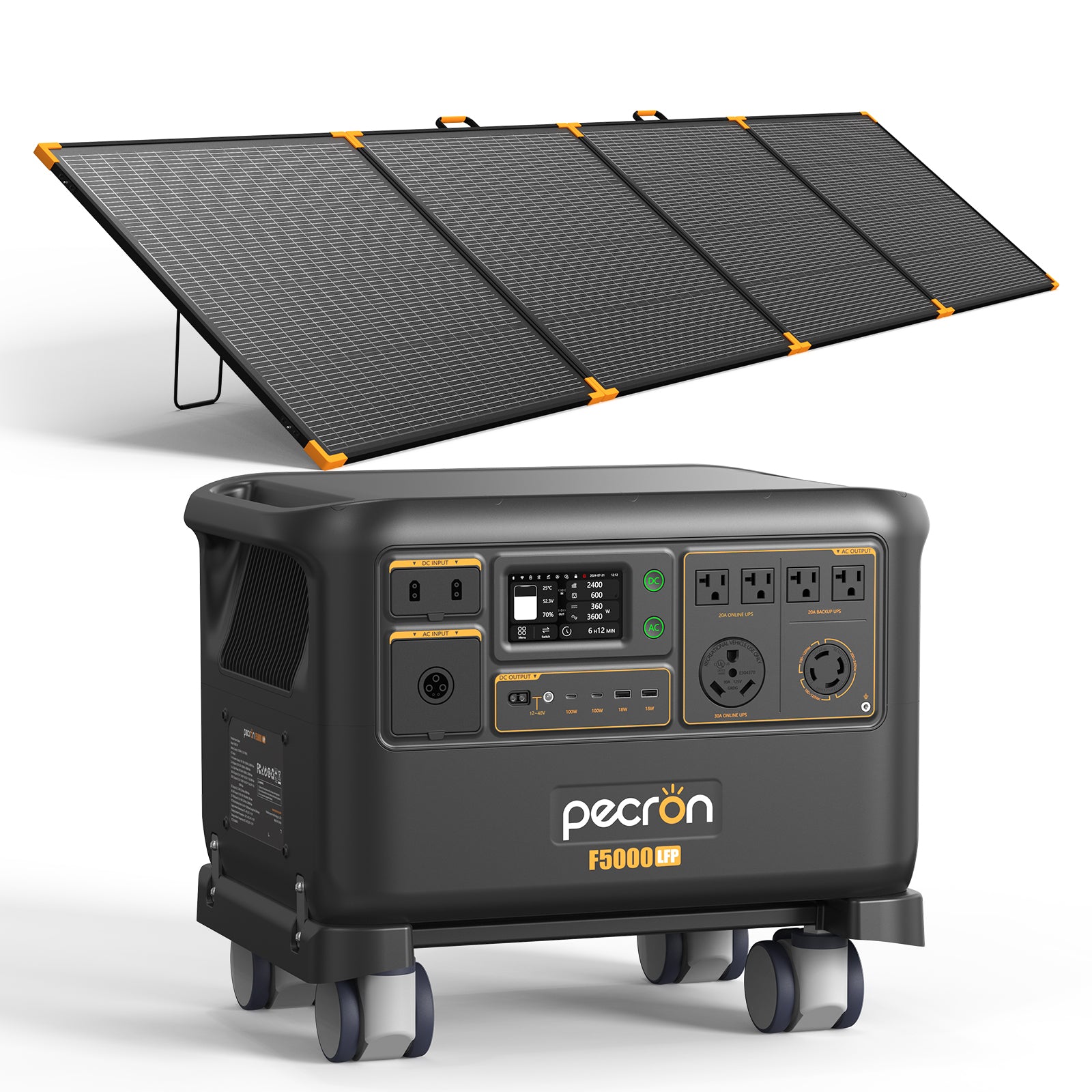
This is the selected F5000LFP package titled “F5000LFP+ PV500,” not a new station generation. Its exact U.S. variant is SKU F5000LFP-PV500, which identifies one PV500 panel alongside one F5000LFP. Pecron’s separate panel page labels the PV500 as a 500 W bifacial portable panel. That is a nameplate figure for the panel; it is not a charging-rate or recharge-time promise. The captured option was not marked available, so its recorded stock state is only a snapshot and should be checked again before purchase.
The station remains a large dual-voltage system
The F5000LFP supplies the main reason to choose this bundle: Pecron specifies 5,120 Wh of battery capacity, up to 3,600 W at 120 V, and up to 7,200 W at 240 V from the single station. That combination can fit a planned 240 V load which a smaller 120 V-only power station cannot serve. It does not make a home panel or transfer switch part of this package, and the 5,120 Wh nameplate capacity is not the same as energy delivered to an AC load. Plan the exact circuit, appliance starting demand, and reserve independently rather than reading a runtime from the headline capacity.
At about 123.9 lb for the station alone, this is not a carry-to-the-sunlight setup. A fixed backup area, garage staging point, or vehicle-supported location is more sensible than frequent hand transport. The selected image shows the station with one folding panel, but it cannot tell you the bundle’s total shipping weight or prove that the panel can be connected in a particular topology.
What one panel adds—and what it does not
One PV500 provides the smallest solar-panel complement in this five-option F5000/PV500 set. Its appeal is a defined panel-in-box choice without committing to a several-panel field layout. If a small panel supplement is enough for your plan, the single-panel count is easier to stage than the four-, six-, or eight-panel packages. If your essential requirement is a substantial daily recharge, this profile should not be assumed to meet it: the 500 W figure is the panel’s nominal rating under test conditions, and the manufacturer page does not provide a PV500 voltage, current, or bundle-specific harvest estimate in the materials captured here.
More importantly, the number on the panel does not change the station’s battery size or its AC output. Buying two, four, six, or eight panels adds nominal panel capacity, not another F5000 battery. Conversely, selecting the one-panel package does not make the station a 500 Wh product. Keep the station’s battery, its solar input, and the included panel as three different figures when comparing options.
Check the electrical bridge before relying on solar
Pecron’s F5000 manual describes two XT60 solar inputs, a 30–180 V operating window, a 25 A limit, and a 3,200 W maximum for each input; Pecron’s page separately lists a 5,800 W maximum for the station alone and 6,400 W only with an extra battery. The standalone limit is the relevant one here. None of those station-side ratings establishes the PV500’s electrical values or the exact included wiring plan. The PV500 product page and selected bundle title establish the panel identity and 500 W rating, but the product materials captured for this review do not settle the panel connector, cable contents, or a supported all-panels array. Do not improvise series or parallel wiring from panel count or the package picture.
The F5000 manual’s packing list names two single-port XT60-to-MC4 solar charging leads for the station. That confirms a station-side lead in the F5000 box; it does not confirm that the PV500 uses MC4, that a particular bundle contains every required adapter, or that all supplied panels are meant to run together. If a complete ready-to-connect solar setup is essential, ask Pecron for the PV500 output specification and the exact package wiring diagram before treating this option as a fit.
How the questionnaire changes the shortlist
This listing can satisfy a need for the station’s published 120 V or 240 V AC output, its 5,120 Wh capacity, solar-input capability, and a panel explicitly included in the selected offer. An advanced minimum of 500 W of supplied panel nameplate or one included panel is also grounded in the exact SKU and panel page. But a requirement that every supplied panel be proven to work together should remain a no-match until Pecron documents the PV500 array and cable plan. A maximum station-weight question should use the 123.9 lb F5000 figure; the combined weight of this station and its PV500 panel is not confirmed.
Who should choose this option?
Consider this package when the F5000’s unusually high 240 V rating is the primary need and one identified panel is a useful extra rather than a guaranteed whole-system solar solution. Compare it with the F5000 plus two PV500 panels if you want a larger nominal panel bundle, or with the 4-, 6-, and 8-panel offers only if you have the space and a verified connection plan. If your decision depends on panel output at a particular time, total transport weight, or every included panel charging the station together, those unanswered details matter more than the 500 W label. Until they are confirmed, treat the PV500 as an included named component and the F5000 as the independently documented power station.
Key details at a glance
| Nameplate battery capacity | 5120 Wh |
|---|---|
| Rated AC output | 7200 W |
| Maximum solar input | 5800 W |
| Included panels, combined nameplate | 500 W |
| Maximum USB-C output per port | 100 W |
| Listed weight | 123.9 lb |
More specifications and setup details
| Compatible extra-battery expansion | Yes |
|---|---|
| Maximum AC recharge input | 3600 W |
| Manufacturer UPS transfer figure | 20 ms |
| Total rated DC output | 800 W |
| AC outlet output | Yes |
| USB-C ports | 2 |
| USB-A ports | 2 |
| Solar input ports | 2 |
| Battery chemistry | LiFePO4 |
| Expansion battery in this package | No |
| Home Power Panel in this package | No |
| Separate station units in offer | 1 |
| Smart Transfer Switch in this package | No |
| Solar panels in exact offer | 1 |
Use the exact model’s instructions for operating limits, supplied equipment and version differences.
Sources for this assessment

A useful match starts with the loads that matter.
Use the finder for hard electrical requirements, then check appliance starting behavior, actual run time and the exact package in the full assessment.