
Your needs, this model
Does it fit your priorities?
Do you need 240 V from one station rather than a paired setup?
One F5000 station is listed for up to 7,200 W at 240 V. Its 240 V outlet has a floating neutral in battery mode.
Explore this need in the finder →Will a TT30-R 120 V output group meet your RV plan?
Pecron lists TT30-R at 3,600 W; verify the exact loads and connection plan.
Explore this need in the finder →Is a 5,800 W single-unit solar ceiling and FP5000 expansion system appropriate?
One station is listed at 5,800 W solar input; 6,400 W requires an extra battery. Up to six FP5000-48V packs are documented.
Explore this need in the finder →Pecron · single-unit 120/240 V system
Pecron F5000LFP review
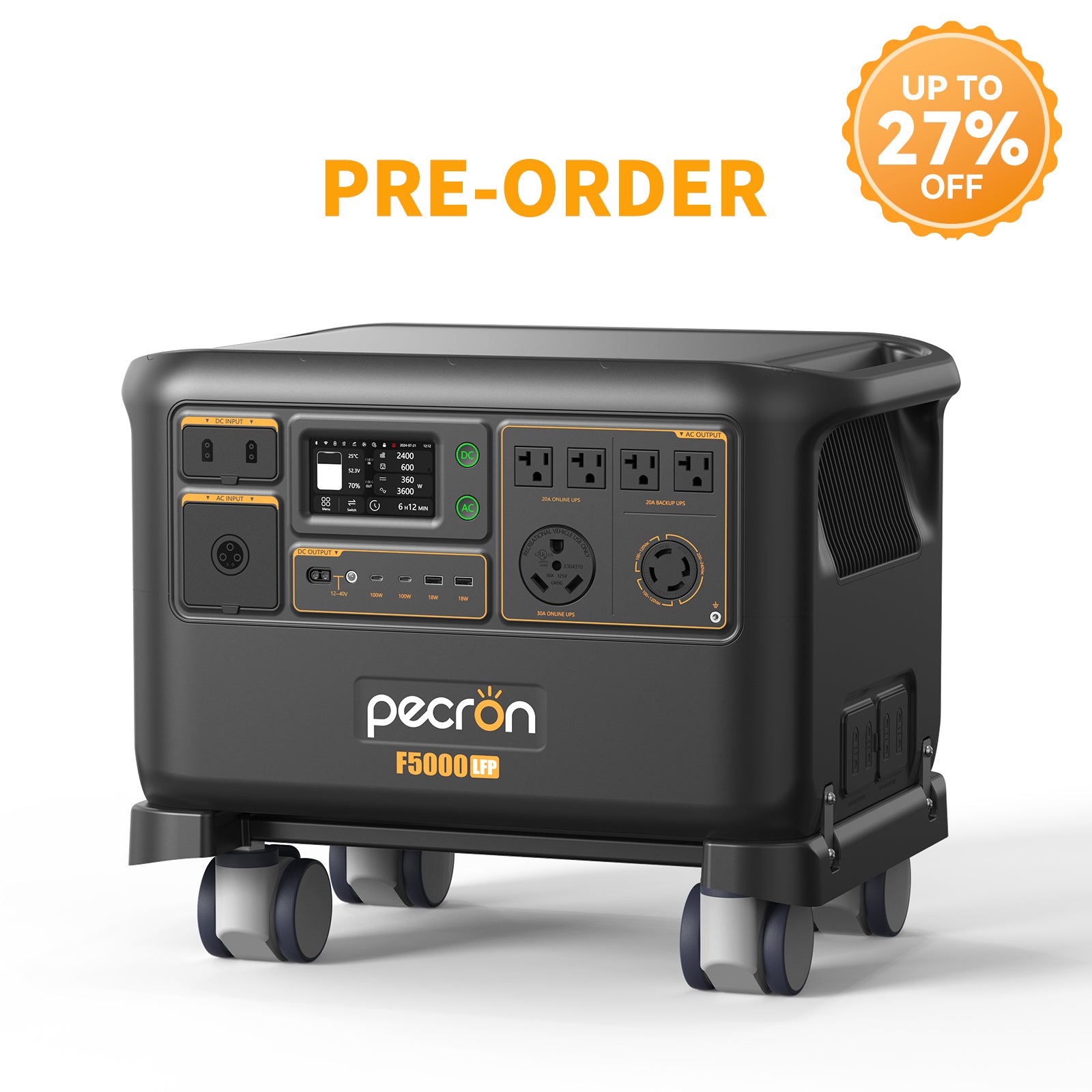
The F5000LFP is a different class of product from the smaller portable stations in Pecron's lineup: a 5,120 Wh battery, up to 7,200 W output and a true 120/240 V operating capability in one heavy wheeled unit. It is designed for serious backup loads and larger energy systems, not a lightweight trip. The manufacturer lists about 123.9 lb before accessories. Its 240 V output, neutral behavior, expansion system and high-power wiring deserve a planned installation, not an improvised extension-cord setup.
Single-station 240 V is the defining difference
Pecron describes 100–120 V output with two 3,600 W groups and a 200–240 V dual-phase output rated up to 7,200 W. The product page lists NEMA 5-20R groups and a TT-30R section rated at 3,600 W, so a TT-30 receptacle is available in this configuration. It is still essential to check the exact load, branch limits and outlet grouping; the total station rating does not mean one ordinary receptacle can supply 7,200 W. For a 120 V plan, review the actual outlet and circuit distribution rather than treating the 240 V aggregate as per-outlet capacity.
The manual and product page call out a floating neutral on the 220–240 V output while operating on battery. Pecron says the UPS mode follows the incoming AC neutral bonding state. That is a material electrical detail for anyone considering a home panel, transfer switch or grounded load. Use only an appropriate transfer arrangement installed according to local code by a qualified electrician; do not backfeed a household circuit or assume a neutral bond is universal.
Massive recharge input and compatible expansion
The page lists two XT60 solar inputs, each up to 3,200 W, for up to 5,800 W on one station and up to 6,400 W with an extra battery. It gives a 30–180 V window and a 25 A maximum per input. Those are unusual input ceilings, but they make array voltage, current, fusing and connectors especially important. The base F5000LFP option does not include solar panels; separate selected offers combine PV500 panels or expansion batteries. The page currently advertises a free trolley and 30 A AC cable during the pre-order, but those offer terms can change, so verify the exact SKU and package contents.
The station supports up to six FP5000-48V expansion batteries, reaching a stated 35.8 kWh. Pecron explicitly cautions against long-term use of EP3000-48V or EP3800-48V packs with this station because of possible overheating and disconnection. This is not a generic “any 48 V battery” expansion port: use the documented FP5000 pack family and the current F5000 manual. The LiFePO4 pack is rated by Pecron at 4,000-plus cycles to 80%, and the company claims a 3+2-year warranty. Those published claims are not an independent test or a substitute for checking registration conditions.
What the ports and charging claims mean
Other listed features include two 100 W USB-C ports, two 18 W USB-A ports and a DC output adjustable from 12 to 40 V, with a combined 800 W maximum. Because Pecron does not publish a separate 12 V current limit for that variable output, this review does not treat it as a rated 12 V car-style outlet. That distinction matters if a 12 V DC connection is essential.
AC charging is listed at up to 3,600 W with the 30 A lead or 1,800 W on a 15 A lead. The manufacturer advertises 0 ms operation in online UPS mode and an 8–20 ms interval in backup mode; those are different paths, not one universal transfer figure. The manual also describes battery heating and the screen/app's operating logs. Consult the [F5000LFP manual](https://cdn.shopify.com/s/files/1/0509/5263/4556/files/PECRON_F5000_LFP_user_manual_100V_120V_-202608.pdf?v=1789528324), then verify the exact load's tolerance and the required electrical installation. Published maximums are not measured runtime, instantaneous surge success or a guarantee that every household circuit can be powered at once.
Who should choose a smaller model?
The F5000LFP is worth considering when a single station must provide 240 V or a large 120/240 V output plan and the user can accommodate a 124 lb wheeled machine. It is overbuilt for laptop charging or a few lights, and its weight alone makes it a poor option for frequent lifting. A suitable install may also require a professional assessment of the home circuits, neutral/grounding behavior, transfer equipment and cable capacity. The standalone offer does not itself include a home transfer switch.
If your essentials are ordinary 120 V loads, the E3800LFP gives 3,840 Wh and 4,200 W from one station but needs a second unit plus a 240 V box for 240 V output. The F3000LFP is smaller at about 63 lb with 3,072 Wh and 3,600 W, but it is a 120 V model. Do not select the F5000 solely for its 7,200 W headline; choose it only if the dual-voltage plan, carefully matched expansion and installation needs justify the size. The current product page marks the offer as pre-order, so check shipment status and support details before relying on it for a dated emergency plan.
Key details at a glance
| Nameplate battery capacity | 5120 Wh |
|---|---|
| Rated AC output | 7200 W |
| Maximum solar input | 5800 W |
| Included panels, combined nameplate | 0 W |
| Maximum USB-C output per port | 100 W |
| Listed weight | 123.9 lb |
| Compatible extra-battery expansion | Yes |
| Maximum AC recharge input | 3600 W |
| Manufacturer UPS transfer figure | 20 ms |
| Total rated DC output | 800 W |
| AC outlet output | Yes |
| USB-C ports | 2 |
| USB-A ports | 2 |
| Solar input ports | 2 |
| Battery chemistry | LiFePO4 |
| Expansion battery in this package | No |
| Home Power Panel in this package | No |
| Separate station units in offer | 1 |
| Smart Transfer Switch in this package | No |
| Solar panels in exact offer | 0 |
Use the exact model’s instructions for operating limits, supplied equipment and version differences.
Sources for this assessment

A useful match starts with the loads that matter.
Use the finder for hard electrical requirements, then check appliance starting behavior, actual run time and the exact package in the full assessment.