
Your needs, this model
Does it fit your priorities?
Does the station itself fit a 120 V AC load needing 2,400 W continuous and 2,048 Wh nameplate?
Yes at the published station limits; the panel title does not change battery capacity, inverter rating or delivered energy.
Explore this need in the finder →Does the title alone confirm its 120 W panel in the shipped package?
No. The selected offer title advertises 120 W panel included, but its Package Includes list names the station and two cables only. Panel inclusion/model/wattage remain unknown and cannot meet an essential requirement.
Explore this need in the finder →Can I require the station solar input without assuming the listed panel is verified?
Yes. The station manual confirms a 12–60 V, 25 A, 1,200 W input; the page’s package list still does not confirm the panel or cable.
Explore this need in the finder →Does the station have a 12 V DC outlet budget independent of the panel?
Yes, 120 W combined across the cigarette-lighter and DC6514 outputs.
Explore this need in the finder →This U.S. listing is titled “PowerStation 2000 Solar Generator Kit — 120W Panel Included.” Its selected Shopify product is 8322712666227, variant 45235578175603 and SKU RPS2024AA-PCS-120-US. The unit in the package is the same RPS2024AA PowerStation 2000 assessed in the standalone review: 2,048 Wh of LiFePO₄ storage and 2,400 W of rated 120 V AC output. The configuration difference is the small panel advertised in this listing title, not a larger battery or inverter.
What is and is not verified about the package
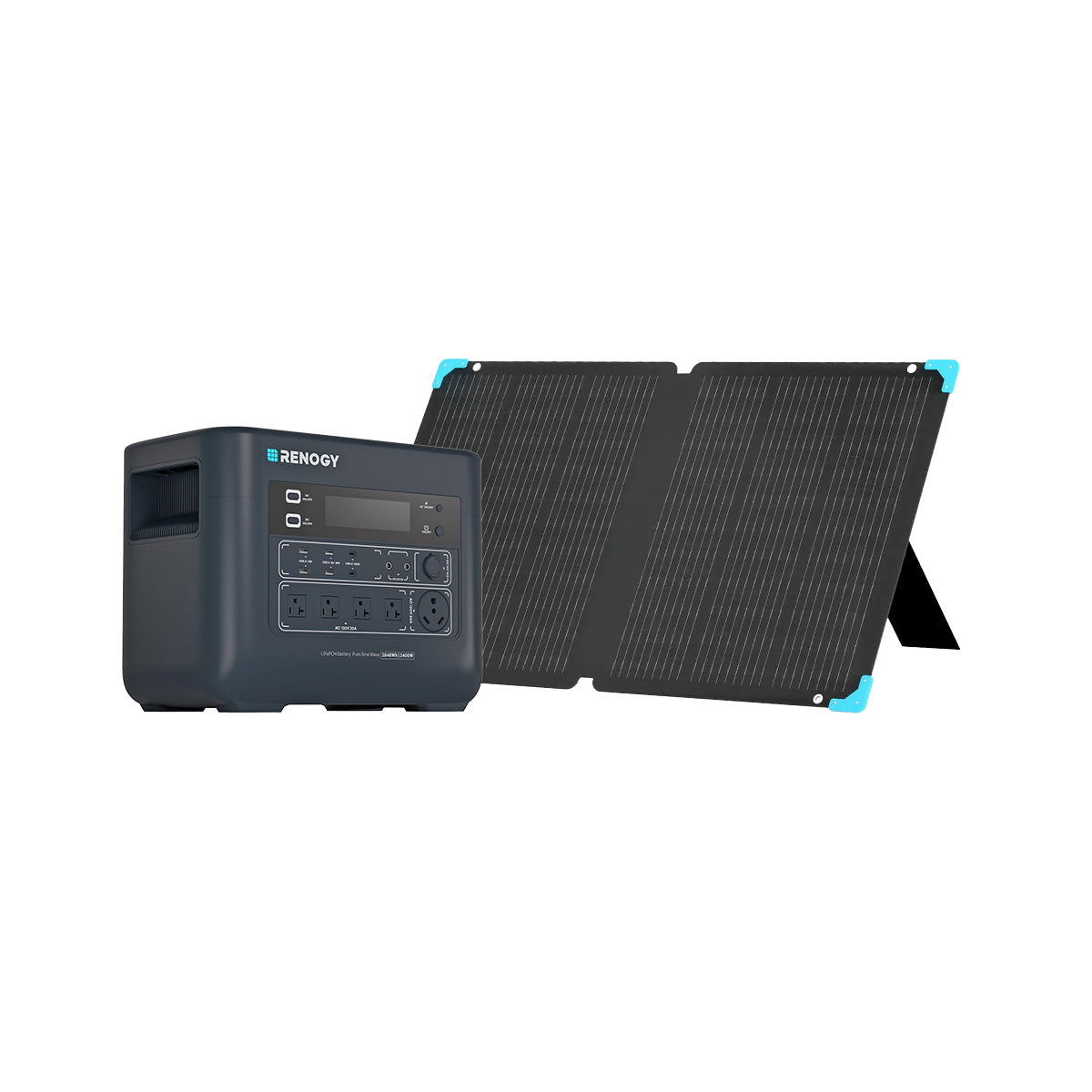
The title says a 120 W panel is included, and the selected product image depicts the station with a folding panel. The same product page’s “Package Includes” block, however, lists one PowerStation 2000, one AC power cable and one car-charge cable; it does not itemize the panel or its solar lead. Renogy’s A2 station manual separately says the solar charging cable is not included with the station. Because the page’s title and image point one way while its enumerated box contents omit the panel, I do not treat the panel, its exact model, or a complete plug-and-charge solar setup as confirmed box contents. The exact listing identity is clear; the field a panel-dependent buyer needs is not.
That distinction affects the finder directly. This profile can meet a 120 V AC requirement, a 2,400 W continuous AC threshold, a 12 V DC need, or a requirement that the station accept solar. It will not pass the “panel must be supplied” or minimum included-panel-wattage questions. If those are essential, verify the precise selected SKU and what will ship with Renogy before purchase rather than taking the title or illustration as an itemized packing list. A known model with unknown package contents is more useful than silently turning a bundle image into a tested capability.
The station remains a 2 kWh-class 120 V unit
Its 2,048 Wh is nameplate battery storage, not guaranteed AC energy delivered to a load. The five AC receptacles share a 2,400 W output ceiling at 120 V; the TT-30 receptacle is useful for a compatible RV connection but the station is not a 30 A source. The page’s “3,600 W surge” figure does not reconcile neatly with the A2 manual’s “4,800 W peak” specification, so this review does not count either as a verified surge threshold. Running watts, startup demand and the RV’s combined loads matter more than the faceplate or connector style.
The 12 V cigarette-lighter and two DC6514 outputs share a 120 W combined limit, so a buyer should not sum the printed per-port maximums. Two USB-C outputs can deliver up to 100 W apiece when the connected device and cable support the required profile. These are useful port choices for small electronics and compatible low-voltage accessories, but the box’s advertised panel does not change the station’s inverter output, stored energy, or solar-input limit.
Panel nameplate is not recharge performance
The station’s DC input accepts 12–60 V and up to 25 A, with 1,200 W maximum input. The listing title’s 120 W value is only the panel nameplate claim, not expected daily harvest or a promise of a particular recharge time. Shade, orientation, season, temperature, cable losses and the station’s charge controls all affect what reaches the battery. The page does not identify the panel model or its voltage/current values, so I cannot verify the wiring against the station input window from this product record alone. A separate panel source might establish compatibility, but I will not infer a match from wattage alone.
The manual’s solar cable warning also matters: a panel can be physically pictured without the exact station lead being itemized in the chosen offer. Ask whether the SKU supplies a compatible adapter/cable, and check the panel’s open-circuit voltage before connecting anything. Do not assume the 1,200 W station ceiling is a recommendation to combine other panels or to use a series arrangement.
Carrying and backup tradeoffs
The station alone weighs 51.81 lb and is about 17.72 × 10.46 × 13.74 in. The bundle’s total lifting weight is not stated; it would include anything actually shipped beyond the station, so the station weight is not a kit-weight estimate. Charging temperatures are 32–104°F, and discharge is specified for 14–104°F. Renogy says its EPS transfer is below 20 ms and limits EPS output to 1,800 W; the manual warns against equipment requiring a faster transfer. This may be suitable for routine outage loads after checking their ratings, but it is not a universal uninterrupted-power source for sensitive IT or medical equipment.
Who should look at it?
The title makes this offer relevant to someone comparing a pre-selected station-and-small-panel package, especially for a parked RV, shed or occasional outdoor setup. But if panel inclusion is the reason to choose this SKU, pause at the missing item in the box list: this assessment leaves that essential attribute unknown by design. If the panel is optional and the station’s 120 V/2,400 W and 2,048 Wh plan fits, the standalone review offers the clearest supply list, while a different confirmed package may give you the extra solar hardware you expect. For 240 V loads, a true 30 A RV service, verified higher surge or a confirmed extra-battery system, choose another architecture. No price, runtime test or stock promise is inferred here.
The exact U.S. selected-option page and product JSON, Renogy’s PowerStation 2000 A2 manual, and the image linked to the 120 W offer were individually inspected. The page title and image advertise a 120 W panel, but its box list omits it; included-panel facts remain unknown.
Key details at a glance
| Nameplate battery capacity | 2048 Wh |
|---|---|
| Rated AC output | 2400 W |
| Maximum solar input | 1200 W |
| Maximum USB-C output per port | 100 W |
| Listed weight | 51.81 lb |
| 12 V DC output | 120 W |
| Manufacturer UPS transfer figure | 20 ms |
| Total rated DC output | 380 W |
| AC outlet output | Yes |
| USB-C ports | 2 |
| USB-A ports | 4 |
| 12 V car-style output | 120 W |
| Battery chemistry | LiFePO4 |
Use the exact model’s instructions for operating limits, supplied equipment and version differences.
Sources for this assessment
A useful match starts with the loads that matter.
Use the finder for hard electrical requirements, then check appliance starting behavior, actual run time and the exact package in the full assessment.