
Your needs, this model
Does it fit your priorities?
Does the station itself fit a 120 V AC load needing 2,400 W continuous and 2,048 Wh nameplate?
Yes at the published station limits; the panel title does not change battery capacity, inverter rating or delivered energy.
Explore this need in the finder →Does the title alone confirm its 220 W panel in the shipped package?
No. The selected offer title advertises 220 W panel included, but its Package Includes list names the station and two cables only. Panel inclusion/model/wattage remain unknown and cannot meet an essential requirement.
Explore this need in the finder →Can I require the station solar input without assuming the listed panel is verified?
Yes. The station manual confirms a 12–60 V, 25 A, 1,200 W input; the page’s package list still does not confirm the panel or cable.
Explore this need in the finder →Does the station have a 12 V DC outlet budget independent of the panel?
Yes, 120 W combined across the cigarette-lighter and DC6514 outputs.
Explore this need in the finder →Renogy’s U.S. collection labels this offer “PowerStation 2000 Solar Generator Kit — 220W Panel Included.” The product page resolves to product ID 8322651619443 and variant 45235462897779, but its option JSON exposes no package SKU. The base unit is the PowerStation 2000 RPS2024AA: 2,048 Wh nameplate LiFePO₄ capacity, 2,400 W rated AC output, and a 120 V U.S. plan. The listing title advertises a 220 W panel; it does not identify a component model code or a different station.
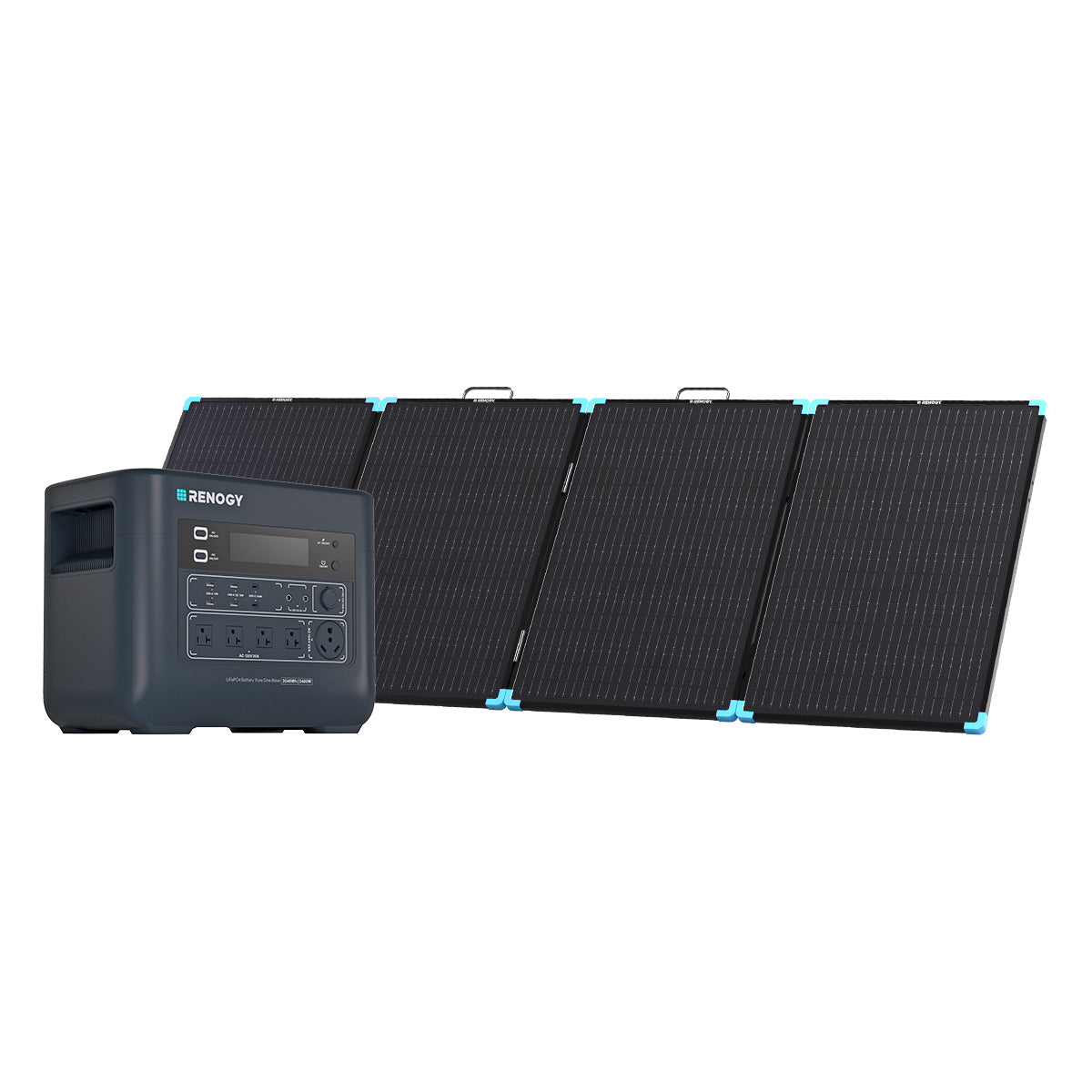
A precise listing, an incomplete box list
The offer title and its selected product image are clear about the advertised 220 W panel. Its own “Package Includes” section is less clear: it lists the PowerStation 2000, AC power cable and car-charge cable, while omitting the panel. The product option data has a unique product/variant identity but no SKU field. This is not enough to discard the exact offer or pretend it is a different station. It is enough to keep “panel included,” the component’s model and total shipped weight unknown. In particular, the station manual says the base model’s solar cable is not included; a panel-titled store page without an itemized solar lead does not establish a complete solar-ready kit.
For that reason, a hard questionnaire requirement for an in-box panel or at least 220 W of panel nameplate output will not return this profile as a confirmed match. The user can still compare it as the exact manufacturer listing and judge whether the unresolved package detail is acceptable after verifying with the seller. A matcher should not answer an essential requirement on the strength of a marketing title when the same page’s box list omits the component.
Same inverter and battery as the standalone PowerStation 2000
Nothing in the panel offer changes the station’s AC system. The five AC outlets share a 2,400 W maximum at 120 V; there is no 240 V/split-phase plan. The TT-30 outlet is convenient for an RV with a compatible connection, but 2,400 W at 120 V is 20 A, not a 30 A source. The unit’s 2,048 Wh is battery nameplate capacity, not guaranteed energy at the outlets. For a refrigerator, pump or cooking device, check both its running watts and startup demand rather than multiplying runtime from the nameplate.
Renogy’s current product page calls the starting figure 3,600 W surge, while the A2 user manual lists 4,800 W peak. I leave the surge fact unresolved because those terms are not reconciled in the official materials reviewed. The 12 V cigarette-lighter and DC6514 ports share 120 W total; two 100 W USB-C ports support compatible USB-PD equipment. These limits remain the same regardless of the panel wattage in the offer title.
What a 220 W panel claim can—and cannot—tell you
The station’s DC input is rated for 12–60 V, 25 A maximum and up to 1,200 W. A panel headline of 220 W is not the station’s charging speed or a promise that a particular amount of energy reaches the battery each day. Light, panel angle, shade, temperature, charge state and wiring affect actual harvest. The 220 W page does not identify the panel code or publish its operating-voltage window in the selected option record. Without those values and the exact cable, compatibility cannot be independently verified here.
The title’s 220 W is more than the 120 W offer’s advertised number and less than the 400 W package claim, but wattage alone is not a complete choice. A buyer who values confirmed kit contents should prioritize an itemized bill of materials, station connector and total carried weight over a larger headline. I do not claim that the image proves the panel is included; it is a source illustration tied to the selected page, not a packing slip.
Carry, temperature and backup planning
The PowerStation itself weighs 51.81 lb and measures 17.72 × 10.46 × 13.74 in. The 220 W bundle’s combined weight and packing dimensions are unknown, so expect a separate panel to take additional space but do not use the station-only weight as the package total. Charging is specified for 32–104°F and discharging for 14–104°F. The EPS mode transfers in under 20 ms, but the manual limits it to 1,800 W and tells users to check connected equipment’s hold-up requirements. This is a consideration for common household outage loads, not a claim that every computer, server or sensitive load will remain uninterrupted.
Who might choose this page?
It is worth comparing if you want one exact store option around the PowerStation 2000 and are considering a mid-sized panel on the same order. It is not yet a verified answer for someone who must receive a 220 W panel and compatible cable in the box. The standalone review is the clean choice if you only want the station and will source solar hardware separately; another properly itemized station-and-panel bundle is preferable when package contents are essential. This offer does not solve 240 V, a full 30 A RV feed, surge above 2,400 W continuous, or a documented extra-battery expansion requirement. The review uses official Renogy page and manual information, not an independent runtime measurement.
Renogy’s U.S. collection, selected 220 W offer page/product JSON, PowerStation 2000 User Manual version A2 and the option-linked product image were inspected. The page title advertises a panel while the package list does not itemize it; panel and accessory attributes remain unknown.
Key details at a glance
| Nameplate battery capacity | 2048 Wh |
|---|---|
| Rated AC output | 2400 W |
| Maximum solar input | 1200 W |
| Maximum USB-C output per port | 100 W |
| Listed weight | 51.81 lb |
| 12 V DC output | 120 W |
| Manufacturer UPS transfer figure | 20 ms |
| Total rated DC output | 380 W |
| AC outlet output | Yes |
| USB-C ports | 2 |
| USB-A ports | 4 |
| 12 V car-style output | 120 W |
| Battery chemistry | LiFePO4 |
Use the exact model’s instructions for operating limits, supplied equipment and version differences.
Sources for this assessment
A useful match starts with the loads that matter.
Use the finder for hard electrical requirements, then check appliance starting behavior, actual run time and the exact package in the full assessment.