
Your needs, this model
Does it fit your priorities?
Does the station itself fit a 120 V AC load needing 2,400 W continuous and 2,048 Wh nameplate?
Yes at the published station limits; the panel title does not change battery capacity, inverter rating or delivered energy.
Explore this need in the finder →Does the title alone confirm its 400 W panel in the shipped package?
No. The selected offer title advertises 400 W panel included, but its Package Includes list names the station and two cables only. Panel inclusion/model/wattage remain unknown and cannot meet an essential requirement.
Explore this need in the finder →Can I require the station solar input without assuming the listed panel is verified?
Yes. The station manual confirms a 12–60 V, 25 A, 1,200 W input; the page’s package list still does not confirm the panel or cable.
Explore this need in the finder →Does the station have a 12 V DC outlet budget independent of the panel?
Yes, 120 W combined across the cigarette-lighter and DC6514 outputs.
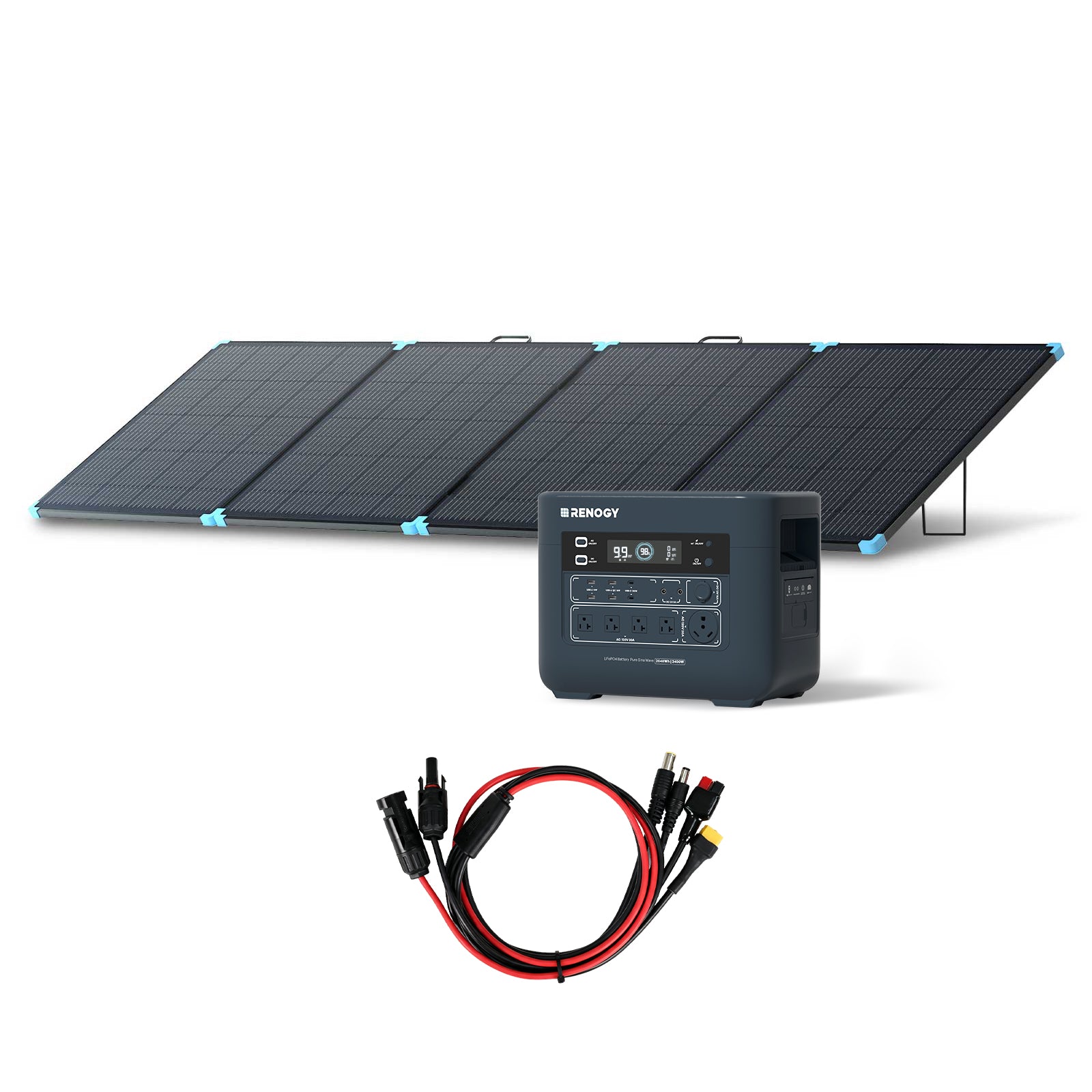
Explore this need in the finder →The U.S. PowerStation 2000 Solar Generator Kit — 400W Panel Included is the most specifically coded of Renogy’s three current panel-titled PowerStation 2000 offers. Its selected option is product 8407780458611, variant 45515558912115, SKU RPS2024AA-PCS-400LSC-RPC0418EF-US. The suffix identifies the panel component code RPC0418EF, and the page-linked image depicts the station, a folding panel and charging leads. The base station remains the 2,048 Wh RPS2024AA, with 2,400 W rated 120 V AC output; this is not a larger-capacity or higher-inverter model.
Why the source conflict matters here
Renogy’s page title says a 400 W panel is included, and the selected offer has a distinct SKU that includes the string RPC0418EF. The image associated with that exact page shows the station, a large folding panel and leads. But the same page’s “Package Includes” list names only the PowerStation 2000, AC power cable and car-charge cable; it does not enumerate the panel or the pictured solar leads. The base station’s A2 manual also says the solar charging cable is not included with that station. Those sources do not let me confirm whether the kit-specific list is simply incomplete or whether every pictured accessory ships with the selected option.
I preserve this as an exact product-page and SKU reference, not as an unverified product identity. The panel’s wattage, model code and image are recorded as listing/image evidence; the matcher’s `solar_panel_included` and `included_solar_panel_w` remain unknown because the itemized in-box specification omits the panel. A buyer who needs the named panel or a compatible lead should ask Renogy to confirm the contents attached to this exact SKU before relying on the kit. The present product name is not a substitute for a verified packing list.
What the station itself can support
Renogy lists a 2,048 Wh LiFePO₄ battery, five 120 V AC outlets and 2,400 W maximum combined AC output. A TT-30 receptacle can simplify a compatible RV connection, yet it does not provide 30 A service: the stated limit is 2,400 W at 120 V, or 20 A. The advertised capacity is stored nameplate energy, not an AC-delivered-energy guarantee or a runtime estimate. A load spreadsheet should account for running watts, startup demand and the station’s conversion losses; the unit should not be used as a bridge to a 240 V appliance.
For high-starting loads, Renogy’s product page says 3,600 W surge, whereas its A2 manual says 4,800 W peak. I do not collapse these manufacturer terms into a single verified surge rating. The ordinary finder therefore compares this profile on its 2,400 W continuous limit and leaves surge unknown. That cautious choice is especially relevant when the entire point of choosing a 400 W panel kit is to run demanding gear: the panel does not raise the inverter ceiling.
Direct outputs include two standard USB-A ports, two Quick Charge USB-A ports, two 100 W USB-C ports, a cigarette-lighter port and two DC6514 ports. Renogy’s manual caps the cigarette-lighter and DC6514 group at 120 W total. The plan gives 12 V accessories and USB-C devices a separate option from the AC outlets, but it does not license adding each port’s maximum or assume that a device with a matching plug is within its electrical limit.
400 W panel versus 1,200 W input ceiling
If Renogy confirms the titled panel is supplied, its 400 W nameplate would be only one third of the station’s 1,200 W maximum solar-input rating. The input is limited to 12–60 V and 25 A; a 1,200 W ceiling does not mean that the included panel produces 1,200 W. Neither this offer page’s package block nor the manual establishes the exact panel’s voltage/current data or the kit’s full lead set in the checked text. The selected SKU’s `RPC0418EF` component code is useful for a direct support question. Do not connect a panel solely because its wattage is lower than the station input maximum—verify voltage, current, polarity and cable compatibility.
The station alone is 51.81 lb, but Renogy does not publish a combined package weight in the material checked. A large folding panel and cable set add space and handling tasks; the picture is an image of the offered composition, not evidence that every pictured lead is in the box. For a mobile setup, consider where the panel will unfold in sunlight while the station stays dry and ventilated. Solar charging is not an automatic weatherproofing feature for the power station.
Who should compare this option?
It is the most interesting of the three panel-titled listings for a buyer already focused on a high-panel-wattage bundle and able to verify code RPC0418EF, box list and station-side cable. It is not the safest no-questions-asked pick when panel inclusion is a hard requirement, because the page’s own inclusion list conflicts with the title. If you already own an array or want only the station’s 120 V/2,400 W system, the standalone SKU is easier to evaluate. If another wattage title better fits your storage or carrying plan, its package still needs the same itemized check.
There is no confirmed 240 V plan, full 30 A RV current, additional-battery configuration or resolved surge figure here. The EPS mode is specified under 20 ms but capped at 1,800 W; sensitive equipment that needs a faster transfer should not depend on it without checking its hold-up time. These are exact-source-based decision limits, not bench results. No purchase price, stock promise or independent test is claimed.
The Renogy U.S. selected offer page and product JSON identify the SKU and option; its image gallery, package list and A2 PowerStation 2000 manual were inspected separately. The itemized package list does not resolve the panel and cable discrepancy, so those essential included-item facts remain unknown.
Key details at a glance
| Nameplate battery capacity | 2048 Wh |
|---|---|
| Rated AC output | 2400 W |
| Maximum solar input | 1200 W |
| Maximum USB-C output per port | 100 W |
| Listed weight | 51.81 lb |
| 12 V DC output | 120 W |
| Manufacturer UPS transfer figure | 20 ms |
| Total rated DC output | 380 W |
| AC outlet output | Yes |
| USB-C ports | 2 |
| USB-A ports | 4 |
| 12 V car-style output | 120 W |
| Battery chemistry | LiFePO4 |
Use the exact model’s instructions for operating limits, supplied equipment and version differences.
Sources for this assessment
A useful match starts with the loads that matter.
Use the finder for hard electrical requirements, then check appliance starting behavior, actual run time and the exact package in the full assessment.