
Your needs, this model
Does it fit your priorities?
Does this station fit a 120 V AC setup needing 2,400 W continuous output and 2,048 Wh nameplate?
Yes for one 120 V / 2,400 W plan and 2,048 Wh nameplate; delivered energy and runtime are not guaranteed.
Explore this need in the finder →Does this exact standalone package confirm an included panel?
No. Its box list names the station, AC cable and car-charge cable; the manual says the solar cable is separate.
Explore this need in the finder →Is the station’s solar input useful even when the panel is separate?
Yes. The manual rates the input up to 1,200 W at 12–60 V and 25 A; panel and compatible lead remain separate.
Explore this need in the finder →Does it have a 12 V DC outlet budget for a compatible accessory?
Yes, up to 120 W shared across the cigarette-lighter and DC6514 outputs.
Explore this need in the finder →Renogy’s U.S. PowerStation 2000 (station SKU RPS2024AA-PCS-US) is a compact-in-form but substantial-in-weight 2,048 Wh LiFePO₄ station. Its clearest strengths are a published 2,400 W continuous 120 V AC limit, a TT-30 receptacle, and a solar-input ceiling high enough to make a separately sourced array useful. The official page and version A2 manual also leave some decision-critical details less tidy than the headline suggests: a 3,600 W “surge” on the page versus a 4,800 W “peak” in the manual, and an optional solar cable that is not in the standalone box.
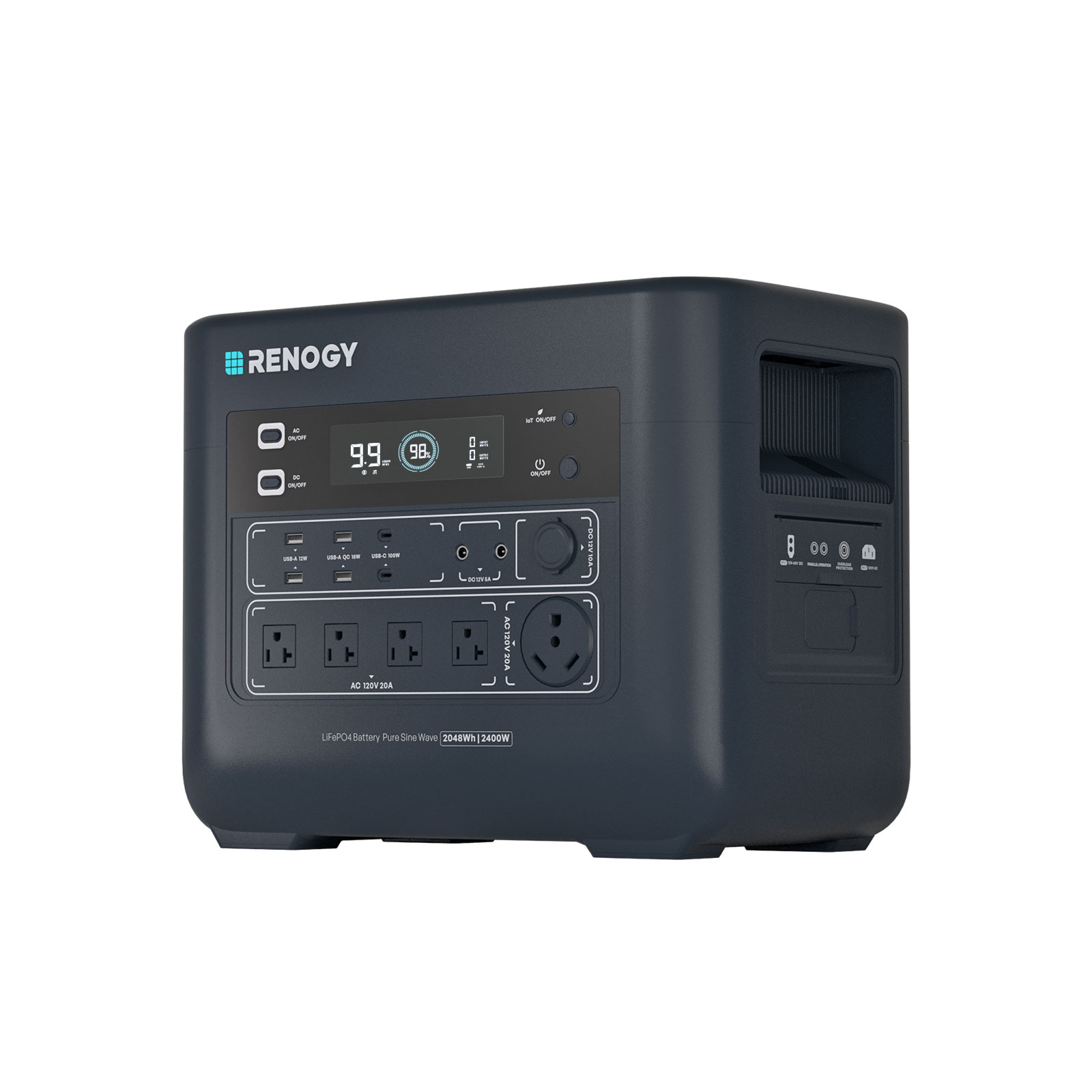
One station-wide power budget
The manufacturer specifies 2,048 Wh of nameplate battery capacity from a 51.2 V, 40 Ah LiFePO₄ pack and 2,400 W total AC output at 120 V. The page says five AC outlets; they share the same inverter ceiling, not 2,400 W apiece. A built-in TT-30 receptacle may make the station convenient for a compatible RV inlet, but its connector shape does not make it a 30 A, 120 V source: the published station limit is 2,400 W, or 20 A at 120 V. Check the RV’s actual loads and connection instructions, and do not treat an adapter as added capacity.
For starting loads, avoid treating two similar but differently named figures as interchangeable. The U.S. product page lists 3,600 W surge, while the A2 manual’s specification table says 4,800 W peak. That difference is not resolved by the material I inspected. The matching profile therefore relies on 2,400 W continuous output and does not pass a minimum-surge requirement. If a refrigerator compressor, pump or tool has a high inrush current, compare its starting demand with Renogy’s current written guidance for this exact unit before relying on it.
Useful direct ports, with a shared DC ceiling
There are two standard USB-A ports, two Quick Charge USB-A ports, two USB-C ports rated up to 100 W each, one 12 V cigarette-lighter outlet and two DC6514 ports. Renogy’s page and manual cap combined cigarette-lighter and DC6514 delivery at 120 W; do not add three individual port labels as if they were separate budgets. The 12 V outputs can serve compatible vehicle accessories, while USB-C is useful for supported laptops and devices. Check a device’s connector, voltage and maximum draw rather than choosing by plug shape alone.
Solar is supported, but the base box is not a solar kit
The station accepts 12–60 V DC at up to 25 A and 1,200 W through its DC input. That is a station-side ceiling, not a promise of 1,200 W from a panel or the amount you will harvest outdoors. The manual says the solar charge cable is not included and must be supplied by the user; the standalone package list names the station, AC power cable and car-charge cable, but no panel. Buyers who already have a compatible array should check open-circuit voltage, current, polarity and the exact lead before connecting it. Buyers who need a ready-to-use solar package should compare the separately titled panel offers and verify their itemized box contents; the kit pages need their own caution in the linked reviews.
Backup mode and operating conditions
Renogy specifies an EPS transfer time below 20 ms, with a maximum 1,800 W output in that mode. The manual warns not to use it for equipment that requires a transfer faster than 20 ms, such as some servers or workstations; check the load’s power-supply hold-up specification. This is emergency backup, not a reason to assume a sensitive computer will ride through every interruption. The AC charging input is listed at 100–120 V and 15 A maximum. The manual says a full AC recharge takes about 90 minutes, while vehicle charging is limited to 8.5 A and takes roughly 20.5 hours from empty; those are manufacturer conditions, not a guarantee for every circuit, temperature or starting state.
The station itself weighs 51.81 lb and measures about 17.72 × 10.46 × 13.74 in. Its manual gives 32–104°F for charging and 14–104°F for discharge. It is therefore a one-person lift for many people but not a featherweight camp accessory; keep it dry, ventilated and within temperature limits, and remember that the product’s stated power does not make it weatherproof. Renogy’s product page lists pass-through operation and app monitoring; the manual says app pairing needs a 2.4 GHz Wi-Fi network or Bluetooth setup.
Who should consider it?
This is a sensible candidate for a fixed RV stop, workshop, cabin or short household outage plan that fits within a single 120 V, 2,400 W inverter and 2,048 Wh nameplate battery. It is especially worth comparing if you value the built-in RV-style outlet or want a relatively large solar-input ceiling for a system you will wire carefully. It is a poor fit for a load that requires 240 V, a genuine 30 A RV source, a confirmed high surge above the continuous rating, or a verified additional-battery expansion path: none of those capabilities is established here. The product has ports described as parallel connections, but I do not assume that means compatible battery expansion or a supported higher-output household system.
Choose this standalone listing only if you are comfortable sourcing a compatible solar cable and panel separately, or you do not need solar. The questionnaire can confirm its 120 V AC, 2,400 W continuous, 2,048 Wh and 12 V DC facts; it does not infer runtime, AC-delivered watt-hours, panel inclusion or expansion from the product name. Compare the 120 W, 220 W and 400 W panel-titled offers only after checking their exact package lists. This assessment uses manufacturer specifications and instructions, not an independent runtime test or personal ownership claim.
Exact U.S. product page and option data were checked against Renogy SKU RPS2024AA-PCS-US; technical limits and the standalone box list were cross-checked against Renogy’s PowerStation 2000 User Manual, version A2. The competing peak/surge figures remain unresolved rather than treated as equivalent.
Key details at a glance
| Nameplate battery capacity | 2048 Wh |
|---|---|
| Rated AC output | 2400 W |
| Maximum solar input | 1200 W |
| Maximum USB-C output per port | 100 W |
| Listed weight | 51.81 lb |
| 12 V DC output | 120 W |
| Manufacturer UPS transfer figure | 20 ms |
| Total rated DC output | 380 W |
| AC outlet output | Yes |
| USB-C ports | 2 |
| USB-A ports | 4 |
| 12 V car-style output | 120 W |
| Battery chemistry | LiFePO4 |
Use the exact model’s instructions for operating limits, supplied equipment and version differences.
Sources for this assessment
A useful match starts with the loads that matter.
Use the finder for hard electrical requirements, then check appliance starting behavior, actual run time and the exact package in the full assessment.