
On this page
Your needs, this model
Does it fit your priorities?
Will your essential AC loads fit one 120 V plan rated to 2,000 W?
The U.S. manual specifies a 110–120 V, 2,000 W rated AC plan; six receptacles share that ceiling.
Explore this need in the finder →Do you require LiFePO4 chemistry and a station weight no higher than 42 lb?
The SBP1500 manual identifies LiFePO4 and lists about 41.45 lb; its wheels help only on smooth rolling surfaces.
Explore this need in the finder →Would an offline UPS with a published 13 ms handoff suit your equipment?
Zendure describes about 13 ms offline UPS operation, not zero-time or online UPS; verify device tolerance.
Explore this need in the finder →Must the exact offer include a solar panel?
No panel appears in the standalone product options or manual box list; the station has solar input but this is not a panel kit.
Explore this need in the finder →Must an expansion battery be supported and included?
The selected standalone offer includes no extra battery, and compatibility with an expansion battery is not established by the reviewed sources.
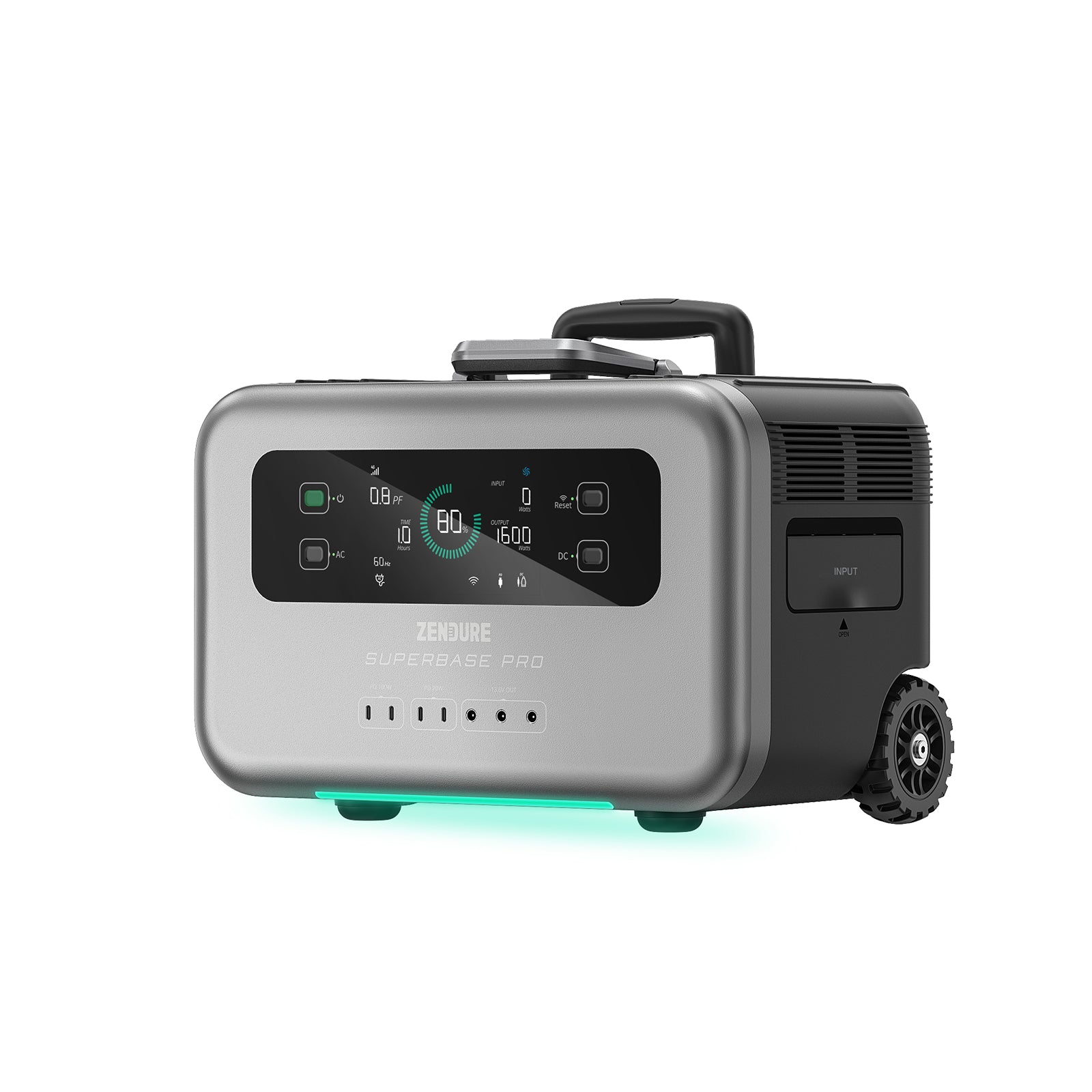
Explore this need in the finder →The Zendure SuperBase Pro 1500 (manual model SBP1500; U.S. SKU ZDSBP1500-BK-US) is a wheeled, 1,456 Wh station with a 2,000 W rated 120 V inverter and a LiFePO4 battery. It suits a planned campsite, garage or outage load that benefits from substantial AC output and can be rolled rather than carried far. The official U.S. selector showed this exact variant sold out when checked on October 26, 2026; availability can change, so this review is useful for comparison but not a claim of a live offer.
More inverter than its capacity number suggests
Capacity and output answer different questions. The 1,456 Wh battery describes nameplate stored energy; the 2,000 W rating is the continuous AC ceiling for the whole station. Neither figure promises a particular runtime. Conversion loss, standby draw, temperature, battery condition and the actual load all affect usable energy. If a refrigerator or tool has a large startup draw, check its label and behavior rather than assuming the 4,000 W surge rating will start every motor.
The U.S. manual lists six AC receptacles sharing the 2,000 W limit, four USB-C ports and three DC5521 outputs, plus a 12 V car-style outlet. Two USB-C ports are rated up to 100 W each; the other two share a 20 W maximum. The car socket and the DC5521 outlets share a combined 136 W limit, not 136 W each. This is useful for a mixed laptop, phone and 12 V setup, but the number of sockets does not create extra inverter capacity. The exact U.S. plan is 110–120 V; it is not a documented 240 V or split-phase source, and the listed outputs do not establish a TT-30 receptacle.
Solar input is flexible; panels are still separate
Zendure documents two solar routes: up to 600 W through the XT60 input at 12–60 V, and up to 1,800 W through the AC/PV input at 60–160 V. The manual states that the two MPPT inputs can work together up to 2,400 W total. Those are station limits, not a harvest or recharge-time promise; the array must stay within the voltage and current limits for its selected port. The manual's box diagram lists a 3 m MC4-to-XT60 lead and a 3 m MC4-to-AC lead, but no panel. It also says the car-charging cable is not included. A solar-capable station is not a solar kit.
AC input is rated up to 1,800 W, while the vehicle input supports 12 V or 24 V at 10 A. Those are different refill paths. Confirm connector compatibility before assembling an array or relying on vehicle charging; do not infer a complete system from the nameplate wattage of a separate panel.
Rolling mobility has a real lifting cost
At about 41.45 lb and 17.5 × 10.5 × 13.8 inches, the SuperBase Pro 1500 is a compact power cart rather than a light hand-carried battery. Zendure's product page shows a telescoping handle and built-in wheels, which help on a smooth driveway or garage floor; you still have to lift the full mass into a vehicle, over steps or across soft ground. Zendure's FAQ says the wheels are not replaceable, so treat them as part of the chassis rather than a serviceable accessory. The manual calls for dry storage and restricts charging to 32–104°F (0–40°C); its discharge range is −4–104°F (−20–40°C). Do not read the word portable as weatherproof or cold-charge capable.
Battery life and backup claims need context
The exact 1500 uses LiFePO4, not the NMC cells in the SuperBase Pro 2000. Its manual specification table lists 6,000 cycles, and its FAQ describes 6,000 cycles to 60% capacity. That is a manufacturer statement under its cycle definition, not a measured guarantee for every temperature, storage state or use pattern. Zendure lists a two-year warranty for this model; check the written terms for the exact seller and purchase date.
The manual describes an offline UPS transfer of about 13 ms. That is not a zero-time or online UPS, and the manual asks users to check device compatibility. A router may tolerate a brief handoff; do not assume sensitive computers, medical devices, life-support equipment or other safety-critical loads will. The app also exposes an AmpUp mode for some higher-wattage loads, but its manual explains that output behavior changes; it does not turn a 2,000 W rated inverter into a general-purpose 3,000 W continuous source.
Who should choose this model?
The Pro 1500 is the more appealing sibling when you want the same 2,000 W AC ceiling as the Pro 2000 but prefer LiFePO4, lower listed weight and a smaller battery. It is not the choice for a need to run 240 V equipment, add documented extra-battery capacity, receive a panel in the box, charge below freezing or carry a station for long distances. Its expansion capability is not established in the reviewed U.S. manual and listing, so an expansion requirement should rule it out until Zendure documents compatibility.
For a similar capacity with lower AC output, the Anker SOLIX F1500 is listed at 1,536 Wh, 1,800 W and 43.7 lb. If expansion is essential, compare a documented expandable system such as the EcoFlow DELTA 2 Max; it is heavier at 50 lb but has a 2,400 W rating and a published expansion route. These comparisons are about stated configurations, not hands-on tests. For this Zendure, verify present availability and the exact included leads before buying.
For the U.S. model identity and selected offer, see the Zendure SuperBase Pro product page. The SBP1500 U.S. user manual provides the port, charging, temperature and offline-UPS limits.
Key details at a glance
| Nameplate battery capacity | 1456 Wh |
|---|---|
| Rated AC output | 2000 W |
| Manufacturer surge rating | 4000 W |
| Maximum solar input | 2400 W |
| Included panels, combined nameplate | 0 W |
| Maximum USB-C output per port | 100 W |
More specifications and setup details
| Listed weight | 41.45 lb |
|---|---|
| 12 V DC output | 136 W |
| Maximum AC recharge input | 1800 W |
| Manufacturer UPS transfer figure | 13 ms |
| Base warranty term | 2 years |
| Total rated DC output | 136 W |
| AC outlet output | Yes |
| USB-C ports | 4 |
| USB-A ports | 0 |
| Solar input ports | 2 |
| Battery chemistry | LiFePO4 |
| Expansion battery in this package | No |
| Home Power Panel in this package | No |
| Separate station units in offer | 1 |
| Expansion packs in exact offer | 0 |
| Solar panels in exact offer | 0 |
Use the exact model’s instructions for operating limits, supplied equipment and version differences.
Sources for this assessment

A useful match starts with the loads that matter.
Use the finder for hard electrical requirements, then check appliance starting behavior, actual run time and the exact package in the full assessment.