
On this page
Your needs, this model
Does it fit your priorities?
Do you need at least 2,000 Wh and a 120 V AC inverter rated at 2,000 W?
The SBP2000 U.S. manual lists 2,096 Wh and a 2,000 W rated, 4,000 W surge inverter on 110–120 V AC.
Explore this need in the finder →Do you specifically want NCM battery chemistry rather than LiFePO4?
The exact SBP2000 manual specifies lithium-NMC cells; the Pro 1500 is a different LiFePO4 model.
Explore this need in the finder →Can your plan handle a 46.5 lb station with wheels?
The manual lists about 46.5 lb; the telescoping handle and wheels help rolling but not lifting into a vehicle.
Explore this need in the finder →Would an offline UPS with a published 13 ms handoff meet your limit?
Zendure describes about 13 ms offline UPS operation. It is not a zero-time UPS and should be checked with the actual load.
Explore this need in the finder →Must an expansion battery be supported and included?
The standalone option includes no extra battery, and the reviewed U.S. sources do not establish a compatible expansion system.
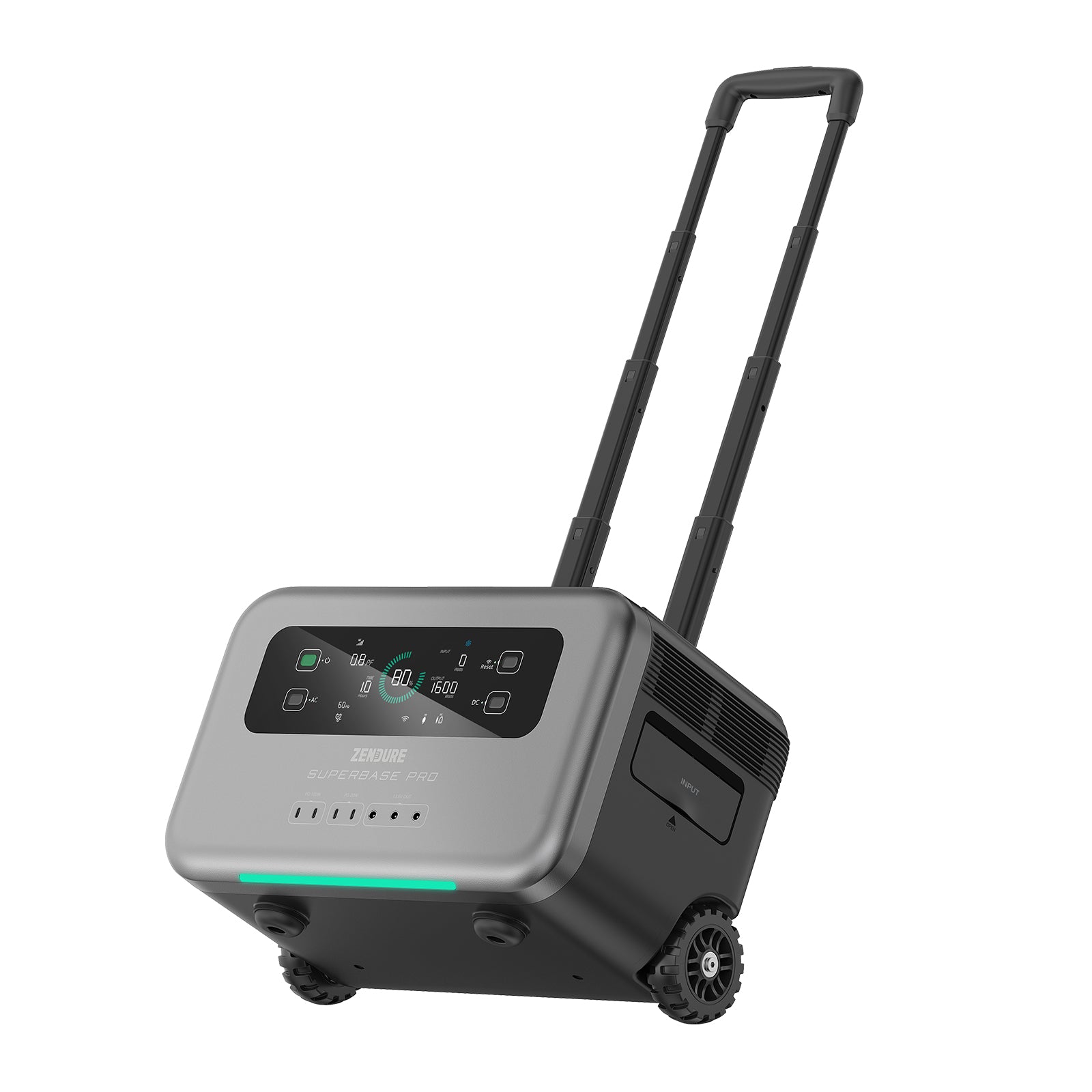
Explore this need in the finder →The Zendure SuperBase Pro 2000 is a 2,096 Wh, 2,000 W U.S. station built around a lithium-NMC battery, suitcase handle and wheels. Its appeal is a little more nameplate storage than many 2 kWh-class units plus two ways to feed solar into the charger. The trade is a 46.5 lb body, no confirmed expansion plan in the reviewed U.S. sources, and a current official listing that showed the exact SKU ZDSBP2000-BK-US sold out on October 26, 2026. Keep the model in comparisons, but check present availability before treating it as a purchase option.
Separate stored energy from the outlet limit
The 2,096 Wh figure is battery capacity, not promised AC-delivered energy. Inverter losses, standby draw, battery age, temperature and the connected load affect how long equipment runs. The continuous AC output is 2,000 W for the station as a whole, with a stated 4,000 W surge; six U.S. receptacles do not provide six independent 2,000 W circuits. Check both steady and startup draw. Zendure's AmpUp mode may support some higher-wattage loads by changing output behavior, but the manual still rates the ordinary inverter at 2,000 W. Do not use that mode as evidence of a universal 3,000 W continuous rating.
The U.S. manual lists four USB-C ports: two can reach 100 W each and the other pair shares a 20 W maximum. Three DC5521 outlets and the 12 V car-style socket share 136 W total. The listed U.S. AC range is 110–120 V, not 240 V split phase; no TT-30 output is listed. This profile can suit a device list that fits those exact limits, but it is not a substitute for checking a home's circuit plan or a motor's startup needs.
Two solar inputs, with a cable plan to verify
Zendure rates the XT60 solar input at up to 600 W over 12–60 V and its AC/PV input at up to 1,800 W over 60–160 V. The manual says both MPPT routes may be used together up to a 2,400 W total. That is a high published charging ceiling, but it depends on a compatible array and exact port limits; it is not a guarantee of sunlight, output or a specific charge time. The manual's in-box diagram shows a 3 m MC4-to-XT60 lead, a 3 m MC4-to-AC lead, an AC cord, a quick guide and a small accessory pouch. It does not list a solar panel, and it says the car-charging cable is not included. Treat the station and panel as separate purchases unless a seller identifies a different exact bundle.
The AC input is rated up to 1,800 W, and the vehicle input accepts 12 V or 24 V at 10 A. The manual cautions that vehicle recharging should be done with the engine running so the vehicle battery is not drained. An array must be designed around the selected station input, not simply connected because a panel plug fits.
NMC chemistry and an inconsistent life claim
The SuperBase Pro 2000 uses lithium-NMC cells, while the Pro 1500 uses LiFePO4. Zendure's 2000 manual specification table lists 3,000 cycles without attaching a clear end-capacity threshold; the same manual's FAQ says 1,500 cycles to 80%. Because those manufacturer statements do not use one consistent figure, this review does not promise a cycle-life endpoint. The written U.S. warranty page lists two years for the Pro 2000; confirm current terms before purchase. For storage, the manual advises a dry, ventilated place and a periodic recharge routine, not leaving a deeply discharged battery forgotten in a vehicle.
Rolling helps, but this is not a light carry
At about 46.5 lb and 17.5 × 10.5 × 13.8 inches, the Pro 2000 is better moved by its handle and built-in wheels across a smooth surface than repeatedly carried by hand. It still needs lifting into a trunk and will be awkward on stairs or loose campsite ground. Zendure's FAQ says the wheels are not replaceable. The manual's listed charging range is 32–104°F (0–40°C), with discharge from −4–104°F (−20–40°C); it warns against moisture. Those limitations matter more than the word portable if the station will live outdoors or be used in freezing weather.
The manual describes an offline UPS transfer of about 13 ms. That may be useful for a compatible router or desktop that tolerates a short handoff, but it is not a zero-interruption online UPS. Test the actual device and do not rely on it for medical, life-support or other safety-critical equipment. The display and Zendure app offer monitoring and settings; cellular/GPS features depend on signal availability and do not change the electrical output ceiling.
How it compares with the Pro 1500
Choose the Pro 2000 when the additional 640 Wh of nameplate capacity is worth roughly five extra pounds and the NMC chemistry fits your replacement and storage preferences. It does not increase the 2,000 W AC rating over the Pro 1500. The lighter Pro 1500 is 1,456 Wh, LiFePO4 and 41.45 lb, with the same stated 2,000 W AC ceiling. If your plan needs a higher AC rating or documented expansion, the EcoFlow DELTA 2 Max is an alternative to compare: its recorded U.S. profile is 2,048 Wh, 2,400 W and expandable, but weighs 50 lb. Anker's SOLIX F1500 is another nearby option at 1,536 Wh and 1,800 W, with a simpler capacity/output tradeoff.
The Pro 2000 makes sense only when its exact output, capacity, cable and handling details fit the load plan. It does not include panels, does not document 240 V output, and the reviewed U.S. sources do not confirm an extra-battery system. As the manufacturer listing was sold out when checked, compare these capabilities without assuming current stock or a current price.
See the Zendure U.S. SuperBase Pro listing, the SBP2000 U.S. user manual and Zendure's U.S. warranty terms for the model-specific specifications and operating limits.
Key details at a glance
| Nameplate battery capacity | 2096 Wh |
|---|---|
| Rated AC output | 2000 W |
| Manufacturer surge rating | 4000 W |
| Maximum solar input | 2400 W |
| Included panels, combined nameplate | 0 W |
| Maximum USB-C output per port | 100 W |
More specifications and setup details
| Listed weight | 46.5 lb |
|---|---|
| 12 V DC output | 136 W |
| Maximum AC recharge input | 1800 W |
| Manufacturer UPS transfer figure | 13 ms |
| Base warranty term | 2 years |
| Total rated DC output | 136 W |
| AC outlet output | Yes |
| USB-C ports | 4 |
| USB-A ports | 0 |
| Solar input ports | 2 |
| Battery chemistry | NCM |
| Expansion battery in this package | No |
| Home Power Panel in this package | No |
| Separate station units in offer | 1 |
| Expansion packs in exact offer | 0 |
| Solar panels in exact offer | 0 |
Use the exact model’s instructions for operating limits, supplied equipment and version differences.
Sources for this assessment

A useful match starts with the loads that matter.
Use the finder for hard electrical requirements, then check appliance starting behavior, actual run time and the exact package in the full assessment.