
On this page
Your needs, this model
Does it fit your priorities?
Will 13,824 Wh of nameplate storage from this one-V4600 package serve a 120 V load plan below the station’s 3,800 W continuous AC rating?
The exact selector option includes a V4600 plus 2 matching B4600 packs for 13,824 Wh nameplate. The extra batteries extend storage, not the one station’s 3,800 W AC ceiling.
Explore this need in the finder →Does this exact selector choice include at least 2 compatible B4600 Satellite Batteries?
The saved official selector title is “V4600 / 2 / Yes” (variant 40157856989258); it names 2 matching expansion batteries. SKU is not exposed for this option.
Explore this need in the finder →Do you need this exact offer to include the ten-circuit Home Panel, and will an electrician verify a single-station circuit plan before installation?
The selector says Home Panel Yes. Its own manual specifies ten circuits and professional installation, but the saved evidence does not settle this exact single-station service topology; verify it before relying on backup circuits.
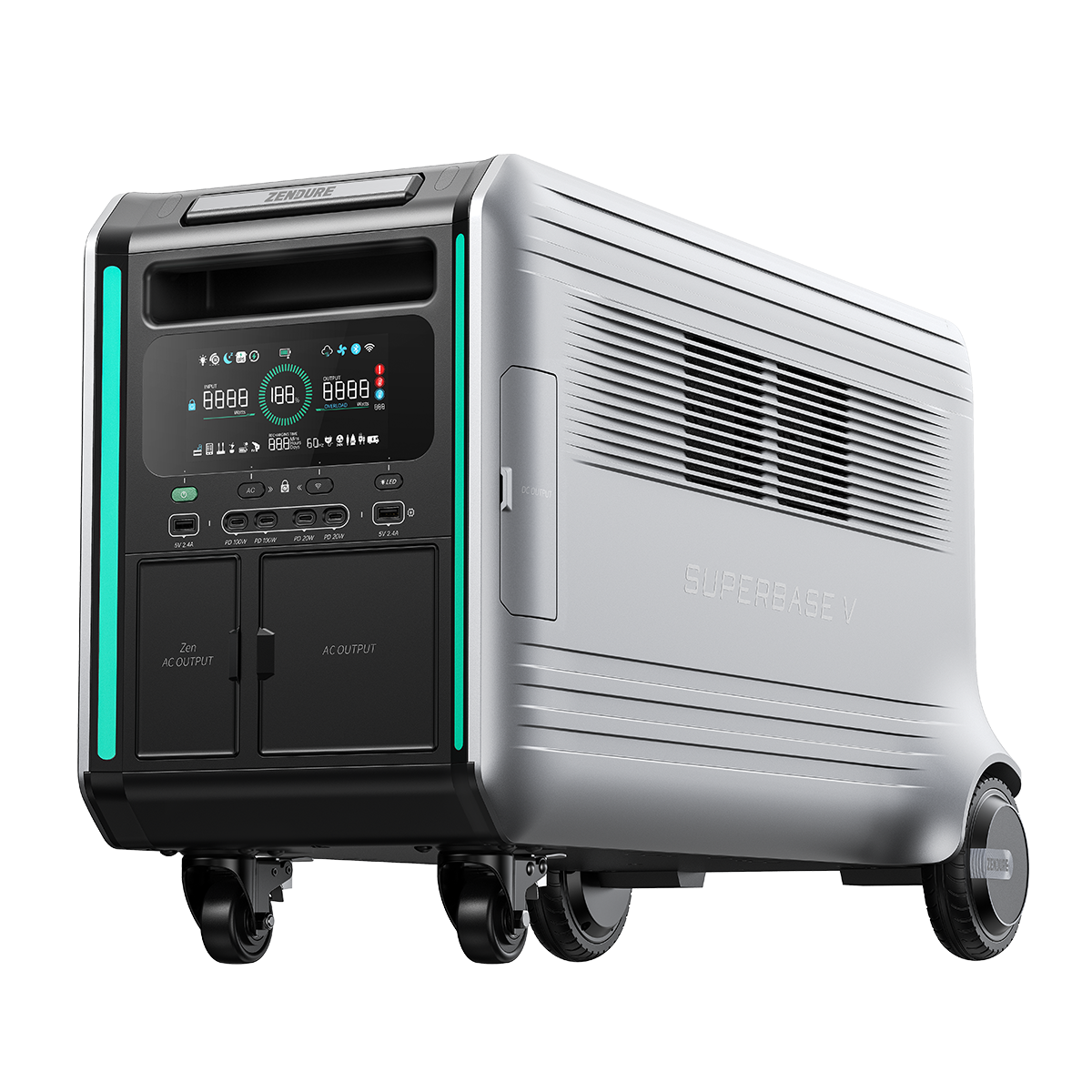
Explore this need in the finder →This is the “V4600 / 2 / Yes” U.S. selector package: one SuperBase V4600, two matching B4600 Satellite Batteries and a Zendure Home Panel. The station plus batteries are listed at 13,824 Wh nameplate; the included panel adds a home-circuit component, not another inverter. The selector capture showed the offer unavailable then, which should not be read as a discontinuation notice.
The package adds reserve, not AC power
Two B4600 packs each contribute a manufacturer-listed 4,608 Wh alongside the V4600’s 4,608 Wh base. The total capacity can make a longer backup schedule more plausible, but it does not raise the single station’s 3,800 W continuous AC ceiling. A 5,000 W peak figure should not be substituted for the running demand of a refrigerator, pump or other appliance. Nameplate storage also is not the same as usable AC energy.
If the electrical load fits one station and storage duration is the limiting factor, this package combines the two extra batteries with the Home Panel rather than leaving the panel to source separately. If you only need 9,216 Wh, the one-B4600 V4600/Home Panel bundle is a lighter alternative. If you need more continuous output, adding batteries will not solve it; compare the documented two-station Home Panel plan and confirm that its layout matches your circuits.
Do not assume the panel topology
The Home Panel manual identifies a ten-circuit, 120/240 V component and requires professional installation. The official manual documents up to two SuperBase V stations and a combined 7,600 W configuration in that paired topology. This offer contains one station, so the two-station 7,600 W rating cannot be applied here. The exact single-station service arrangement remains unconfirmed; ask Zendure and a qualified installer to verify the circuits and permitted operating mode before planning a fixed backup installation.
The station retains four ordinary 120 V outlets and two Zen outputs with 120/240 V choices. The home panel’s inclusion does not mean every receptacle is 240 V. Solar input is up to 3,000 W on the station, while no solar panel is listed in this option. Check array voltage and the separate charging leads. AC input is 1,800 W at 120 V or up to 3,600 W at 240 V under the manufacturer’s stated plan.
Heavy components need an installation plan
The V4600 is listed at 121 lb, each B4600 at 93 lb, and the Home Panel at about 19.4 lb: roughly 326.4 lb of named components, excluding packaging. The batteries and station are not a single wheeled object; plan how each piece reaches its operating location. This is a stationary backup-oriented bundle, not a lightweight portable set.
Choose this option only if the two included batteries and panel match a verified load-and-circuit plan. It is less attractive when the Home Panel would remain unused, when installation topology is unresolved, or when the 3,800 W single-station ceiling is inadequate. The no-panel two-B4600 V4600 bundle is the simpler portable alternative; the two-station system is a distinct choice, not an assumed extension of this one.
Keep the battery and installation choices separate
The manual identifies the V4600/B4600 combination as lithium iron phosphate and lists 6,000 cycles in its manufacturer cycle-life table. Treat that as Zendure’s published figure, not an independent longevity test or a warranty term; the same instructions prohibit mixing battery types. Moving from two to three B4600 packs adds 4,608 Wh and about 93 lb, but leaves the station at 3,800 W continuous output. If your load needs more watts, that extra module is the wrong answer.
The included Home Panel is hardware in the selected offer, not evidence that the kit includes labor, permits, every cable or a confirmed one-station circuit-service arrangement. Bring the exact load and circuit list to a qualified installer and confirm it with Zendure. The no-panel version avoids that installation commitment, while a four-pack V4600 stores more energy but makes the staged equipment heavier still.
Key details at a glance
| Nameplate battery capacity | 13824 Wh |
|---|---|
| Rated AC output | 3800 W |
| Manufacturer surge rating | 5000 W |
| Maximum solar input | 3000 W |
| Included panels, combined nameplate | 0 W |
| Maximum USB-C output per port | 100 W |
More specifications and setup details
| Listed weight | 121 lb |
|---|---|
| Compatible extra-battery expansion | Yes |
| 12 V DC output | 126 W |
| Manufacturer UPS transfer figure | 13 ms |
| AC outlet output | Yes |
| USB-C ports | 4 |
| USB-A ports | 2 |
| Battery chemistry | LiFePO4 |
| Expansion battery in this package | Yes |
| Home Power Panel in this package | Yes |
| HPP 120/240 V split-phase | Yes |
| Separate station units in offer | 1 |
| Smart Transfer Switch in this package | Yes |
| Expansion packs in exact offer | 2 |
| Solar panels in exact offer | 0 |
| Included expansion batteries | 2 units |
Use the exact model’s instructions for operating limits, supplied equipment and version differences.
Sources for this assessment
A useful match starts with the loads that matter.
Use the finder for hard electrical requirements, then check appliance starting behavior, actual run time and the exact package in the full assessment.