
On this page
Your needs, this model
Does it fit your priorities?
Will 13,824 Wh of nameplate storage from this one-V4600 package serve a 120 V load plan below the station’s 3,800 W continuous AC rating?
The exact selector option includes a V4600 plus 2 matching B4600 packs for 13,824 Wh nameplate. The extra batteries extend storage, not the one station’s 3,800 W AC ceiling.
Explore this need in the finder →Does this exact selector choice include at least 2 compatible B4600 Satellite Batteries?
The saved official selector title is “V4600 / 2 / No” (variant 40159460622410); it names 2 matching expansion batteries. SKU is ZDSBV4600-GY-US-2&ZDSATB4600-GY.
Explore this need in the finder →Can you supply compatible solar hardware separately for the one-V4600 station’s 3,000 W maximum solar input?
Solar charging is supported up to the station’s specified input window, but this exact selector option contains no solar panel.
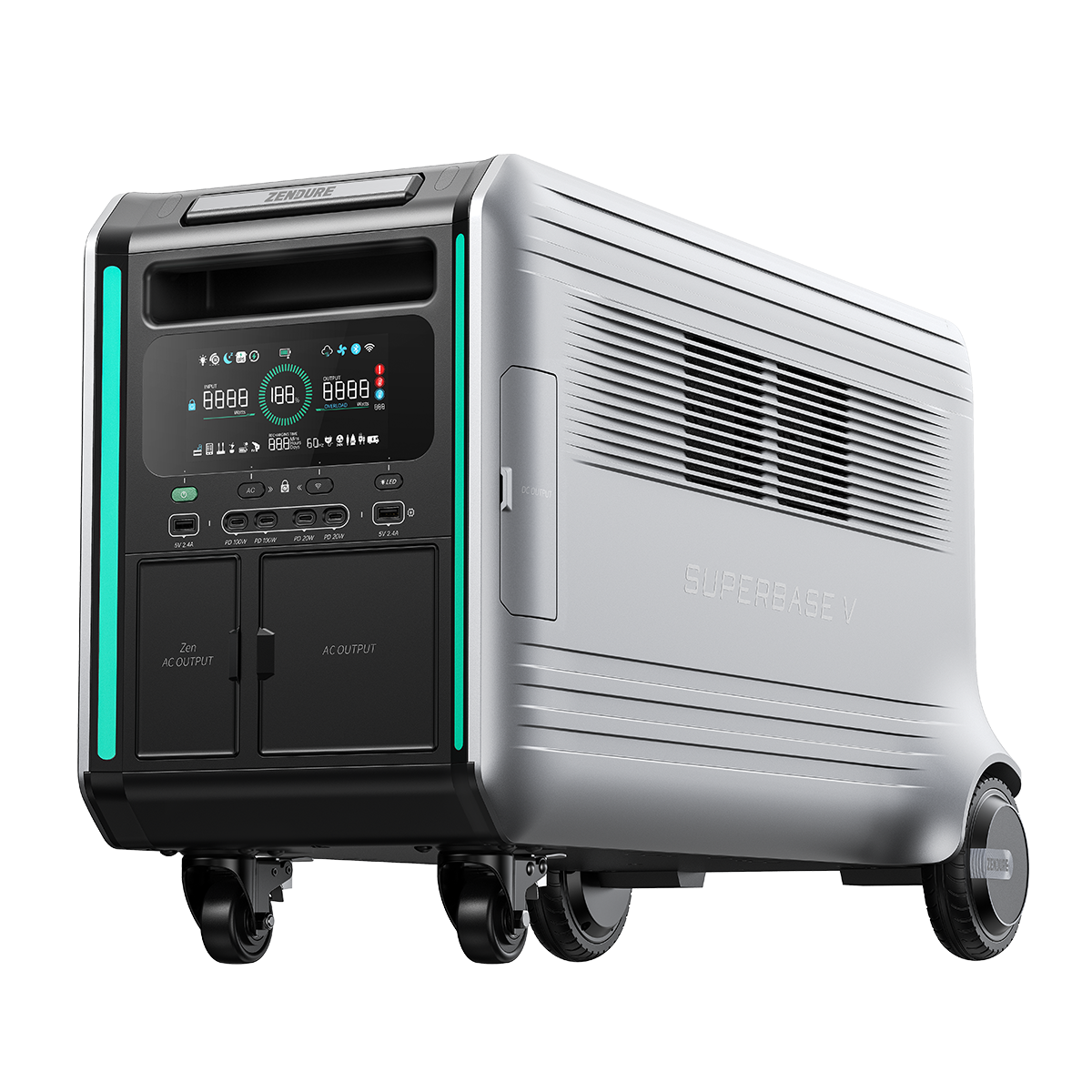
Explore this need in the finder →This exact U.S. selector package is “V4600 / 2 / No”: one SuperBase V4600 with two matching B4600 Satellite Batteries and no Home Panel. Zendure’s listed component capacities total 13,824 Wh nameplate. That is a storage choice, not an output upgrade: one station still carries a 3,800 W continuous AC rating. The saved selector snapshot marked the offer unavailable; that historical state does not establish discontinuation.
Three batteries answer a duration question
Two 4,608 Wh B4600 packs join the V4600’s 4,608 Wh base. That gives a larger energy reserve for a load schedule that stays under one inverter’s rating. It does not make the station suitable for an appliance whose running draw is above 3,800 W, and the manufacturer’s 5,000 W peak/AmpUp figure is not a continuous rating. Likewise, 13,824 Wh is nameplate storage, not an estimate of AC energy delivered after conversion losses, reserves or temperature effects.
The practical alternative is the one-B4600 V4600 package if its 9,216 Wh nameplate capacity is sufficient. This two-pack offer is more compelling when additional stored energy avoids swapping or recharging packs during a planned outage. If the load itself exceeds the single-station ceiling, adding another battery is the wrong fix; compare a supported two-station arrangement, with its different wiring and Home Panel requirements, rather than assuming that this bundle doubles power.
Confirm ports and charging separately
The V4600 has four ordinary 120 V receptacles and two Zen outlets that the manual describes as switchable between 120 V and 240 V. The ordinary outlets do not become 240 V outlets. This selected bundle omits the Home Panel, so it is a portable plug-in system rather than a supplied circuit-transfer installation. A single 240 V appliance still has to fit the documented Zen outlet mode and its limits.
Solar input is rated up to 3,000 W within Zendure’s voltage and current window, but the selector choice includes no solar panel. Buyers should select compatible panels and cables separately and check the panel string’s open-circuit voltage, not just the sum of marketing wattages. AC input is also voltage-specific: the manual distinguishes 1,800 W at 120 V from 3,600 W at 240 V. The station’s combined car/DC5521 output limit is 126 W; it is not 126 W for each jack.
Plan for weight, not just watt-hours
The listed V4600 weighs 121 lb and each B4600 about 93 lb. The named components therefore total about 307 lb before packaging. The wheeled base can help on a suitable floor, but each battery remains a heavy lift and the bundle is not a casual carry-in camping option. Check the path, storage surface and room for ventilation before treating the capacity as a practical benefit.
This configuration suits a buyer who can stage three heavy components, needs more reserve than one V4600 plus one pack, and does not need the Home Panel in this offer. It is a poor fit if transport weight, a wired panel, included solar hardware or more than 3,800 W continuous output is essential. Keep the V4600’s single-station limit in view when comparing the higher-capacity V6400 line; choose on the actual load and installation plan, not on the large capacity total alone.
Battery chemistry and the next expansion step
The SuperBase V manual identifies the V4600/B4600 family as lithium iron phosphate and lists a 6,000-cycle figure in its cycle-life table. That is a manufacturer-published claim, not an independently measured lifespan or a warranty promise. The same manual warns against mixing battery types. If two packs are not enough, a third B4600 adds another 4,608 Wh of nameplate storage and roughly 93 lb while leaving the inverter at 3,800 W; the four-pack configuration is the ceiling for one V4600.
That makes this middle option a real staging decision: it weighs less than the three- and four-pack offers, but a buyer who later wants the third pack must plan for the additional lift and floor space. Compare that incremental path with a larger single offer only after checking the actual load schedule. A larger battery count does not replace a second inverter, a verified transfer design or installation work.
Key details at a glance
| Nameplate battery capacity | 13824 Wh |
|---|---|
| Rated AC output | 3800 W |
| Manufacturer surge rating | 5000 W |
| Maximum solar input | 3000 W |
| Included panels, combined nameplate | 0 W |
| Maximum USB-C output per port | 100 W |
More specifications and setup details
| Listed weight | 121 lb |
|---|---|
| Compatible extra-battery expansion | Yes |
| 12 V DC output | 126 W |
| Manufacturer UPS transfer figure | 13 ms |
| AC outlet output | Yes |
| USB-C ports | 4 |
| USB-A ports | 2 |
| Battery chemistry | LiFePO4 |
| Expansion battery in this package | Yes |
| Home Power Panel in this package | No |
| Separate station units in offer | 1 |
| Smart Transfer Switch in this package | No |
| Expansion packs in exact offer | 2 |
| Solar panels in exact offer | 0 |
| Included expansion batteries | 2 units |
Use the exact model’s instructions for operating limits, supplied equipment and version differences.
Sources for this assessment
A useful match starts with the loads that matter.
Use the finder for hard electrical requirements, then check appliance starting behavior, actual run time and the exact package in the full assessment.