
On this page
Your needs, this model
Does it fit your priorities?
Will 23,040 Wh of nameplate storage from this one-V4600 package serve a 120 V load plan below the station’s 3,800 W continuous AC rating?
The exact selector option includes a V4600 plus 4 matching B4600 packs for 23,040 Wh nameplate. The extra batteries extend storage, not the one station’s 3,800 W AC ceiling.
Explore this need in the finder →Does this exact selector choice include at least 4 compatible B4600 Satellite Batteries?
The saved official selector title is “V4600 / 4 / Yes” (variant 40157857054794); it names 4 matching expansion batteries. SKU is not exposed for this option.
Explore this need in the finder →Do you need this exact offer to include the ten-circuit Home Panel, and will an electrician verify a single-station circuit plan before installation?
The selector says Home Panel Yes. Its own manual specifies ten circuits and professional installation, but the saved evidence does not settle this exact single-station service topology; verify it before relying on backup circuits.
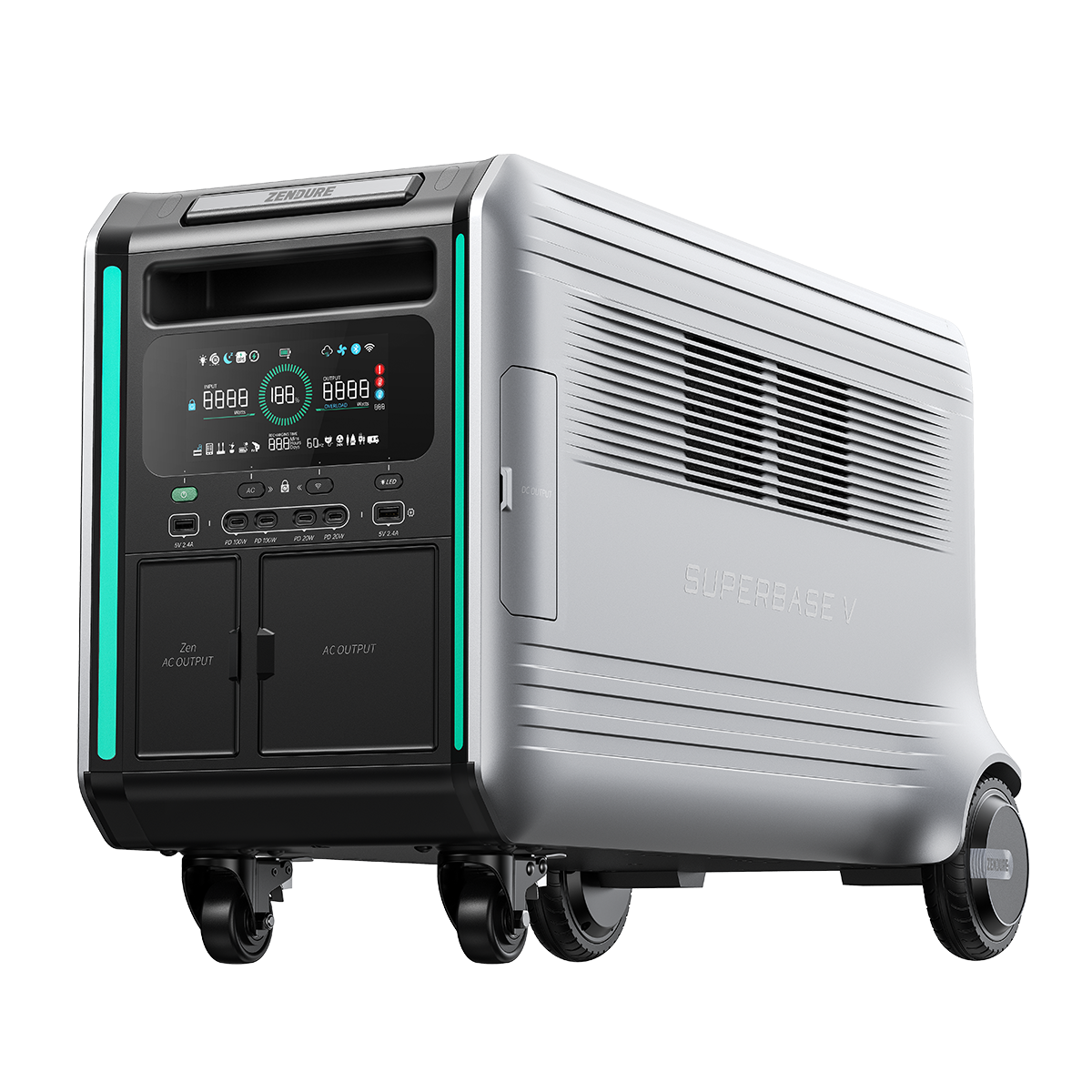
Explore this need in the finder →Zendure’s “V4600 / 4 / Yes” selector option combines one SuperBase V4600, four B4600 Satellite Batteries and a Home Panel. The station plus batteries provide 23,040 Wh nameplate, the listed maximum for one V4600 with four matched satellites. The panel adds a home-backup component, not another station. Zendure’s saved selector capture recorded this option as unavailable; that is not proof it is discontinued.
At the expansion ceiling
Each B4600 is listed at 4,608 Wh, so four packs join the V4600’s 4,608 Wh base. More storage can lengthen a load schedule but does not raise one station’s 3,800 W continuous AC ceiling. The 5,000 W peak/AmpUp figure should not be used as a continuous appliance rating, and 23,040 Wh is not a measured amount of energy delivered to AC devices. Conversion losses, reserve and temperature affect use.
This offer uses all four of the V4600’s documented satellite slots. A buyer who wants to stage expansion over time may prefer the two- or three-pack bundle; this exact package leaves no additional compatible slot on that station. If you need more power rather than longer duration, do not spend on batteries to solve an inverter limit. A separate, documented two-station plan is the appropriate comparison.
Panel inclusion is not an installation guarantee
The Home Panel is specified as a ten-circuit, 120/240 V device and requires professional installation. Zendure documents up to two SuperBase V stations and 7,600 W in the paired configuration, but this package has one V4600. Do not claim the paired output for a single station. The saved evidence does not settle the exact one-station circuit service topology; confirm the proposed layout with Zendure and a qualified electrician before treating the offer as whole-home backup.
On the station itself, four conventional outlets are 120 V; two Zen AC outlets select the documented 120/240 V mode. Solar charging is rated to 3,000 W within the specified electrical window, but no panel is included. The station’s AC input is voltage-dependent (1,800 W at 120 V or up to 3,600 W at 240 V), while the car/DC5521 group shares a 126 W ceiling. The Home Panel should not obscure those individual limits.
Consider the installation weight
About 121 lb for the base, four 93 lb batteries and approximately 19.4 lb for the Home Panel add to roughly 512.4 lb before packaging. The station’s wheels help on an appropriate floor; they do not make the battery lifts easy. This is a high-capacity fixed-location plan, not a frequently moved emergency kit. Decide the installation route and room layout with the electrician before purchase.
This is the strongest single-V4600 storage option in the selector, but is sensible only for a load plan that benefits from the full reserve and a confirmed Home Panel installation. The three-pack panel package is lighter and leaves an expansion slot. The two-station design is a separate power configuration. Compare output need, circuit topology and real weight before paying for the maximum pack count.
Maximum storage still needs a verified panel plan
The V4600/B4600 family is listed as lithium iron phosphate in Zendure’s manual, which gives a 6,000-cycle manufacturer claim and cautions against mixing battery types. Neither the cycle count nor the nameplate 23,040 Wh total is an independent service-life or delivered-energy guarantee. The one-station four-pack bundle uses the full satellite allowance; stepping down to three B4600s removes about 4,608 Wh and 93 lb but leaves one supported expansion position available.
Home Panel inclusion does not itself establish the exact service topology for this one-base configuration, nor does the seller selector describe an installation service. Ask the manufacturer and electrician to confirm circuit count, voltage arrangement, connection hardware and the loads you intend to back up. If the answer is not clear, the no-panel V4600/4 offer is easier to evaluate as a local-outlet system; if the load exceeds 3,800 W continuous, compare a documented two-station design rather than buying storage alone.
Key details at a glance
| Nameplate battery capacity | 23040 Wh |
|---|---|
| Rated AC output | 3800 W |
| Manufacturer surge rating | 5000 W |
| Maximum solar input | 3000 W |
| Included panels, combined nameplate | 0 W |
| Maximum USB-C output per port | 100 W |
More specifications and setup details
| Listed weight | 121 lb |
|---|---|
| Compatible extra-battery expansion | Yes |
| 12 V DC output | 126 W |
| Manufacturer UPS transfer figure | 13 ms |
| AC outlet output | Yes |
| USB-C ports | 4 |
| USB-A ports | 2 |
| Battery chemistry | LiFePO4 |
| Expansion battery in this package | Yes |
| Home Power Panel in this package | Yes |
| HPP 120/240 V split-phase | Yes |
| Separate station units in offer | 1 |
| Smart Transfer Switch in this package | Yes |
| Expansion packs in exact offer | 4 |
| Solar panels in exact offer | 0 |
| Included expansion batteries | 4 units |
Use the exact model’s instructions for operating limits, supplied equipment and version differences.
Sources for this assessment
A useful match starts with the loads that matter.
Use the finder for hard electrical requirements, then check appliance starting behavior, actual run time and the exact package in the full assessment.