
On this page
Your needs, this model
Does it fit your priorities?
Will 23,040 Wh of nameplate storage from this one-V4600 package serve a 120 V load plan below the station’s 3,800 W continuous AC rating?
The exact selector option includes a V4600 plus 4 matching B4600 packs for 23,040 Wh nameplate. The extra batteries extend storage, not the one station’s 3,800 W AC ceiling.
Explore this need in the finder →Does this exact selector choice include at least 4 compatible B4600 Satellite Batteries?
The saved official selector title is “V4600 / 4 / No” (variant 40159460687946); it names 4 matching expansion batteries. SKU is ZDSBV4600-GY-US-4&ZDSATB4600-GY.
Explore this need in the finder →Can you supply compatible solar hardware separately for the one-V4600 station’s 3,000 W maximum solar input?
Solar charging is supported up to the station’s specified input window, but this exact selector option contains no solar panel.
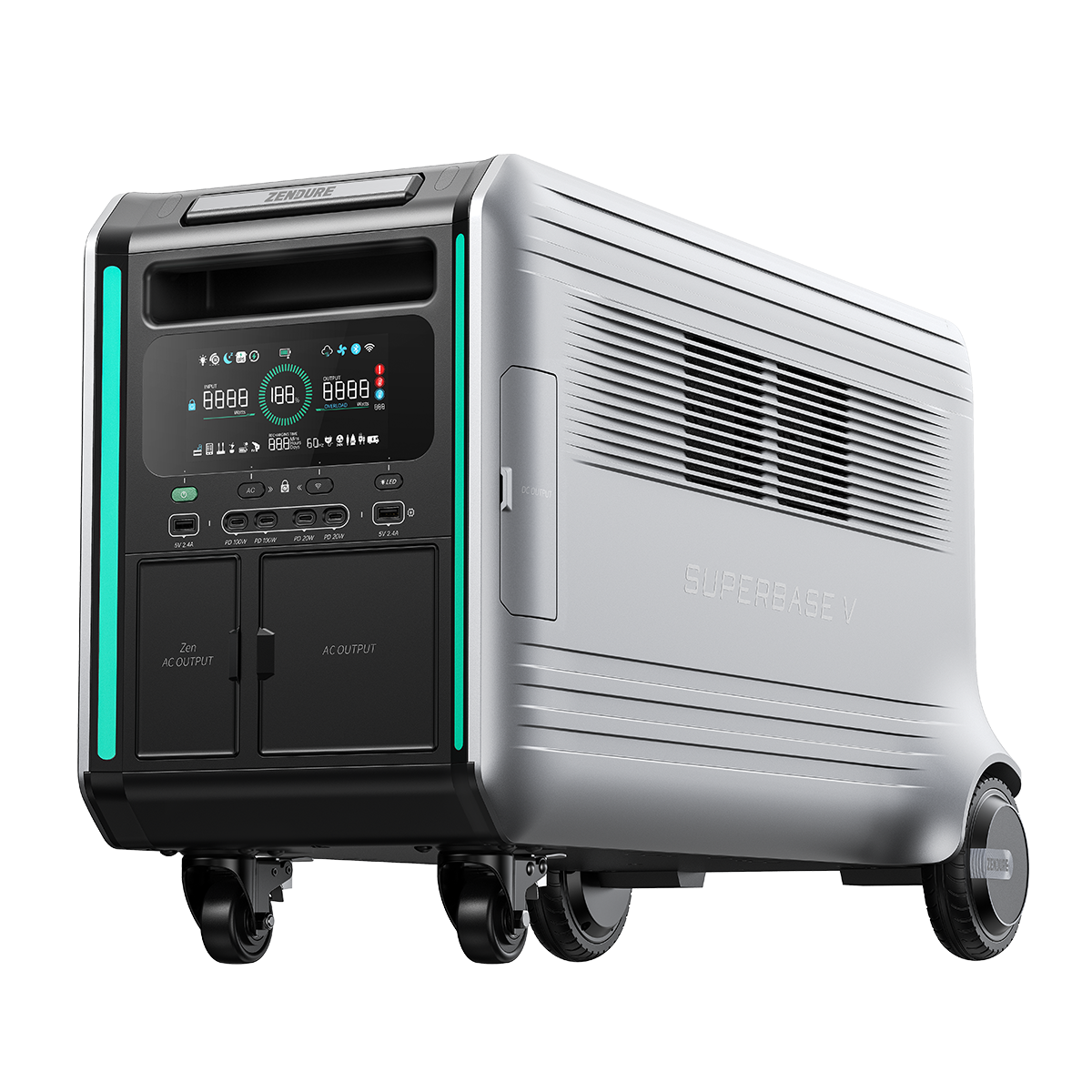
Explore this need in the finder →This U.S. selector package is one SuperBase V4600 with four B4600 Satellite Batteries and no Home Panel (“V4600 / 4 / No”). The listed station and packs total 23,040 Wh nameplate, matching Zendure’s documented maximum one-station V4600 expansion capacity. The offer still contains one 3,800 W continuous AC inverter. The archived selector showed the option unavailable at capture, which should not be treated as a discontinuation decision.
Maximum storage does not mean maximum output
Four 4,608 Wh satellites plus the 4,608 Wh base make the V4600’s maximum documented one-station storage plan. That is useful when a long outage schedule is the binding problem and the load is within one inverter’s output. It does not support a larger running load than the V4600’s 3,800 W rating. Its 5,000 W peak figure is not continuous headroom. The battery total is nameplate energy; real AC service is lower and depends on operating conditions.
The fourth battery also closes the station’s expansion headroom. If you expect to add batteries later, the three-pack offer keeps one compatible slot open; the four-pack selection does not. That distinction can be more useful than the largest capacity figure. Compare the two- and three-pack V4600 packages if you want to reduce initial weight or preserve an incremental expansion path.
Know the physical and electrical arrangement
The station is listed at 121 lb, each B4600 at about 93 lb, for approximately 493 lb of named components before packaging. A wheeled base does not solve the separate lifts, doorway turns, battery-cable reach or floor-loading question. This is a staged backup installation, not a portable camping battery. Check the manufacturer’s placement and temperature instructions and plan the storage location before committing to the maximum bundle.
This option has no Home Panel and no solar panel. Four ordinary AC outlets remain 120 V and two Zen AC outputs support the manual’s selectable 120/240 V modes. Solar input can reach 3,000 W only within the station’s voltage/current limits. The AC charge ceiling is 1,800 W at 120 V or 3,600 W at 240 V; it is not a universal rate. The 126 W limit for the car and DC5521 group is combined, not per port.
Choose a system for the load list
For one V4600, this is the largest battery count shown by the source selector. If the buyer wants circuit backup, the Home Panel is a separate package choice with professional installation and an unresolved one-station topology; the two-station 7,600 W claim cannot be borrowed. If continuous output is inadequate, a different two-station system is the relevant comparison. If only duration is short, this maximum-storage package may fit, but first estimate load energy with losses and reserve—not a simple nameplate division.
The V6400 four-pack alternative raises maximum nameplate storage further, but also changes the station model and battery chemistry. The V4600 four-pack is a better fit only when its 23,040 Wh capacity is enough, its LiFePO4 platform is preferred, and the weight is manageable. None of those decisions can be made from the package count alone.
At the four-pack limit
Zendure’s manual identifies the V4600/B4600 family as lithium iron phosphate and lists a 6,000-cycle figure in its cycle-life table. This is the maker’s claim, not an independent durability result or warranty term; it also says not to mix battery types. Four B4600s use the full satellite allowance for one station. Dropping to three saves about 93 lb and 4,608 Wh of nameplate capacity while retaining one possible matching-pack slot for a later decision.
The physical difference matters more than the neat capacity total suggests. Four batteries plus the base are separate heavy components, and this exact package does not supply the Home Panel. It is therefore a local-outlet plan unless you separately source and verify a transfer installation. If you need that installation, compare the panel-included option and confirm the single-station topology; if the need is simply more continuous power, adding another battery will not solve it.
Key details at a glance
| Nameplate battery capacity | 23040 Wh |
|---|---|
| Rated AC output | 3800 W |
| Manufacturer surge rating | 5000 W |
| Maximum solar input | 3000 W |
| Included panels, combined nameplate | 0 W |
| Maximum USB-C output per port | 100 W |
More specifications and setup details
| Listed weight | 121 lb |
|---|---|
| Compatible extra-battery expansion | Yes |
| 12 V DC output | 126 W |
| Manufacturer UPS transfer figure | 13 ms |
| AC outlet output | Yes |
| USB-C ports | 4 |
| USB-A ports | 2 |
| Battery chemistry | LiFePO4 |
| Expansion battery in this package | Yes |
| Home Power Panel in this package | No |
| Separate station units in offer | 1 |
| Smart Transfer Switch in this package | No |
| Expansion packs in exact offer | 4 |
| Solar panels in exact offer | 0 |
| Included expansion batteries | 4 units |
Use the exact model’s instructions for operating limits, supplied equipment and version differences.
Sources for this assessment
A useful match starts with the loads that matter.
Use the finder for hard electrical requirements, then check appliance starting behavior, actual run time and the exact package in the full assessment.