
On this page
Your needs, this model
Does it fit your priorities?
Does a V4600 and one B4600 provide the 9,216 Wh nameplate reserve you planned for a single station?
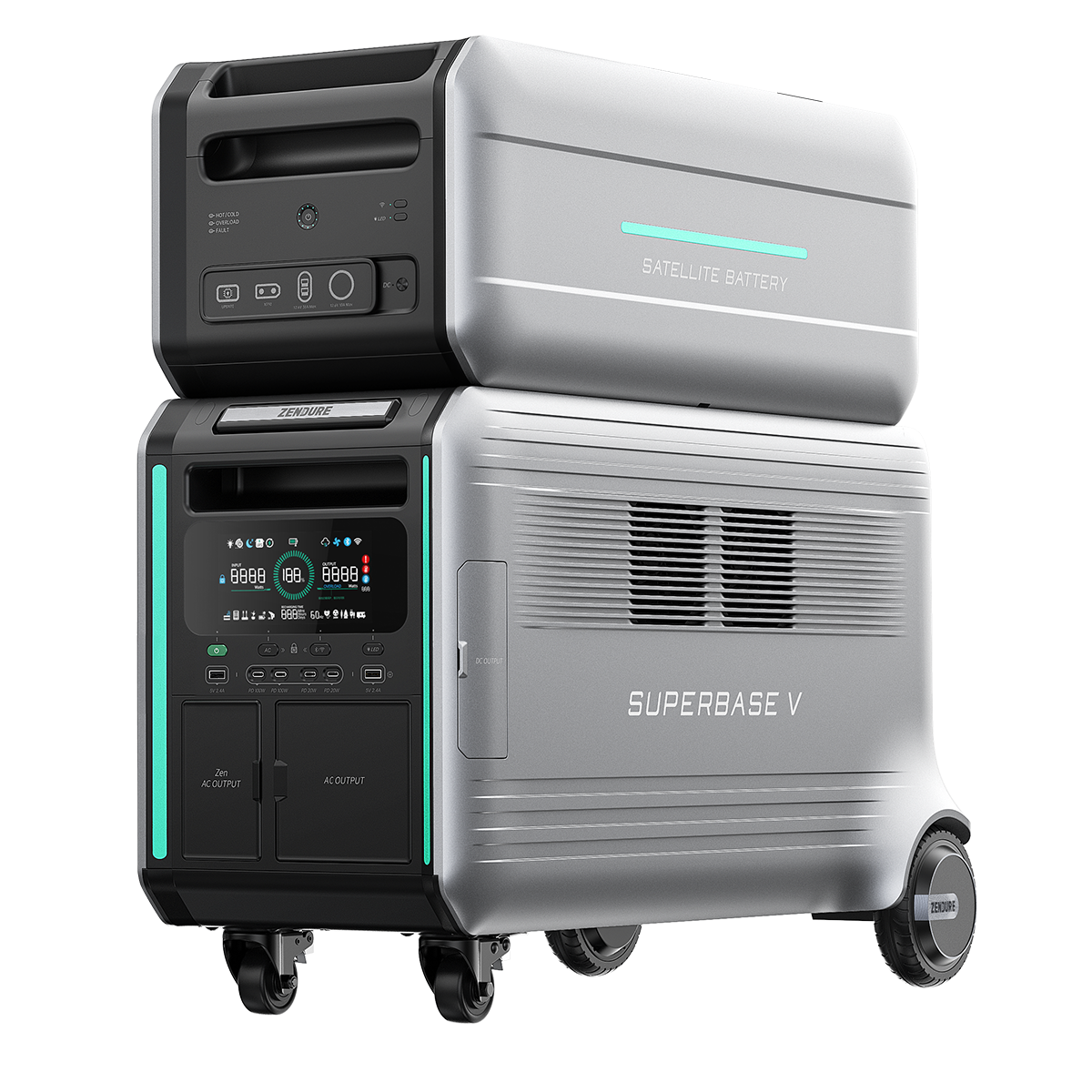
This Home Panel option still contains one 3,800 W V4600 inverter; the included satellite raises storage to 9,216 Wh.
Explore this need in the finder →Must the specific V4600 Home Panel offer include its matching B4600 now?
The selector explicitly sets one extra battery and Home Panel Yes; the battery count is not a maximum-expansion promise.
Explore this need in the finder →Is a ten-circuit Home Panel part of the exact one-station purchase you are considering?
The option includes ZDSHPEV2 and its manual lists ten circuits. Confirm single-station service topology and installation with a qualified electrician.
Explore this need in the finder →Will solar be a charging source even though the V4600/Home Panel/battery bundle has no panel in the box?
The station supports a manual-limited solar input up to 3,000 W; the selected offer does not include solar modules.
Explore this need in the finder →The U.S. selector identifies this option as “V4600 / 1 / Yes”: one SuperBase V4600, one B4600 Satellite Battery and Zendure’s Home Panel. The base station and compatible battery are rated at 4,608 Wh each, giving this exact bundle 9,216 Wh of nameplate storage. It is a more involved purchase than a portable station alone: the panel is fixed electrical equipment, and the included parts are not an installed backup system.
Why choose the panel bundle?
The Home Panel is useful only if you intend to plan a home-circuit installation and have a qualified installer confirm that the chosen one-station arrangement fits your service and loads. Zendure’s Home Panel manual identifies model ZDSHPEV2, a ten-circuit panel rated for 120/240 V service. Its inclusion can save a separate component decision, but it does not by itself prove that a one-station configuration provides every 120/240 V household topology a buyer might expect. The manufacturer material reviewed here does not establish the exact single-station service arrangement; confirm it with Zendure and the electrician before treating this package as a solution for a particular panel, circuit or 240 V appliance.
That qualification matters because one station remains a 3,800 W rated AC source. Zendure’s 7,600 W Home Panel figure is for the supported two-station arrangement, not for a single V4600 plus an extra battery. The B4600 doubles nameplate storage compared with the station alone; it does not double inverter output. The manufacturer’s 5,000 W peak/AmpUp number is not a continuous power rating. Nameplate watt-hours also do not equal guaranteed AC energy delivered to a home circuit after conversion and reserve limits.
What the exact package includes—and what it does not
The extra battery is the matching B4600, not a B6400. Zendure’s U.S. manual allows up to four matching Satellite Batteries on one station, but this offer contains one. Do not treat a maximum expansion claim as included hardware, and do not mix the V4600/LFP system with a V6400 battery. The base station is listed at 121 lb, the satellite battery at 93 lb and the Home Panel at about 19.4 lb, for roughly 233 lb of named components before packaging. The selector does not include installation labor, wiring or a solar panel.
For portable loads, the V4600 retains four ordinary 120 V receptacles and two Zen AC outputs selectable at 120 V or 240 V. That outlet mode is not a substitute for an installed transfer design. The station’s solar input is rated up to 3,000 W, subject to the manual’s 12–150 V and 25 A limits, but panels are not in this package. AC input is up to 1,800 W on 120 V or 3,600 W on 240 V; the voltage matters. Its USB outputs and combined car/DC5521 ceiling can serve smaller electronics, but do not read 126 W as a per-port car socket rating. The listed 13 ms UPS figure is a manufacturer specification, not a blanket assurance for sensitive equipment.
When to pick another configuration
Choose this package when the included Home Panel is part of a real, electrician-reviewed plan and you want the additional matching storage in the same offer. If your goal is only portable backup, the otherwise similar V4600-plus-B4600 option without the panel avoids bundling a component that will not be installed. If your essential requirement is a linked 7,600 W household arrangement, the correct comparison is the two-station Home Panel bundle, not this single-station package. If you need a 240 V Zen outlet for one appliance, validate the appliance and mode directly; do not assume all four ordinary outlets or the single-station Home Panel layout provide it.
The selector marked this exact option unavailable at the saved check, which does not establish discontinuation. It is a current-reference identity rather than a promise of present stock. The useful decision is the installation topology: confirm that first, then compare capacity and the added battery. No independent run-time, transfer, or installation test is claimed here.
Key details at a glance
| Nameplate battery capacity | 9216 Wh |
|---|---|
| Rated AC output | 3800 W |
| Manufacturer surge rating | 5000 W |
| Maximum solar input | 3000 W |
| Included panels, combined nameplate | 0 W |
| Maximum USB-C output per port | 100 W |
More specifications and setup details
| Listed weight | 121 lb |
|---|---|
| Compatible extra-battery expansion | Yes |
| 12 V DC output | 126 W |
| Manufacturer UPS transfer figure | 13 ms |
| AC outlet output | Yes |
| USB-C ports | 4 |
| USB-A ports | 2 |
| Battery chemistry | LiFePO4 |
| Expansion battery in this package | Yes |
| Home Power Panel in this package | Yes |
| HPP 120/240 V split-phase | Yes |
| Separate station units in offer | 1 |
| Smart Transfer Switch in this package | Yes |
| Expansion packs in exact offer | 1 |
| Solar panels in exact offer | 0 |
| Included expansion batteries | 1 units |
Use the exact model’s instructions for operating limits, supplied equipment and version differences.
Sources for this assessment
A useful match starts with the loads that matter.
Use the finder for hard electrical requirements, then check appliance starting behavior, actual run time and the exact package in the full assessment.