
On this page
Your needs, this model
Does it fit your priorities?
Can your 120 V plan use two independent stations, each limited to 3,800 W, with 18,432 Wh nameplate across this offer?
The option totals 18,432 Wh nameplate; each of the two independent V4600 outputs remains rated at 3,800 W.
Explore this need in the finder →Do you require at least 2 matching B4600 batteries included with the two stations?
This exact option contains 2 B4600 packs; the expansion minimum must not be set above that count.
Explore this need in the finder →Does one V4600 Zen outlet in 240 V mode meet your need without assuming the bases are linked?
The manual documents an individual 240 V Zen output; this no-panel offer does not prove a paired household system.
Explore this need in the finder →Can you obtain solar panels separately if you depend on solar charging?
The stations accept solar within published limits, but this option includes no solar panels; cable contents are unknown.
Explore this need in the finder →Can you handle a single V4600 base weighing about 121 lb?
Each V4600 weighs about 121 lb before packaging, independent of the included expansion pack count.
Explore this need in the finder →Can you stage the full 428 lb station-and-battery plan?
Two bases and 2 matching B4600 packs total approximately 428 lb. This is not a carry-friendly one-piece system.
Explore this need in the finder →A two-station package with a substantial reserve
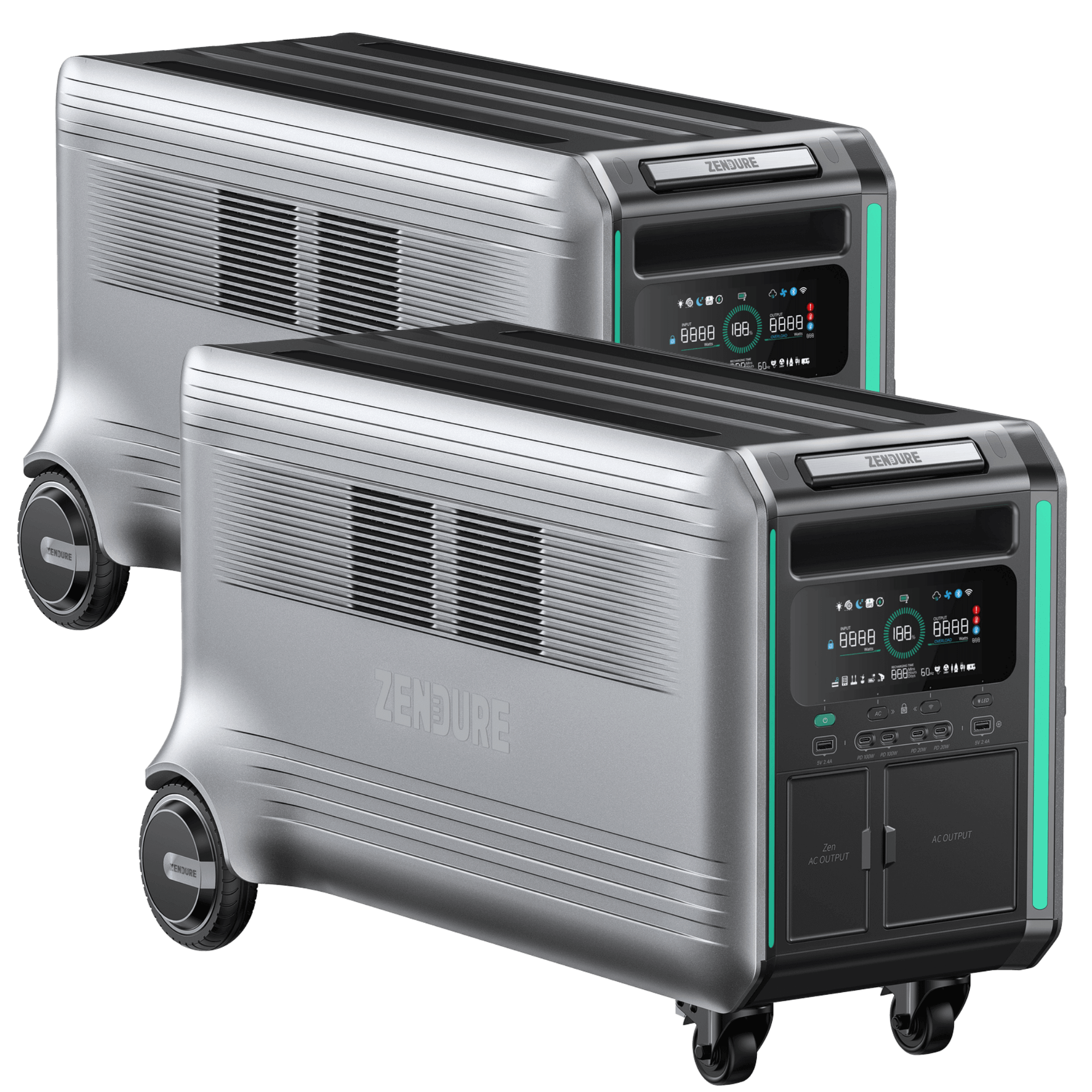
This U.S. selector choice is two SuperBase V4600 stations plus two matching B4600 Satellite Batteries, with no Home Panel. Zendure lists 4,608 Wh for each V4600 and each B4600, so the named set adds up to 18,432 Wh of battery nameplate capacity. That is a large store of energy, but the figure is not a promise of usable AC watt-hours: conversion losses, reserve settings, load behavior and temperature all matter. The selector’s saved stock snapshot says unavailable; that does not establish that Zendure discontinued the configuration.
What two B4600s change
The two added packs contribute 9,216 Wh beyond the pair of base stations. Compared with the one-extra-battery option, this selection buys a second 4,608 Wh module and another roughly 93 lb of equipment. The alternative with three packs offers 23,040 Wh nameplate, but it also adds another heavy component. Choose two only if a written load schedule or outage plan calls for that reserve; a larger capacity total cannot fix an appliance whose running demand exceeds the output of the station feeding it.
Two inverters are not one 7,600 W outlet
Without the Home Panel, the package gives you two separate stations, each documented for 3,800 W continuous AC output. Do not combine those ratings into a single 7,600 W source. A 120 V operating plan can use the stations independently on separate loads, drawing on the total package energy; each individual load still has to fit the station it is plugged into. Each V4600 also has a Zen outlet with a documented 120 V or 240 V mode. That supports a compatible 240 V load from a station, but it does not prove a linked split-phase household system for this exact no-panel package.
Charging and ports require separate planning
The manual lists up to 3,000 W solar input per station within the specified voltage and current window. This selector package includes no solar modules, and the exact option does not confirm a station-side solar cable in the box. Panel strings must remain inside the station’s electrical limits; adding the printed wattages of panels is not a substitute for checking open-circuit voltage. Each station’s manual also distinguishes its 120 V AC input rate from its faster 240 V charge rate. The product’s four ordinary receptacles remain 120 V; only the two Zen outlets are selectable.
Weight, staging and practical fit
Two bases weigh about 242 lb together, and the two B4600s add about 186 lb, for roughly 428 lb of named station-and-battery components before packaging. That total is not one lift, but it is still a serious placement and storage problem: a V4600 is about 121 lb and a B4600 about 93 lb. Map the route, floor, ventilation and access for each component before choosing this bundle. It is aimed at a stationary backup arrangement or a planned multi-piece setup, not a light camping kit.
Who should choose this exact offer
It suits someone who wants two independent V4600 power sources and roughly 18.4 kWh of nameplate storage, can handle the component count and does not require a supplied home panel. The two-pack option sits between one extra battery and the larger three- and four-pack choices, so it is the sensible stopping point only when that intermediate reserve is useful. If household circuits must transfer automatically or you need one 7,600 W paired plan, compare the exact Home Panel configuration instead and budget professional installation. If 3,800 W per station or the weight is unacceptable, look at a different output architecture rather than adding batteries.
Limitations to verify before buying
Capacity is nameplate, no solar panel is included, and the no-panel listing does not verify the accessories needed to link the stations. This review relies on Zendure’s selector and manual, not hands-on testing or a measured runtime. The two B4600 packs must match the V4600 battery family; Zendure’s manual warns against mixing battery types and documents up to four compatible satellites per station. Confirm present stock and the exact seller option before purchase, because the captured U.S. listing was unavailable and no verified ASIN or complete retail SKU is recorded for every option.
Key details at a glance
| Nameplate battery capacity | 18432 Wh |
|---|---|
| Rated AC output | 3800 W |
| Maximum solar input | 3000 W |
| Included panels, combined nameplate | 0 W |
| Maximum USB-C output per port | 100 W |
| Listed weight | 121 lb |
More specifications and setup details
| Compatible extra-battery expansion | Yes |
|---|---|
| 12 V DC output | 126 W |
| Manufacturer UPS transfer figure | 13 ms |
| AC outlet output | Yes |
| USB-C ports | 4 |
| USB-A ports | 2 |
| Battery chemistry | LiFePO4 |
| Expansion battery in this package | Yes |
| Home Power Panel in this package | No |
| Separate station units in offer | 2 |
| Smart Transfer Switch in this package | No |
| Expansion packs in exact offer | 2 |
| Solar panels in exact offer | 0 |
| Included expansion batteries | 2 units |
Use the exact model’s instructions for operating limits, supplied equipment and version differences.
Sources for this assessment
A useful match starts with the loads that matter.
Use the finder for hard electrical requirements, then check appliance starting behavior, actual run time and the exact package in the full assessment.