
On this page
Your needs, this model
Does it fit your priorities?
Do you need the Home Panel and a larger reserve than the base stations provide?
This option includes the Home Panel and three B4600 packs. Zendure documents the paired panel arrangement; battery allocation remains unspecified by the selector.
Explore this need in the finder →Is 23,040 Wh nameplate a useful target rather than a runtime promise?
The four base batteries and three satellites sum to 23,040 Wh, before AC conversion losses and any reserve settings.
Explore this need in the finder →Will your installation support more than 540 lb of listed components?
The two V4600 bases, three B4600 packs and Home Panel total about 540.4 lb, excluding packaging and unconfirmed wiring.
Explore this need in the finder →Can your circuit plan use a 120/240 V paired Home Panel system?
The official panel manual describes 120/240 V service and ten circuits; it does not establish 120/208 V compatibility.
Explore this need in the finder →Do you need at least 3 compatible satellite batteries included, rather than merely supported?
The exact U.S. option lists 3 B4600 packs in the box; the seller record does not state a station-by-station allocation.
Explore this need in the finder →The U.S. selector’s “V4600*2 / 3 / Yes” choice combines two SuperBase V4600 base stations, three matching B4600 Satellite Batteries and the Home Panel. At 4,608 Wh nameplate per V4600 or B4600, the listed components sum to 23,040 Wh. This is a bundle-capacity total, not a measured usable-energy result. Zendure’s saved selector snapshot marked the configuration unavailable; that records one moment in the listing, not a discontinued product. The variant record has no SKU, so that remains unknown rather than being copied from the no-panel version.
The third satellite is a meaningful jump
Compared with the two-pack Home Panel option, this one adds 4,608 Wh and roughly 93 lb of B4600 hardware. The pair of base stations contributes 9,216 Wh; three satellites raise the nameplate total to 23,040 Wh. That extra reserve may matter for a longer outage window, but it changes neither the station’s own 3,800 W continuous AC rating nor the Home Panel’s manufacturer-published 7,600 W paired maximum. A battery pack stores energy; it is not another inverter. The step is best justified by a concrete load schedule, such as a longer expected support period for selected household circuits, not by the appeal of a larger headline number.
What the included Home Panel does—and does not—solve
Zendure documents the Home Panel with EV Outlets as supporting up to two SuperBase V stations, 120/240 V service and ten load circuits. It is the key difference from the identical three-pack selection without the panel: the supported linked home-circuit system is present in this offer. That still is not a turnkey whole-house guarantee. An electrician must review the service, chosen circuits, installation method and local requirements. Appliance starting loads, simultaneous demand and household energy use need a separate plan. The documented panel service is 120/240 V; the sources do not establish 120/208 V support. Do not treat the two bases as a pair for 7,600 W unless the exact panel-linked plan is actually installed.
Battery placement and expansion limits
The selector identifies three B4600 batteries in total but does not say how they are allocated between the two V4600 stations. Zendure’s manual allows matched satellite expansion and a maximum of four same-family packs on one station. A workable system layout must observe that per-station limit; this package’s three extras can be divided between the two bases without exceeding it. But the source does not prescribe a particular allocation, so the review does not promise a specific per-station capacity. Keep the same B4600 family and follow the manual’s warning not to mix battery types. If you want the cleanest planning story, confirm with Zendure how its seller configures the three packs and connection hardware.
Charging and energy budgeting
Each V4600 is listed for solar charging up to 3,000 W within the manual’s electrical input limits. The three satellites do not mean solar capability triples; the rating is per station, and no solar modules are listed in the selected package. Check module voltage, current and wiring against the manual instead of summing panel wattage alone. For a home-backup plan, estimate the daily energy of the selected circuits and the likely interruption length, then allow for conversion losses and reserve. The 23,040 Wh figure is not fully available at AC outlets. No runtime or usable-energy measurement is represented here.
Weight, installation and fit
The two bases weigh about 242 lb together, the three B4600s another 279 lb, and the Home Panel about 19.4 lb. The named components therefore weigh roughly 540.4 lb before shipping materials or unconfirmed wiring. Each base is around 121 lb and each satellite about 93 lb, so placement means several separate heavy lifts. Measure every doorway and staging area, check the floor and ventilation plan, and decide where an electrician can reach the equipment. It is not a sensible choice for users who want frequent campsite repositioning or a single carryable unit.
Choose three only when the extra reserve has a job
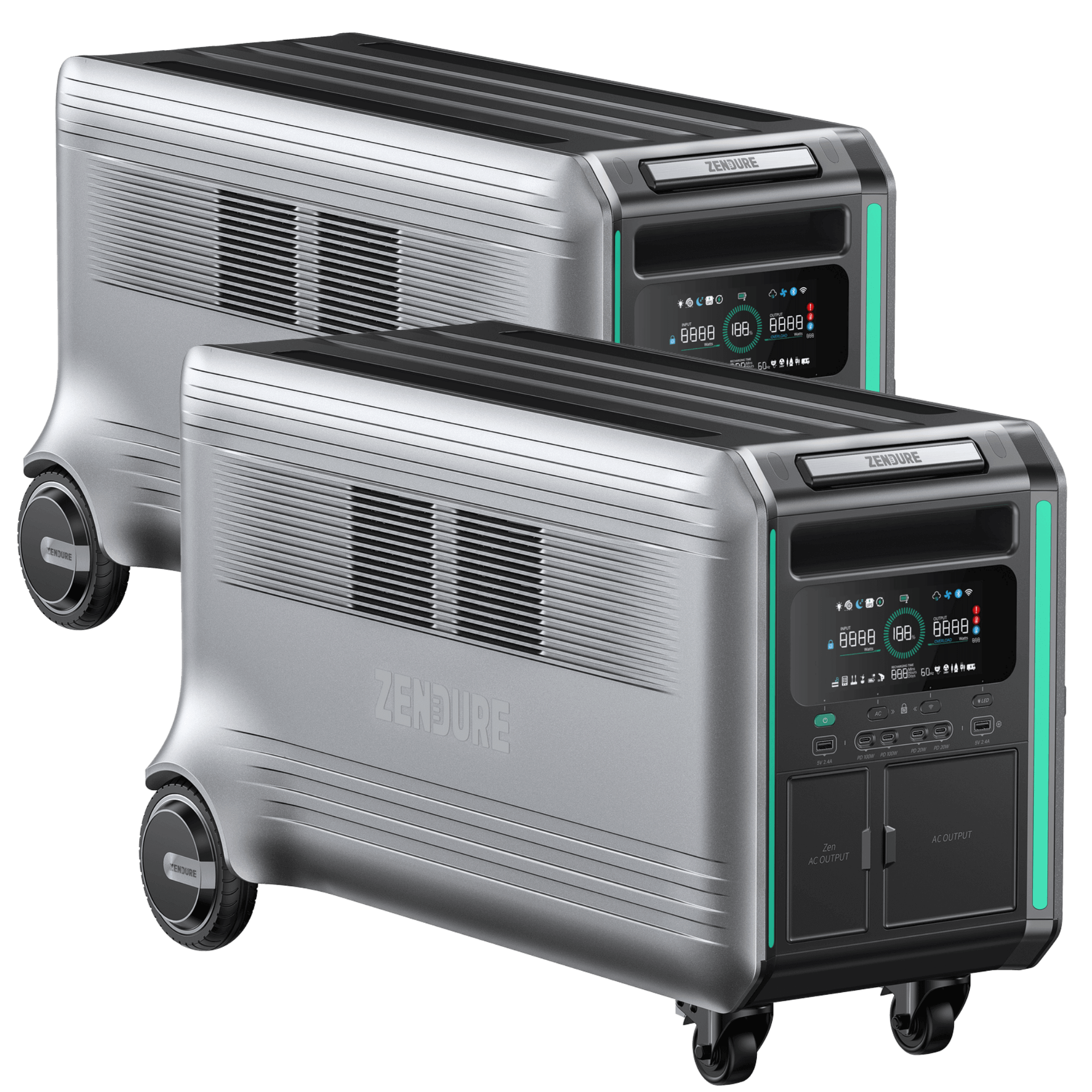
This package suits a household already choosing a two-station Home Panel setup that has a documented need for more than the two-pack’s 18,432 Wh nameplate storage. The two-pack saves approximately 93 lb; the four-pack adds another 4,608 Wh and the same additional battery weight. If you do not need circuit integration, compare the no-panel version rather than assuming the Home Panel is a free convenience. If your equipment exceeds the system output ceiling, more batteries will not fix it. The exact package details come from the selector and manuals, not this CGI image, which shows the two base stations but not the satellites or Home Panel. Confirm current seller availability and the selected option before purchase.
Key details at a glance
| Nameplate battery capacity | 23040 Wh |
|---|---|
| Rated AC output | 7600 W |
| Maximum solar input | 3000 W |
| Included panels, combined nameplate | 0 W |
| Maximum USB-C output per port | 100 W |
| Listed weight | 121 lb |
More specifications and setup details
| Compatible extra-battery expansion | Yes |
|---|---|
| 12 V DC output | 126 W |
| Manufacturer UPS transfer figure | 13 ms |
| AC outlet output | Yes |
| USB-C ports | 4 |
| USB-A ports | 2 |
| Battery chemistry | LiFePO4 |
| Expansion battery in this package | Yes |
| Home Power Panel in this package | Yes |
| HPP 120/240 V split-phase | Yes |
| Separate station units in offer | 2 |
| Smart Transfer Switch in this package | Yes |
| Expansion packs in exact offer | 3 |
| Solar panels in exact offer | 0 |
| Included expansion batteries | 3 units |
Use the exact model’s instructions for operating limits, supplied equipment and version differences.
Sources for this assessment
A useful match starts with the loads that matter.
Use the finder for hard electrical requirements, then check appliance starting behavior, actual run time and the exact package in the full assessment.