
On this page
Your needs, this model
Does it fit your priorities?
Does a two-station Home Panel configuration fit your home's backup design?
This exact selector says Home Panel Yes. The manufacturer manual supports a two-station 120/240 V arrangement, subject to professional installation and circuit review.
Explore this need in the finder →Would 27,648 Wh nameplate across the V4600 bases and four B4600s fit your reserve plan?
That is the sum of six 4,608 Wh battery units; it is not usable AC energy or tested runtime.
Explore this need in the finder →Can you choose four packs and manage their placement?
The selector lists four packs total but no station allocation. A two-plus-two layout is supported by the manual’s four-per-station limit.
Explore this need in the finder →Is the Home Panel installed circuit plan worth a roughly 633 lb equipment package?
The bases, four satellites and panel weigh about 633.4 lb together before cartons or installation wiring.
Explore this need in the finder →Do you need at least 4 compatible satellite batteries included, rather than merely supported?
The exact U.S. option lists 4 B4600 packs in the box; the seller record does not state a station-by-station allocation.
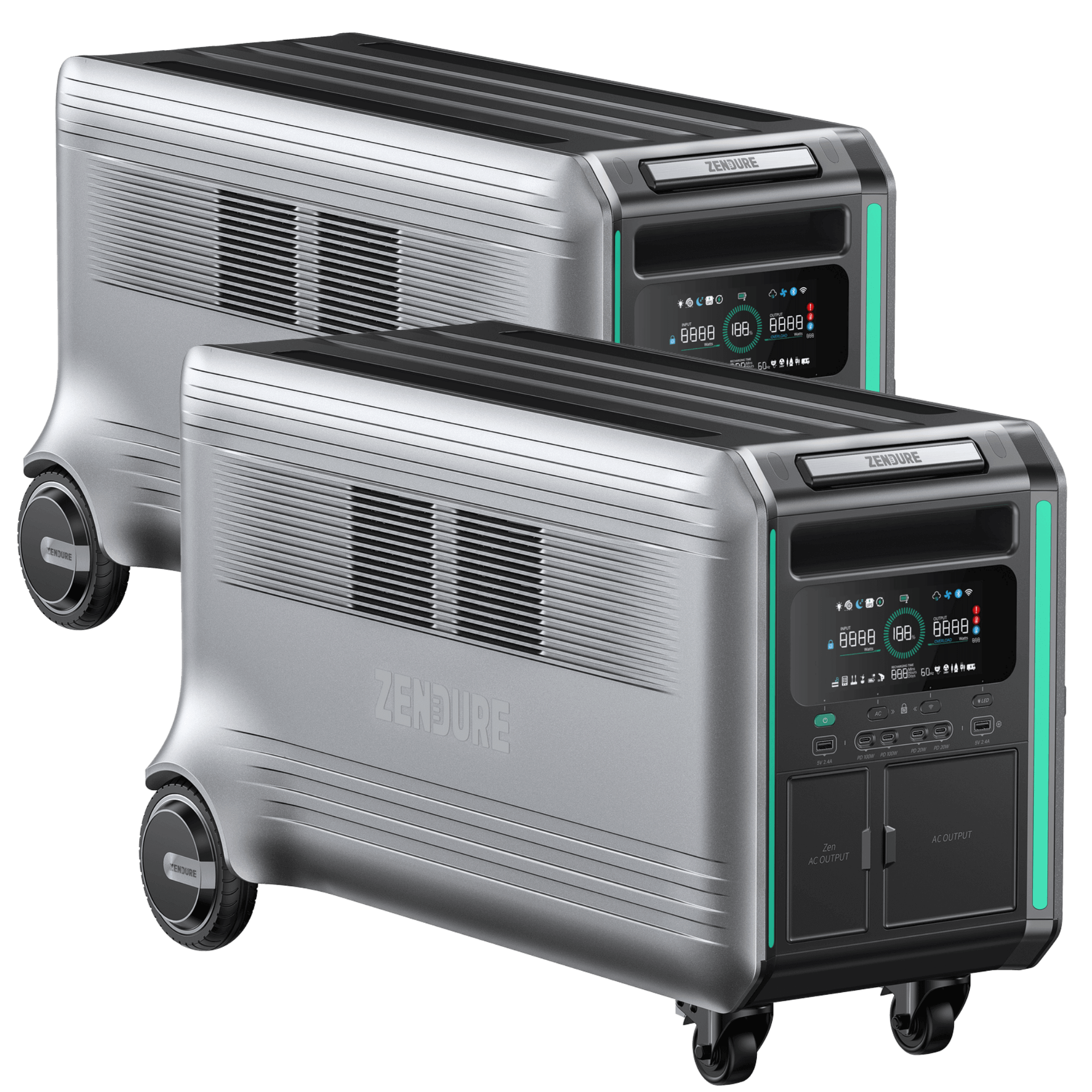
Explore this need in the finder →This exact Zendure U.S. selector option, “V4600*2 / 4 / Yes,” consists of two V4600 power stations, four matching B4600 batteries and the Home Panel. Each named battery is listed at 4,608 Wh, so the package totals 27,648 Wh of nameplate capacity. The selector record has a blank SKU and was unavailable at the time of the saved capture; neither point supports an invented retail code or a discontinuation claim. Treat the capacity as an arithmetic sum of the components, not a measured amount of AC energy available to appliances.
A balanced expansion tier
Four satellites are a practical midpoint for buyers comparing expansion sizes because the system can be arranged as two B4600 packs with each V4600, respecting Zendure’s limit of four matched packs per station. The official option identifies four packs in total but does not assign them, so this is a feasible layout rather than a promised factory allocation. The four batteries contribute 18,432 Wh beyond the two base units. Compared with three packs, the fourth adds another 4,608 Wh and roughly 93 lb; compared with five, it forgoes that same increment and weight. This choice deserves a load plan that explains why the middle point is enough.
The Home Panel changes the system, not each station
Zendure’s Home Panel manual supports up to two SuperBase V units in a 120/240 V home system with ten load circuits, and the manufacturer documents a 7,600 W maximum for the two-station arrangement. That is the panel-linked system figure, not a per-station rating and not a promise that the home can run every circuit together. The installation manual calls for professional electrical work. Have an electrician review which circuits matter, their combined demand, their startup behavior and the site’s service. The document supports 120/240 V; 120/208 V is not established. An option without the included panel has separate station output plans and should not be described with this paired rating.
Plan loads and recharge independently
Two V4600 bases still have 3,800 W continuous AC output each. Four batteries increase the amount of energy stored, not the output limit. A fridge, lights and communications equipment may draw modest power for a long time, while a large heating or motor load can dominate the plan; check the appliance labels and startup requirements rather than selecting by Wh alone. Zendure lists up to 3,000 W solar input per station within its voltage and current window. No solar panels are part of this selector option. This per-station input rating should not be doubled into a system promise without confirming actual wiring and operating details.
Where 27.6 kWh fits
At 27,648 Wh nameplate, this package is far removed from a compact camping station. The V4600 bases weigh approximately 121 lb apiece; each B4600 is about 93 lb. With the Home Panel’s listed 19.4 lb, the named hardware totals approximately 633.4 lb before cartons and wiring. Those pieces are movable only with planning, and the panel needs a permanent installation location. Check the floor, doorway clearances, ventilation, cable routes and service access before buying. Neither wheels on the bases nor handles on the batteries make this assembly a light portable setup.
Who should pay the weight cost?
The four-pack option fits a home-backup buyer who wants the documented Home Panel connection, needs more stored reserve than the three-pack, and does not want to step up to the five-pack’s additional battery. If your outage plan has no meaningful use for the fourth module, the three-pack offers a lower total weight. If more stored energy is needed, the five-pack is the next selector choice; do not expect it to solve an excessive concurrent load. A no-panel configuration may suit independent 120 V stations, but it is not equivalent to this Home Panel package. The manufacturer rendering shows the two base stations only; the exact four-battery and Home Panel contents are supported by the selector and manuals. No hands-on runtime testing, current stock, installation price or verified Amazon ASIN is claimed here.
Key details at a glance
| Nameplate battery capacity | 27648 Wh |
|---|---|
| Rated AC output | 7600 W |
| Maximum solar input | 3000 W |
| Included panels, combined nameplate | 0 W |
| Maximum USB-C output per port | 100 W |
| Listed weight | 121 lb |
More specifications and setup details
| Compatible extra-battery expansion | Yes |
|---|---|
| 12 V DC output | 126 W |
| Manufacturer UPS transfer figure | 13 ms |
| AC outlet output | Yes |
| USB-C ports | 4 |
| USB-A ports | 2 |
| Battery chemistry | LiFePO4 |
| Expansion battery in this package | Yes |
| Home Power Panel in this package | Yes |
| HPP 120/240 V split-phase | Yes |
| Separate station units in offer | 2 |
| Smart Transfer Switch in this package | Yes |
| Expansion packs in exact offer | 4 |
| Solar panels in exact offer | 0 |
| Included expansion batteries | 4 units |
Use the exact model’s instructions for operating limits, supplied equipment and version differences.
Sources for this assessment
A useful match starts with the loads that matter.
Use the finder for hard electrical requirements, then check appliance starting behavior, actual run time and the exact package in the full assessment.