
On this page
Your needs, this model
Does it fit your priorities?
Can your 120 V plan use two independent stations, each limited to 3,800 W, with 27,648 Wh nameplate across this offer?
The option totals 27,648 Wh nameplate; each of the two independent V4600 outputs remains rated at 3,800 W.
Explore this need in the finder →Do you require at least 4 matching B4600 batteries included with the two stations?
This exact option contains 4 B4600 packs; the expansion minimum must not be set above that count.
Explore this need in the finder →Does one V4600 Zen outlet in 240 V mode meet your need without assuming the bases are linked?
The manual documents an individual 240 V Zen output; this no-panel offer does not prove a paired household system.
Explore this need in the finder →Can you obtain solar panels separately if you depend on solar charging?
The stations accept solar within published limits, but this option includes no solar panels; cable contents are unknown.
Explore this need in the finder →Can you handle a single V4600 base weighing about 121 lb?
Each V4600 weighs about 121 lb before packaging, independent of the included expansion pack count.
Explore this need in the finder →Can you stage the full 614 lb station-and-battery plan?
Two bases and 4 matching B4600 packs total approximately 614 lb. This is not a carry-friendly one-piece system.
Explore this need in the finder →Four added packs reach the midpoint of this system
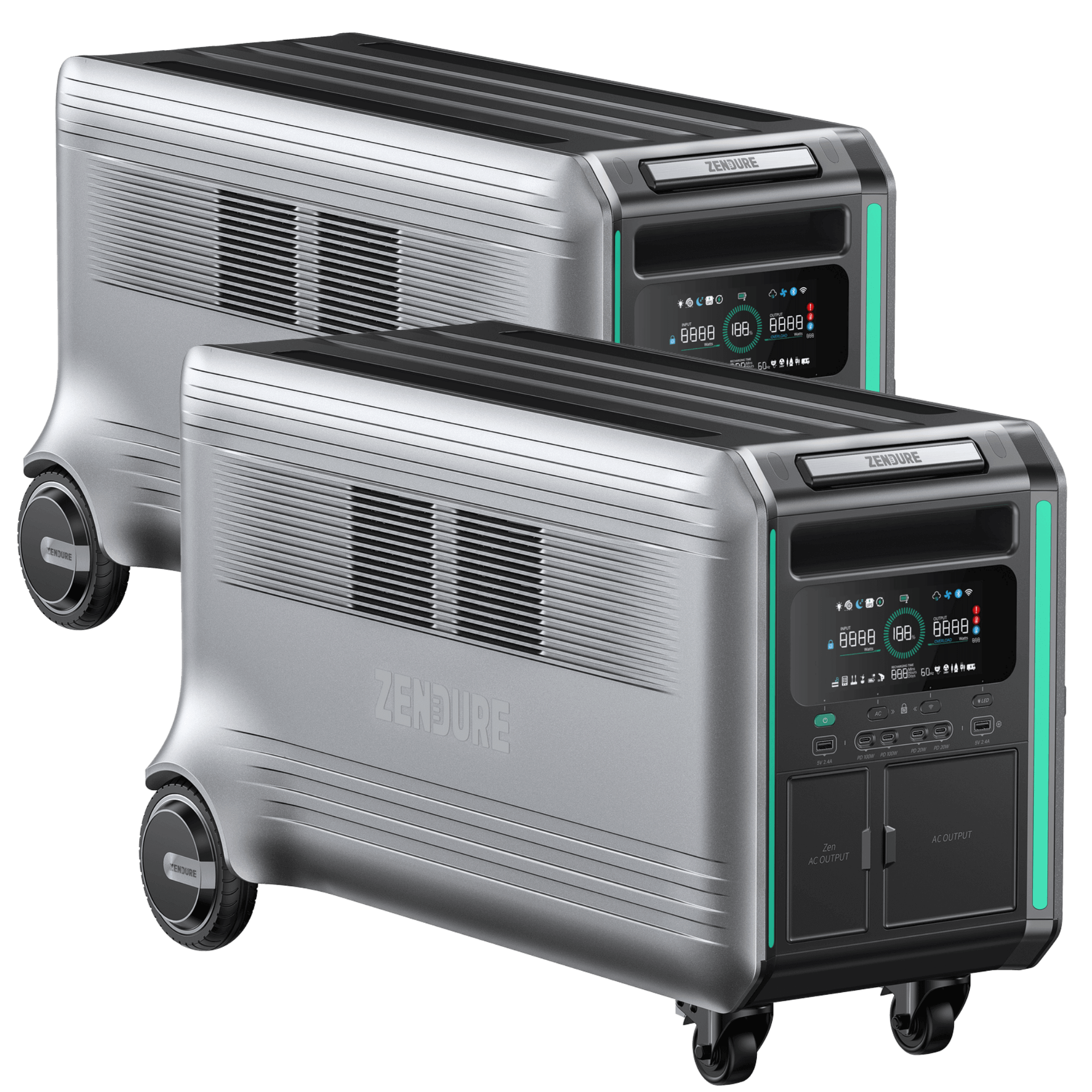
This U.S. selector configuration combines two V4600 base stations with four matching B4600 Satellite Batteries and no Home Panel. Each named component is listed at 4,608 Wh, giving 27,648 Wh of total nameplate storage: 9,216 Wh in the two bases and 18,432 Wh in the added packs. The total is useful for sizing a long backup plan, but it should not be translated directly into delivered AC energy or appliance hours. The original selector capture showed this exact option unavailable; availability can change, and the snapshot does not mean discontinued.
Capacity with a clear expansion ceiling
At four added batteries, the offer is halfway to the manual’s maximum of four compatible satellite batteries per station and eight for a two-station system. The two included V4600s therefore preserve room for additional B4600s later, if the installation and budget justify it. Compared with the three-pack setup, this choice adds 4,608 Wh and about 93 lb of hardware; moving to five packs adds the same amount again. The practical question is whether the extra reserve is more useful than the added storage burden, not whether the larger number sounds better.
Output remains separate unless the topology changes
For this no-Home-Panel package, each station is documented for 3,800 W continuous AC. The two ratings are not a single 7,600 W outlet. A buyer can plan separate 120 V loads across the two units, while keeping every individual load within the station serving it. A V4600’s Zen outlet can switch between 120 V and 240 V, but that per-station capability does not prove the two units create a household split-phase output together. The exact package does not confirm an included ZenY link cable or a transfer installation.
Solar and familiar outlets
The station manual lists up to 3,000 W solar input per V4600, with a 12–150 V input window and a 150 V open-circuit ceiling. No solar panels are included here, and cable contents remain unconfirmed for this exact choice. Two bases do not make it safe to assume an aggregate 6,000 W solar path unless the wiring and system instructions establish that configuration. Each base offers four ordinary 120 V outlets, two Zen outputs with selectable voltage, USB-C, USB-A and DC outlets. Verify the right connector and current rating for the loads you intend to power.
Placement is a project
The two bases weigh about 242 lb combined. Four B4600 batteries add about 372 lb, so the named station-and-battery hardware totals roughly 614 lb before boxes or accessories. It is not one lift, but the 121 lb bases and 93 lb modules need a realistic moving route, stable storage and ventilation. The manual’s LFP/cycle-life claims do not remove normal requirements around temperature, charge limits and manufacturer instructions. If the hardware will be moved often, a smaller pack count may be the more useful plan despite its lower nameplate capacity.
Who gets value from this option?
This four-battery arrangement is aimed at a fixed backup user who wants a substantial reserve across two station bodies and does not need a bundled Home Panel. The two-pack version is materially lighter; the six-pack version offers 36,864 Wh but adds two more large modules. If your critical circuit plan depends on a licensed-electrician-installed Home Panel or a combined 7,600 W output, compare the separate Home Panel selector choices rather than assuming this no-panel package provides that functionality.
What the spec does not say
The manual’s 5,000 W peak figure is not a continuous rating, and 27,648 Wh is not a guaranteed usable AC amount. The exact listing snapshot does not verify a current price, solar panel, bundled wiring, or Amazon identity; none is supplied here. B4600 chemistry must remain compatible with the V4600 system. This is a capacity-heavy option with clear limits, and it suits only a buyer whose energy reserve, station-level output and component placement all fit the actual plan.
Key details at a glance
| Nameplate battery capacity | 27648 Wh |
|---|---|
| Rated AC output | 3800 W |
| Maximum solar input | 3000 W |
| Included panels, combined nameplate | 0 W |
| Maximum USB-C output per port | 100 W |
| Listed weight | 121 lb |
More specifications and setup details
| Compatible extra-battery expansion | Yes |
|---|---|
| 12 V DC output | 126 W |
| Manufacturer UPS transfer figure | 13 ms |
| AC outlet output | Yes |
| USB-C ports | 4 |
| USB-A ports | 2 |
| Battery chemistry | LiFePO4 |
| Expansion battery in this package | Yes |
| Home Power Panel in this package | No |
| Separate station units in offer | 2 |
| Smart Transfer Switch in this package | No |
| Expansion packs in exact offer | 4 |
| Solar panels in exact offer | 0 |
| Included expansion batteries | 4 units |
Use the exact model’s instructions for operating limits, supplied equipment and version differences.
Sources for this assessment
A useful match starts with the loads that matter.
Use the finder for hard electrical requirements, then check appliance starting behavior, actual run time and the exact package in the full assessment.