
On this page
Your needs, this model
Does it fit your priorities?
Can your 120 V plan use two independent stations, each limited to 3,800 W, with 32,256 Wh nameplate across this offer?
The option totals 32,256 Wh nameplate; each of the two independent V4600 outputs remains rated at 3,800 W.
Explore this need in the finder →Do you require at least 5 matching B4600 batteries included with the two stations?
This exact option contains 5 B4600 packs; the expansion minimum must not be set above that count.
Explore this need in the finder →Does one V4600 Zen outlet in 240 V mode meet your need without assuming the bases are linked?
The manual documents an individual 240 V Zen output; this no-panel offer does not prove a paired household system.
Explore this need in the finder →Can you obtain solar panels separately if you depend on solar charging?
The stations accept solar within published limits, but this option includes no solar panels; cable contents are unknown.
Explore this need in the finder →Can you handle a single V4600 base weighing about 121 lb?
Each V4600 weighs about 121 lb before packaging, independent of the included expansion pack count.
Explore this need in the finder →Can you stage the full 707 lb station-and-battery plan?
Two bases and 5 matching B4600 packs total approximately 707 lb. This is not a carry-friendly one-piece system.
Explore this need in the finder →A five-battery pair for long-duration storage
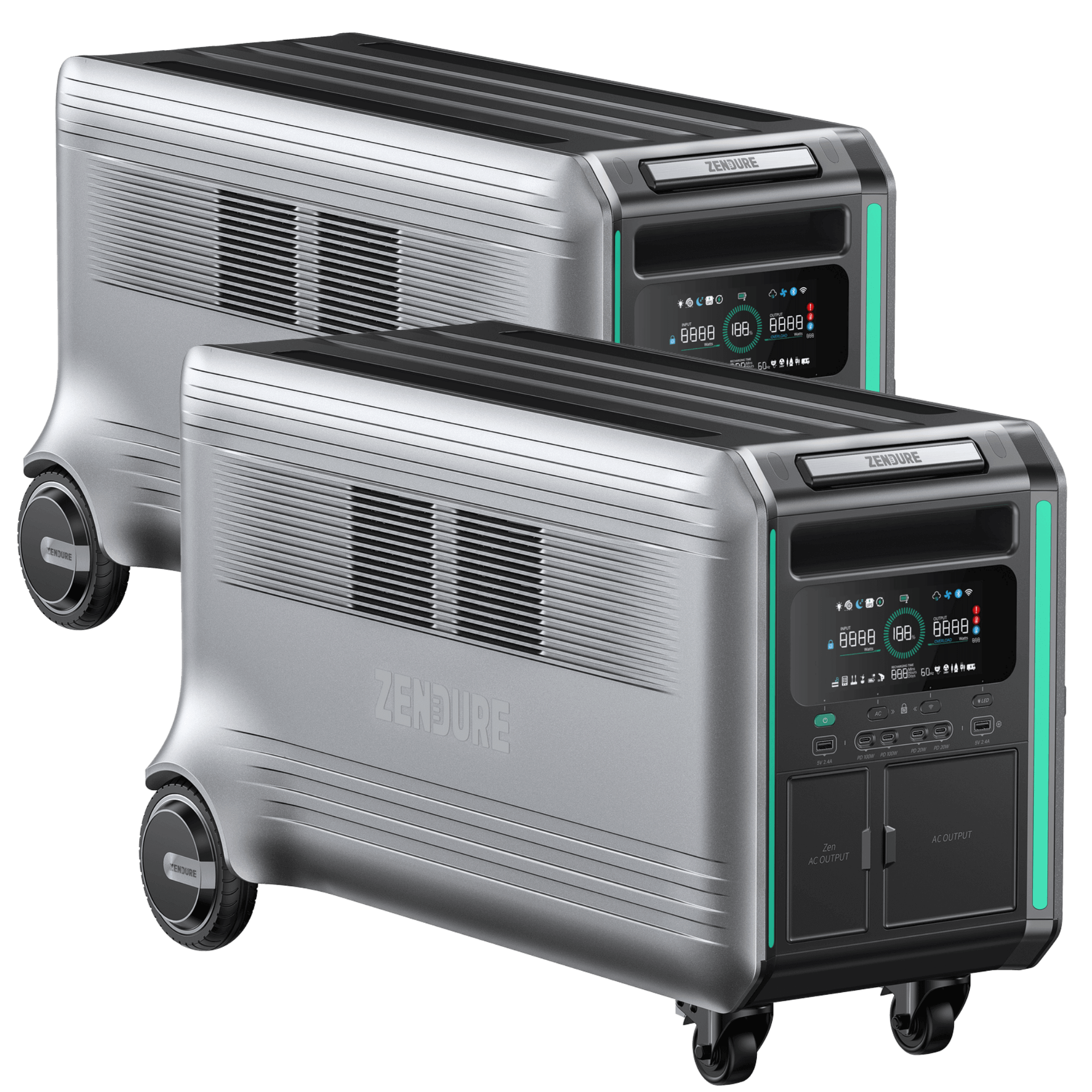
Zendure’s selected option reads V4600*2 / 5 / No: two SuperBase V4600 power stations and five matching B4600 expansion batteries, without a Home Panel. On the manufacturer’s 4,608 Wh nameplate figures, the complete set totals 32,256 Wh. This is a considerable reserve across seven heavy components, not an estimate of AC energy that will reach appliances. The archived official selector snapshot marked the option unavailable, so the stock observation is historical and does not establish that the product has been discontinued.
Five satellites change storage, not inverter power
The two V4600s supply 9,216 Wh of base capacity; the five B4600s add 23,040 Wh. In comparison, four satellite packs leave the buyer with 27,648 Wh, while six provide 36,864 Wh. Each step means another roughly 93 lb pack. Five is a useful middle choice only for a load schedule that genuinely needs that incremental energy between charges. It does not raise the single station’s 3,800 W continuous AC ceiling or convert a surge number into a safe running load.
Two stations, no bundled linking claim
The exact seller choice includes two station bodies but lists Home Panel No. Treat each V4600 as a separate source, each rated for 3,800 W continuous AC. Loads can be split between units in a 120 V plan, but no one load should be assumed to draw from both. The manual identifies a 240 V mode on a station’s Zen outlet; that still does not equal a confirmed linked residential service for this no-panel package. The manufacturer describes paired configurations elsewhere, but this selector does not establish the cable or installation parts needed to use one.
Use the input ratings rather than panel marketing totals
Each station supports solar charging up to 3,000 W within its prescribed voltage/current limits. This offer contains no solar modules; exact solar cable contents are unknown. Check a proposed array’s open-circuit voltage, current and connector before deciding that panels are suitable. The manual lists AC charging at different maximum wattages for 120 V and 240 V input; that is a charging-input distinction and should not be confused with AC output. Standard AC receptacles remain 120 V, while only the two Zen outlets can select 120 or 240 V.
Handle six hundred-plus pounds of named components
Two bases weigh about 242 lb together. The five batteries add 465 lb, for approximately 707 lb of station-and-battery equipment before packaging. Plan the route for each roughly 121 lb station and 93 lb battery, along with floor capacity, ventilation and storage access. A stationary setup is much more plausible than repeated transport. Use the published component weight as a planning value rather than treating wheels on the station as a way to move every battery or the complete system at once.
Choose this instead of a panel only when the layout fits
This configuration fits someone who wants the storage scale of 32.256 kWh across two separate generators and does not need a Home Panel included in this exact package. A homeowner wanting ten backed-up circuits or the system’s stated 7,600 W paired path should compare a Home Panel version and budget for professional installation. If the use case is only a few appliances or weekend travel, the two- or three-battery packages avoid a large investment in energy capacity that may sit unused.
Limits and alternatives
Zendure identifies LFP chemistry and publishes a 6,000-cycle claim in the manual; that is not an independent lifespan test. The 5,000 W peak/AmpUp figure is not continuous output. No panels, a transfer panel, an exact bundle cable list, current stock status or verified ASIN are established by this review. If you want a higher stored-energy total, compare the six- or eight-pack option; if you need higher output, changing battery count is the wrong lever. This offer makes sense only when all those distinctions match your actual load and installation plan.
Key details at a glance
| Nameplate battery capacity | 32256 Wh |
|---|---|
| Rated AC output | 3800 W |
| Maximum solar input | 3000 W |
| Included panels, combined nameplate | 0 W |
| Maximum USB-C output per port | 100 W |
| Listed weight | 121 lb |
More specifications and setup details
| Compatible extra-battery expansion | Yes |
|---|---|
| 12 V DC output | 126 W |
| Manufacturer UPS transfer figure | 13 ms |
| AC outlet output | Yes |
| USB-C ports | 4 |
| USB-A ports | 2 |
| Battery chemistry | LiFePO4 |
| Expansion battery in this package | Yes |
| Home Power Panel in this package | No |
| Separate station units in offer | 2 |
| Smart Transfer Switch in this package | No |
| Expansion packs in exact offer | 5 |
| Solar panels in exact offer | 0 |
| Included expansion batteries | 5 units |
Use the exact model’s instructions for operating limits, supplied equipment and version differences.
Sources for this assessment
A useful match starts with the loads that matter.
Use the finder for hard electrical requirements, then check appliance starting behavior, actual run time and the exact package in the full assessment.