
On this page
Your needs, this model
Does it fit your priorities?
Can your 120 V plan use two independent stations, each limited to 3,800 W, with 36,864 Wh nameplate across this offer?
The option totals 36,864 Wh nameplate; each of the two independent V4600 outputs remains rated at 3,800 W.
Explore this need in the finder →Do you require at least 6 matching B4600 batteries included with the two stations?
This exact option contains 6 B4600 packs; the expansion minimum must not be set above that count.
Explore this need in the finder →Does one V4600 Zen outlet in 240 V mode meet your need without assuming the bases are linked?
The manual documents an individual 240 V Zen output; this no-panel offer does not prove a paired household system.
Explore this need in the finder →Can you obtain solar panels separately if you depend on solar charging?
The stations accept solar within published limits, but this option includes no solar panels; cable contents are unknown.
Explore this need in the finder →Can you handle a single V4600 base weighing about 121 lb?
Each V4600 weighs about 121 lb before packaging, independent of the included expansion pack count.
Explore this need in the finder →Can you stage the full 800 lb station-and-battery plan?
Two bases and 6 matching B4600 packs total approximately 800 lb. This is not a carry-friendly one-piece system.
Explore this need in the finder →Six extra B4600s raise the energy reserve to 36.9 kWh
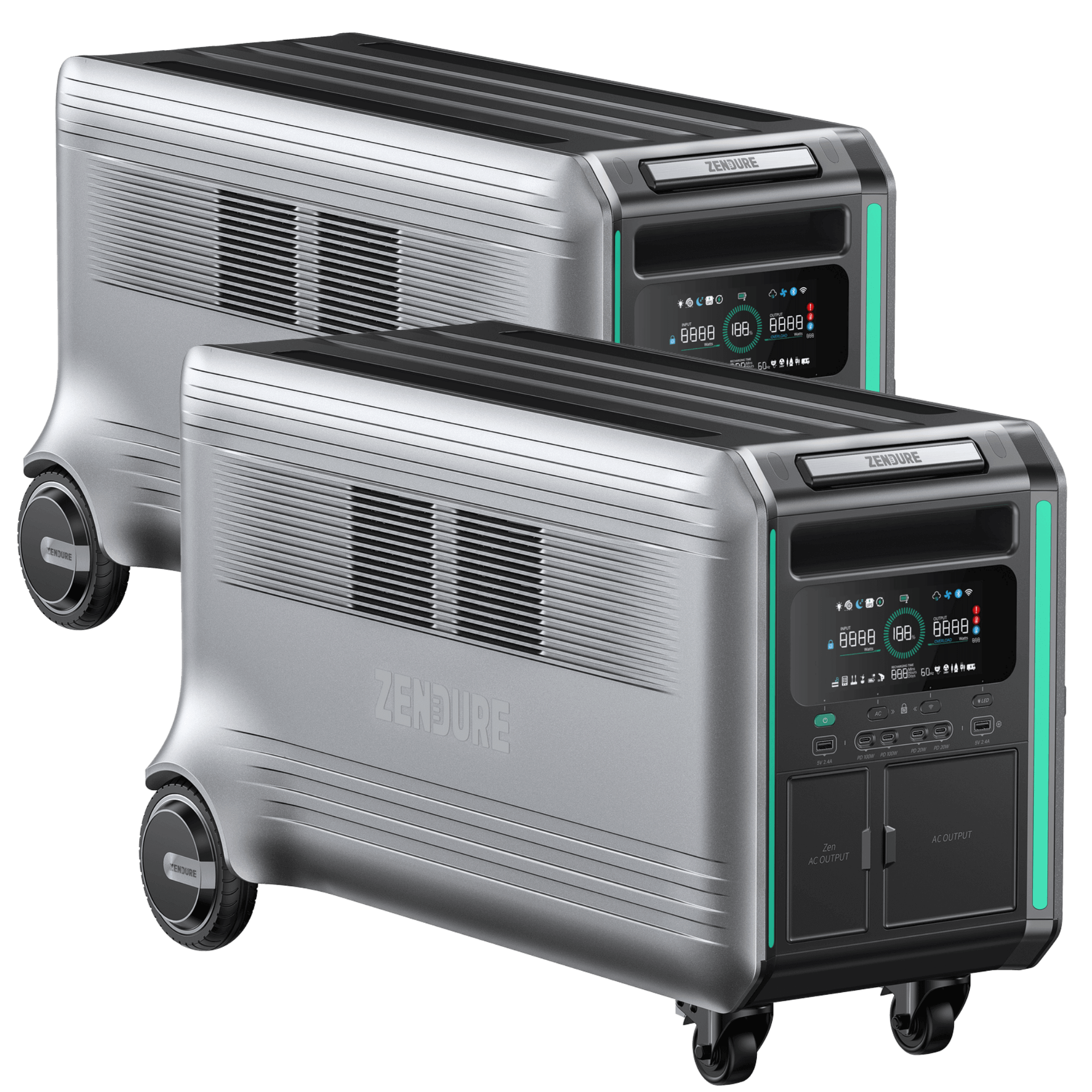
This exact Zendure U.S. selector option contains two V4600 base stations, six matching B4600 Satellite Batteries and no Home Panel. At 4,608 Wh per named component, the package totals 36,864 Wh of nameplate capacity. That number describes stored battery capacity, not guaranteed AC delivery or a promise that a household will run for a fixed number of hours. The source snapshot on file showed the selector option unavailable; it should be read as a dated status observation rather than discontinuation evidence.
A large middle tier has real tradeoffs
The six modules add 27,648 Wh on top of the two stations’ 9,216 Wh. Five satellites would provide 32,256 Wh; seven raise the total to 41,472 Wh. The difference between either adjacent option is one 4,608 Wh B4600 and about 93 lb. Buyers should compare that energy increment with their actual daily loads, recharge opportunities and tolerance for staging multiple batteries. It is possible to buy more storage than a system can recharge conveniently or than the backup loads can use.
Keep the two AC sources separate
This version excludes the Home Panel. Each V4600 is rated for 3,800 W continuous AC output. Do not present these as one 7,600 W receptacle or a split-phase home system. At 120 V, the two independent stations can serve separate appliances or groups of loads, each within its own rating. A 240 V mode is documented for the Zen output on each station, but a linked residential installation is not confirmed by this exact no-panel option. The package includes two station units, but only a supported wiring design can tell you whether they may be used together for a particular purpose.
Solar and AC charging are per-station facts
The manual lists a maximum 3,000 W solar input for a V4600 and a 12–150 V DC input range, with a 150 V open-circuit maximum. This listing includes no panels and does not settle cable contents. A separate panel set is therefore needed for solar use; check the electrical limits for each station rather than counting panel wattage twice. AC recharge also has different rated limits at 120 V and 240 V input. The ordinary receptacles are 120 V; the selectable Zen ports have distinct limits and should be checked for the intended appliance.
Move and place the equipment carefully
The two bases total about 242 lb; the six B4600s add 558 lb, yielding around 800 lb of named station-and-battery components. That is before cartons, cables or other accessories. Each piece is heavy enough to influence stairs, doorways, flooring, storage and safe lifting. This is best planned as a stationary multi-component system with a clear installation area. If the backup equipment has to move through a house during an outage, consider whether fewer batteries and a smaller staged energy target are safer and more practical.
Who benefits from the no-panel choice?
The buyer most likely to prefer this option already has a plan for two independent V4600 units and wants a large reserve without selecting a bundled Home Panel. Someone who requires transfer to household circuits, the panel’s ten-circuit arrangement or the documented 7,600 W paired rating should compare the Home Panel offer instead. Someone whose one appliance exceeds 3,800 W should not assume that six batteries change that limit. Compare the V6400 family or another rated architecture only after identifying the appliance’s continuous and startup demands.
What remains uncertain
The manual’s 6,000-cycle statement is a manufacturer claim, not measured proof of service life. The 5,000 W peak figure is not a continuous AC rating. Solar panels and the exact included cable list are not confirmed in this selected package, and the saved availability flag does not establish current inventory. Use the model selector’s exact option, check present seller contents, and treat nameplate capacity as a comparison point rather than a promise of usable energy.
Key details at a glance
| Nameplate battery capacity | 36864 Wh |
|---|---|
| Rated AC output | 3800 W |
| Maximum solar input | 3000 W |
| Included panels, combined nameplate | 0 W |
| Maximum USB-C output per port | 100 W |
| Listed weight | 121 lb |
More specifications and setup details
| Compatible extra-battery expansion | Yes |
|---|---|
| 12 V DC output | 126 W |
| Manufacturer UPS transfer figure | 13 ms |
| AC outlet output | Yes |
| USB-C ports | 4 |
| USB-A ports | 2 |
| Battery chemistry | LiFePO4 |
| Expansion battery in this package | Yes |
| Home Power Panel in this package | No |
| Separate station units in offer | 2 |
| Smart Transfer Switch in this package | No |
| Expansion packs in exact offer | 6 |
| Solar panels in exact offer | 0 |
| Included expansion batteries | 6 units |
Use the exact model’s instructions for operating limits, supplied equipment and version differences.
Sources for this assessment
A useful match starts with the loads that matter.
Use the finder for hard electrical requirements, then check appliance starting behavior, actual run time and the exact package in the full assessment.