
On this page
Your needs, this model
Does it fit your priorities?
Do you need nearly the full two-station B4600 expansion allowance?
The offer includes seven B4600s. The two bases can be arranged with three on one and four on the other, within the published limit, but the selector does not assign them.
Explore this need in the finder →Is the Home Panel's documented paired 120/240 V system part of your plan?
The exact option includes the Home Panel; Zendure documents up to two stations, ten circuits and up to 7,600 W paired output.
Explore this need in the finder →Is 41,472 Wh nameplate a genuine reserve need?
It is the sum of two V4600 bases and seven matching B4600 batteries, not independently measured usable AC energy.
Explore this need in the finder →Can you stage a system weighing about 912 lb before installation materials?
The listed station, battery and panel component weights sum to about 912.4 lb, before packaging or wiring.
Explore this need in the finder →Do you need at least 7 compatible satellite batteries included, rather than merely supported?
The exact U.S. option lists 7 B4600 packs in the box; the seller record does not state a station-by-station allocation.
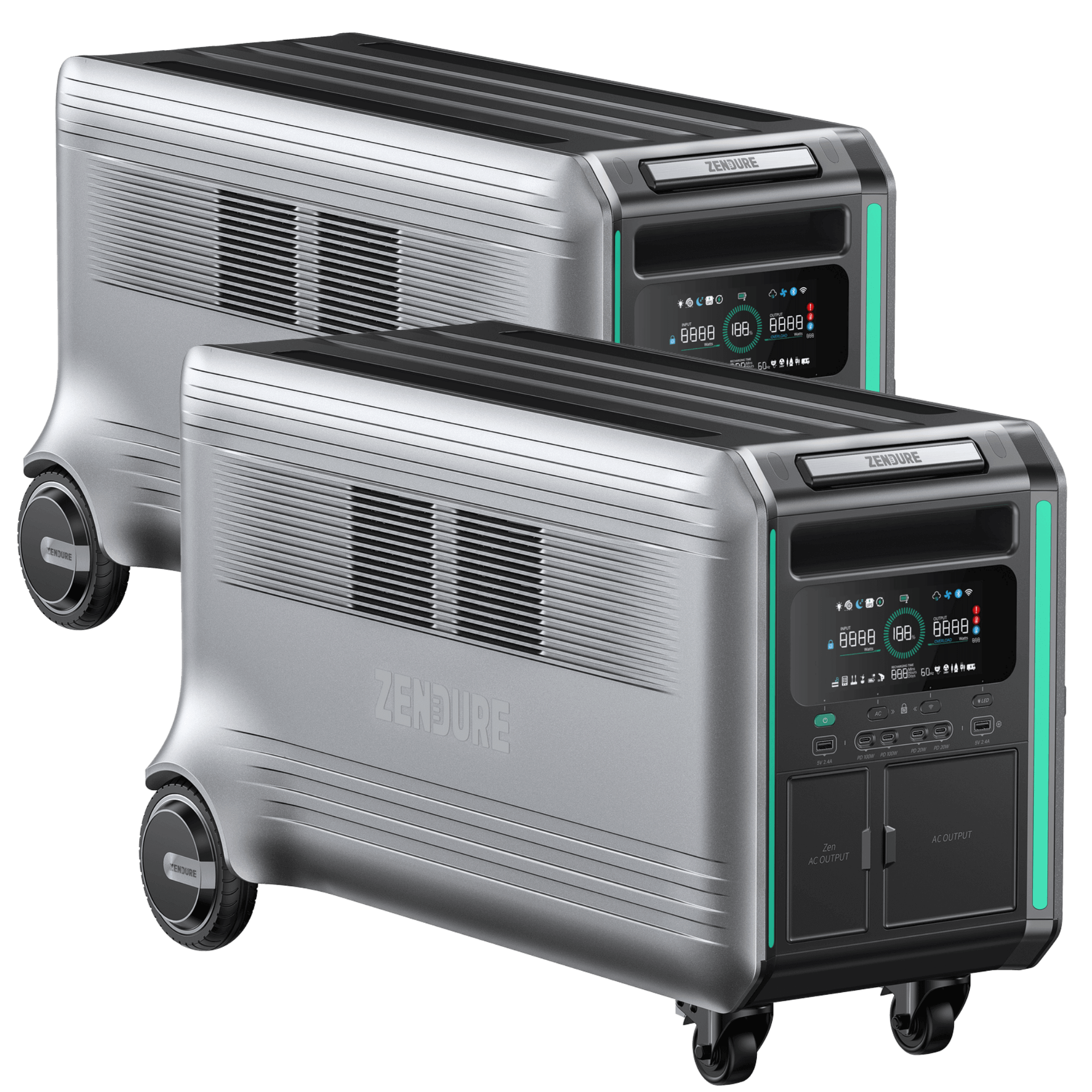
Explore this need in the finder →The saved U.S. selector identifies this offer as “V4600*2 / 7 / Yes”: two V4600 base stations, seven matching B4600 satellite packs and the Home Panel. At 4,608 Wh per listed component, the package sums to 41,472 Wh of nameplate battery capacity. That is not usable AC energy and does not determine runtime without a real load plan. The captured availability field was false, which is a dated listing observation rather than proof of discontinuation. The option’s SKU is blank in the source, so it is not filled with a neighboring code.
Seven satellites sit one step below maximum
Zendure’s U.S. manual allows up to four matched B4600 satellites per V4600. Across two bases, seven packs fit the combined limit of eight, and a three-plus-four distribution is one possible way to honor the per-station cap. The selector records seven in total but does not specify which station gets which pack. This distinction matters: it is possible to arrange the components within the published limit, but no exact station allocation is promised by the listing. The seventh battery adds 4,608 Wh and about 93 lb over the six-pack; the eight-pack adds one more matching step and reaches the maximum 46,080 Wh system nameplate.
Panel integration is the reason to choose this package
The included Home Panel changes the intended use from two independent portable outputs to a documented home-circuit setup. Zendure’s installation manual lists 120/240 V service, ten load circuits and support for up to two SuperBase V stations. The manufacturer documents up to 7,600 W on the linked pair. A qualified electrician still needs to inspect the home’s service, choose which loads belong on the panel, confirm wiring and assess local-code conditions. The documentation does not show support for 120/208 V. Seven batteries raise stored energy; they do not raise the Home Panel’s output limit or turn the package into a whole-house guarantee.
Output and endurance are different decisions
Each V4600 is rated for 3,800 W continuous AC. The 7,600 W figure applies only to the correctly linked two-station Home Panel system. Before buying, compare that ceiling with simultaneous load and motor-start demands. Then estimate how much energy the selected circuits use over the desired outage window. A load may fit the power rating but consume the reserve too quickly, or the reserve may be enormous while a single appliance exceeds the output capability. Nameplate Wh cannot settle either question by itself. This review does not claim an independent runtime test, and the seller record does not state usable AC energy.
Solar and space are not afterthoughts
Each station accepts up to 3,000 W solar input within the manual’s voltage and current limits. The selector does not include panels, and no panel string or charging cable is inferred from a product image. Verify array voltage and the exact connection accessories separately. The two bases weigh about 242 lb in total; seven batteries add 651 lb, and the panel adds about 19.4 lb. The named parts therefore approach 912.4 lb before cartons and wiring. These are separate heavy pieces, not a single load, but you still need safe routes, floor capacity, storage space, ventilation and access for the installer. The system is not a practical choice for frequent moves.
Compare with the eight-pack and six-pack
The six-pack is lighter by about 186 lb and provides 36,864 Wh nameplate. The eight-pack adds one battery and reaches the two-base expansion ceiling at 46,080 Wh, but weighs about 93 lb more than this selection. Choose seven only if its 41,472 Wh midpoint matches a meaningful reserve target and you prefer not to buy the eighth module. If a circuit-integration plan is not important, compare the no-Home-Panel option and weigh its different output topology. The saved official image is a CGI of two SuperBase V4600 bases only; neither the seven batteries nor the Home Panel appears. Package facts are supported by the selector and manuals. Installation cost, current stock, third-party seller identity and verified ASIN remain unknown.
Key details at a glance
| Nameplate battery capacity | 41472 Wh |
|---|---|
| Rated AC output | 7600 W |
| Maximum solar input | 3000 W |
| Included panels, combined nameplate | 0 W |
| Maximum USB-C output per port | 100 W |
| Listed weight | 121 lb |
More specifications and setup details
| Compatible extra-battery expansion | Yes |
|---|---|
| 12 V DC output | 126 W |
| Manufacturer UPS transfer figure | 13 ms |
| AC outlet output | Yes |
| USB-C ports | 4 |
| USB-A ports | 2 |
| Battery chemistry | LiFePO4 |
| Expansion battery in this package | Yes |
| Home Power Panel in this package | Yes |
| HPP 120/240 V split-phase | Yes |
| Separate station units in offer | 2 |
| Smart Transfer Switch in this package | Yes |
| Expansion packs in exact offer | 7 |
| Solar panels in exact offer | 0 |
| Included expansion batteries | 7 units |
Use the exact model’s instructions for operating limits, supplied equipment and version differences.
Sources for this assessment
A useful match starts with the loads that matter.
Use the finder for hard electrical requirements, then check appliance starting behavior, actual run time and the exact package in the full assessment.