
On this page
Your needs, this model
Does it fit your priorities?
Can your 120 V plan use two independent stations, each limited to 3,800 W, with 41,472 Wh nameplate across this offer?
The option totals 41,472 Wh nameplate; each of the two independent V4600 outputs remains rated at 3,800 W.
Explore this need in the finder →Do you require at least 7 matching B4600 batteries included with the two stations?
This exact option contains 7 B4600 packs; the expansion minimum must not be set above that count.
Explore this need in the finder →Does one V4600 Zen outlet in 240 V mode meet your need without assuming the bases are linked?
The manual documents an individual 240 V Zen output; this no-panel offer does not prove a paired household system.
Explore this need in the finder →Can you obtain solar panels separately if you depend on solar charging?
The stations accept solar within published limits, but this option includes no solar panels; cable contents are unknown.
Explore this need in the finder →Can you handle a single V4600 base weighing about 121 lb?
Each V4600 weighs about 121 lb before packaging, independent of the included expansion pack count.
Explore this need in the finder →Can you stage the full 893 lb station-and-battery plan?
Two bases and 7 matching B4600 packs total approximately 893 lb. This is not a carry-friendly one-piece system.
Explore this need in the finder →Seven B4600 modules approach the pair’s expansion limit
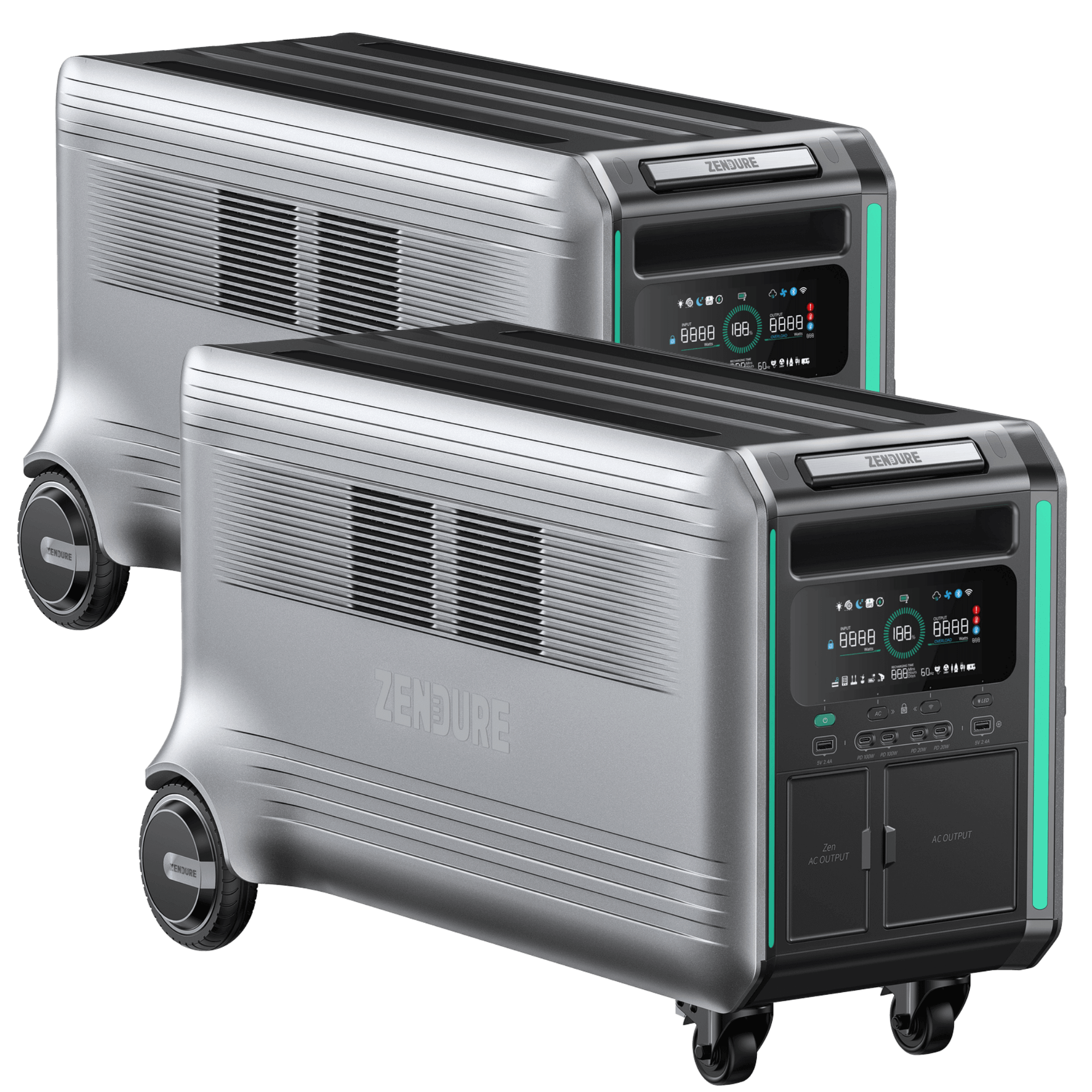
The exact option here is V4600*2 / 7 / No: two SuperBase V4600 stations with seven matching B4600 Satellite Batteries and no Home Panel. The manufacturer lists 4,608 Wh per station and battery, so the equipment has 41,472 Wh total nameplate capacity. The base pair accounts for 9,216 Wh and the seven added modules for 32,256 Wh. That is battery nameplate storage, not a guaranteed AC amount or a calculated runtime. The official selector record saved for this research marked the configuration unavailable; it is a stock snapshot, not proof of discontinued status.
Why choose seven instead of eight?
The manual permits up to four compatible satellite batteries per station and up to eight across two stations. Seven is one below that family ceiling. Moving from six to seven adds 4,608 Wh and about 93 lb; moving from seven to eight adds the same. Decide whether one more heavy pack changes your actual outage plan enough to justify the cost and charging logistics. A seven-pack package is not a compromise for output: it still does not raise a V4600’s 3,800 W station-level AC limit.
Two power stations do not imply paired output
There are two bases, each capable of independent use, but the exact package does not include a Home Panel. Treat the 120 V output as separate station plans, each with its own 3,800 W continuous limit. Do not add the two ratings for one appliance. The station’s Zen outlet also has a 240 V setting according to the manual, yet the no-panel selector does not verify a paired split-phase service or a required linking accessory. If a 240 V home circuit or larger combined AC load is essential, use the exact Home Panel configuration and professional installation plan, not an assumed cable upgrade.
Solar needs panels and electrical checks
Each station is documented for up to 3,000 W solar input, inside the specified 12–150 V DC range and 150 V open-circuit maximum. This offer includes no solar modules, and cable inclusion remains unknown. For a high-capacity system, assess the two station inputs separately and verify how the specific panels are connected; panel wattage alone does not establish voltage compatibility. At the AC inlet, the manual differentiates maximum charging rates by 120 V or 240 V source. Four ordinary outlets remain 120 V, while the two Zen outlets offer selectable voltage.
Storage density versus handling burden
Two V4600 stations weigh about 242 lb, and seven B4600 batteries bring the named hardware to about 893 lb before packaging. This is not a single lift, but the parts must fit somewhere safe, with room for ventilation, charging connections and movement. The bases weigh roughly 121 lb each and the batteries about 93 lb each. If an installer or family member must repeatedly move them, this upper-tier configuration may create more practical risk than value. A six-pack set weighs less and stores about 4.6 kWh less; compare that difference with real load estimates.
Ideal user and meaningful alternative
This package fits a fixed backup layout that values a very large nameplate reserve over low weight and already has a separate plan for the two station outputs. It is not the right bundle if you need the Home Panel included, a verified 7,600 W paired system, or an easy-to-carry power source. The eight-pack option reaches the stated maximum compatible expansion total; a V6400 pair can carry more energy per base but also changes the total mass. Compare packages by watt-hours, continuous output, installation and component count, not their headline expansion ceiling alone.
Manufacturer claims and purchase checks
Zendure’s manual identifies LFP batteries and publishes a cycle-life figure; it is not an independent test. The 5,000 W peak rating is not a continuous-output allowance. This selector listing supplies no solar panels or Home Panel, and the source does not verify an Amazon ASIN or a current in-stock offer. Confirm the exact option, current contents and installation path before purchase. This review makes no runtime or performance claims beyond Zendure’s published specifications.
Key details at a glance
| Nameplate battery capacity | 41472 Wh |
|---|---|
| Rated AC output | 3800 W |
| Maximum solar input | 3000 W |
| Included panels, combined nameplate | 0 W |
| Maximum USB-C output per port | 100 W |
| Listed weight | 121 lb |
More specifications and setup details
| Compatible extra-battery expansion | Yes |
|---|---|
| 12 V DC output | 126 W |
| Manufacturer UPS transfer figure | 13 ms |
| AC outlet output | Yes |
| USB-C ports | 4 |
| USB-A ports | 2 |
| Battery chemistry | LiFePO4 |
| Expansion battery in this package | Yes |
| Home Power Panel in this package | No |
| Separate station units in offer | 2 |
| Smart Transfer Switch in this package | No |
| Expansion packs in exact offer | 7 |
| Solar panels in exact offer | 0 |
| Included expansion batteries | 7 units |
Use the exact model’s instructions for operating limits, supplied equipment and version differences.
Sources for this assessment
A useful match starts with the loads that matter.
Use the finder for hard electrical requirements, then check appliance starting behavior, actual run time and the exact package in the full assessment.