
On this page
Your needs, this model
Does it fit your priorities?
Could two V4600 bases plus one B4600 give your separate-load setup 13,824 Wh while each station remains within 3,800 W continuous AC?
The two bases and one satellite sum to 13,824 Wh; without the Home Panel, rated output stays 3,800 W per station rather than becoming a shared 7,600 W path.
Explore this need in the finder →Does this two-station selector offer include one B4600 battery total, compatible with the V4600 family?
The selected option lists one added B4600 for the pair; it does not state that one pack is supplied for each station.
Explore this need in the finder →Do you need two separate V4600 units and a 240 V Zen output, without a Home Panel in this bundle?
There are two station units. One station can use its documented 240 V Zen mode, but this exact offer does not establish linked home-panel output.
Explore this need in the finder →Will you add your own solar panels if you rely on solar charging across these two V4600 units?
Solar input is available up to 3,000 W per base within the manual limits; the bundle contains no panel.
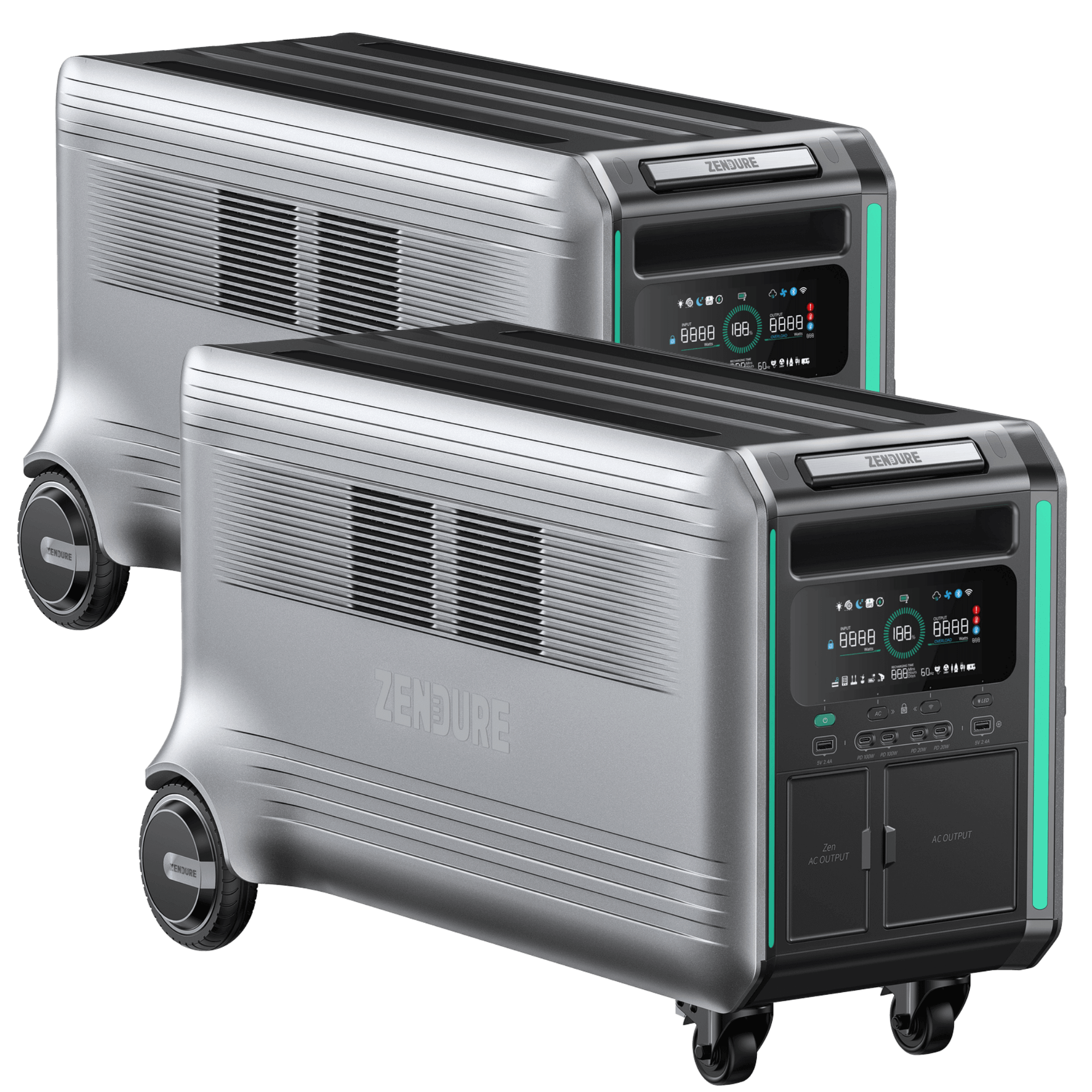
Explore this need in the finder →“V4600*2 / 1 / No” is a two-station U.S. offer with one extra B4600 Satellite Battery total and no Home Panel. The package therefore contains two 4,608 Wh V4600 stations plus one 4,608 Wh B4600, or 13,824 Wh of nameplate capacity across the equipment. It is not one 13.8 kWh inverter: each base station retains a 3,800 W rated AC limit, and the option does not include the Home Panel that Zendure documents for its 7,600 W linked arrangement.
Two stations are useful when loads are separate
The strongest case for this option is distributing equipment between two genuinely separate places or circuits—such as a home office and a refrigerator area—while having more stored energy than two bare bases. Two outlets or two independent installations can be convenient, but one station’s capacity and inverter do not flow through the other. The selected bundle’s listing identifies one extra battery; it does not say which of the two station systems receives it. The safe package-level assessment is 13,824 Wh total, while any 240 V load and its extra-battery allocation should be planned around the station actually connected to it.
Do not join the two station outputs to obtain 7,600 W without the manufacturer-specified linking arrangement. The Home Panel is absent from this exact selector option. Zendure’s single-station rating remains 3,800 W; the paired figure belongs to a documented two-station/Home Panel plan. The 5,000 W peak/AmpUp figure for a single V4600 is also not the continuous output rating. Each load should be placed on a specific station and checked against the continuous and starting requirements of its equipment.
Battery type and operating limits
Both V4600 bases and the included B4600 use Zendure’s LFP family. The U.S. manual lists a base capacity of 4,608 Wh and says that the matching satellite battery connects to a SuperBase V with its battery cable. It permits up to four compatible batteries per station; the eight-pack ceiling for a two-station maximum is not what this offer contains. Do not mix in a B6400: the V6400’s semi-solid-state cells are a different family. A large nameplate total does not promise the same amount of AC-delivered energy, and Zendure’s cycle-life number is a manufacturer claim rather than an independent test.
Each base has four ordinary 120 V AC receptacles and two Zen outlets selectable for 120 V or 240 V. In this no-panel offer, the user should treat the stations as separate output sources, not assume a shared 240 V home service. Solar input is listed up to 3,000 W per station within the manual’s voltage/current limits, but this box includes no panels. AC input is voltage-specific at 1,800 W/120 V or 3,600 W/240 V per unit. The manual’s combined 126 W car/DC5521 output ceiling is per station’s output group, not a package-wide rating for every connector.
Moving and alternatives
Two 121 lb base stations and a 93 lb battery add up to about 335 lb of listed components before packaging. The built-in wheels are practical on a suitable floor but do not make this a single portable unit; plan for multiple placements, lifting and the route each heavy box must travel. The included battery cable, clearances and operating conditions should follow the manual.
Choose the two-station V4600 package without a battery if two units matter but the extra duration does not. Choose the corresponding Home Panel bundle if you need the documented paired home-circuit path and can arrange professional installation. If you need more reserve in only one location, compare a single V6400 plus B6400; if the loads can remain at 3,800 W or less per station and independence is valuable, this two-unit option is the more flexible layout. The official snapshot marked the selected package unavailable, without establishing that it has been discontinued.
Key details at a glance
| Nameplate battery capacity | 13824 Wh |
|---|---|
| Rated AC output | 3800 W |
| Maximum solar input | 3000 W |
| Included panels, combined nameplate | 0 W |
| Maximum USB-C output per port | 100 W |
| Listed weight | 121 lb |
More specifications and setup details
| Compatible extra-battery expansion | Yes |
|---|---|
| 12 V DC output | 126 W |
| Manufacturer UPS transfer figure | 13 ms |
| AC outlet output | Yes |
| USB-C ports | 4 |
| USB-A ports | 2 |
| Battery chemistry | LiFePO4 |
| Expansion battery in this package | Yes |
| Home Power Panel in this package | No |
| Separate station units in offer | 2 |
| Smart Transfer Switch in this package | No |
| Expansion packs in exact offer | 1 |
| Solar panels in exact offer | 0 |
| Included expansion batteries | 1 units |
Use the exact model’s instructions for operating limits, supplied equipment and version differences.
Sources for this assessment
A useful match starts with the loads that matter.
Use the finder for hard electrical requirements, then check appliance starting behavior, actual run time and the exact package in the full assessment.