
On this page
Your needs, this model
Does it fit your priorities?
Does the two-unit V4600/Home Panel plan meet 9,216 Wh nameplate and 7,600 W rated output?
Zendure documents 4,608 Wh and 3,800 W per V4600; the paired Home Panel system supports up to 7,600 W output.
Explore this need in the finder →Is 120/240 V Home Panel service essential for the two-station setup?
Zendure’s Home Panel manual lists 120/240 V rated service and up to two SuperBase V inputs.
Explore this need in the finder →Must the exact two-unit offer include the Home Panel?
The selector says Home Panel Yes; the official panel manual identifies model ZDSHPEV2 and ten load circuits.
Explore this need in the finder →Do you need the car-style 12 V outlet and 126 W combined DC/car rating?
Each V4600 provides a car-style output; the 126 W ceiling is combined with DC5521, not per port.
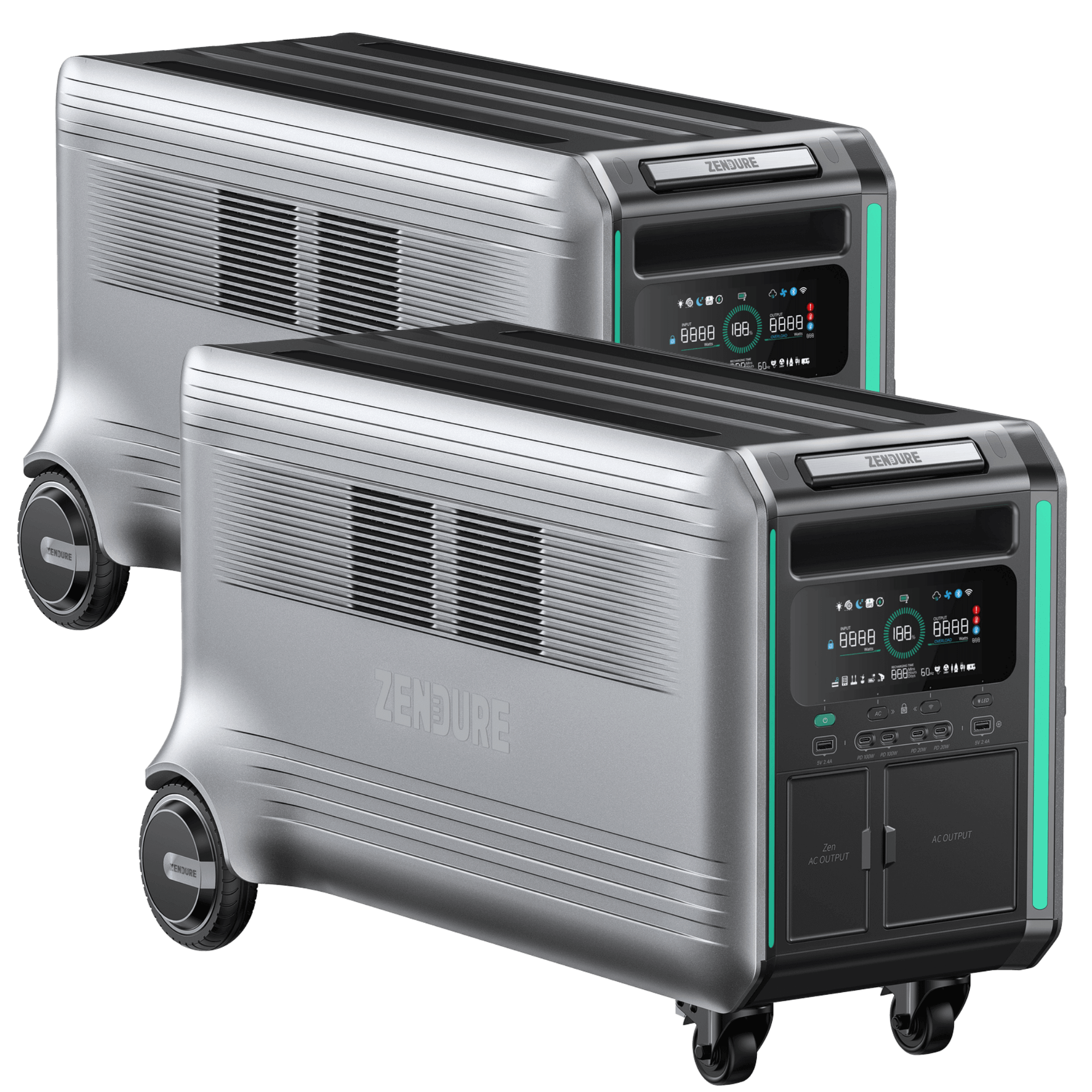
Explore this need in the finder →This SuperBase V package contains two Zendure V4600 stations, zero extra Satellite Batteries and the Home Panel option. The U.S. selector called the choice “V4600*2 / 0 / Yes.” Its variant record did not expose a SKU; this review keeps that unknown rather than borrowing a SKU from the station-only pair. Each V4600 is a 4,608 Wh LFP station rated for 3,800 W continuous AC. Together, the selected pair carries 9,216 Wh nameplate and is the documented same-type basis for Zendure’s higher-output Home Panel setup.
The Home Panel is a fixed system, not plug-and-play room backup
Zendure’s U.S. Home Panel with EV Outlets installation manual identifies model ZDSHPEV2, with a 120/240 V rated system, ten load circuits, two EV outlets and a listed weight of 19.4 lb. It can connect two SuperBase V units, and Zendure lists up to 7,600 W total V input/output capacity for the pair. Those limits do not guarantee a particular home’s backup coverage: the actual circuits and loads have to fit the system. The manual requires installation by a licensed electrician and verification by the local authority having jurisdiction. Treat the panel as electrical infrastructure, and make the circuit plan before relying on it in an outage.
What the two V4600s can do together
The V4600 manual says two same-type V stations can be connected through the Home Panel or a ZenY cable to reach up to 7,600 W combined output. In this exact package the Home Panel is included, so a documented linked plan is available without assuming a cable is included. The Home Panel manual confirms 120/240 V service and up to two SuperBase V inputs; each station contributes up to 3,800 W. The V4600 also has Zen AC outlets for 120 V or 240 V output when used as a station, but the panel is what makes the selected two-unit fixed-circuit system materially different from two independent boxes.
Capacity, battery type and expansion count
The pair’s base nameplate capacity is 9,216 Wh. This exact offer includes zero Satellite Batteries, even though each V4600 can support up to four compatible B4600 packs. Zendure’s comparison page rounds the single-V4600 maximum to about 23 kWh and lists 46,080 Wh for a two-V4600 configuration with eight B4600 packs; those added packs are not in the selector choice reviewed here. Zendure’s manual identifies the V4600/B4600 chemistry as LFP and warns not to mix it with the V6400/B6400 semi-solid-state system. The 6,000+ cycle figure is manufacturer-published, not an independent life test.
Space, service and upkeep are part of the purchase
The two base stations weigh about 242 lb total; add the 19.4 lb panel, for about 261.4 lb of listed equipment before wiring or other installation materials. Each station is about 121 lb. Their motorized wheels help move them across a suitable surface but do not remove the need for safe transport and a suitable indoor installation location. The V4600 manual says solar panels are sold separately, supports up to 3,000 W solar input per station within its voltage and current limits, and requires the array to remain within the manual’s voltage envelope. The exact package does not include extra batteries or a solar panel. The cable contents for solar input were not established.
Who should consider this exact package?
This pairing fits a household buyer who specifically wants LFP chemistry, two stations, the Home Panel included and a professionally designed 120/240 V backup plan. It is not the simple choice for a renter, an occasional campsite or someone who only needs one 3,800 W station. Compared with the V6400 pair, it offers less base energy but the LFP chemistry and a higher published cycle count. Before selecting it, list the essential loads, their continuous/startup demand and how long they need to run; 9,216 Wh nameplate does not predict delivered runtime. Do not count the panel’s ten circuits as permission to exceed the stations’ power limits.
Package identity and option values come from Zendure’s U.S. SuperBase V page. The V4600 specifications and pair-linking instructions are in the SuperBase V U.S. manual, pages 2–3, 6–7 and 11. The Home Panel’s ZDSHPEV2 rating, weight, circuits and professional-installation requirements come from Zendure’s U.S. installation manual, pages 2–3 and 7–10. The maximum expanded configuration is listed in Zendure’s comparison page.
Key details at a glance
| Nameplate battery capacity | 9216 Wh |
|---|---|
| Rated AC output | 7600 W |
| Maximum solar input | 3000 W |
| Included panels, combined nameplate | 0 W |
| Maximum USB-C output per port | 100 W |
| Listed weight | 121 lb |
More specifications and setup details
| Compatible extra-battery expansion | Yes |
|---|---|
| 12 V DC output | 126 W |
| Manufacturer UPS transfer figure | 13 ms |
| AC outlet output | Yes |
| USB-C ports | 4 |
| USB-A ports | 2 |
| Battery chemistry | LiFePO4 |
| Expansion battery in this package | No |
| Home Power Panel in this package | Yes |
| HPP 120/240 V split-phase | Yes |
| Separate station units in offer | 2 |
| Smart Transfer Switch in this package | Yes |
| Expansion packs in exact offer | 0 |
| Solar panels in exact offer | 0 |
| Included expansion batteries | 0 units |
Use the exact model’s instructions for operating limits, supplied equipment and version differences.
Sources for this assessment
A useful match starts with the loads that matter.
Use the finder for hard electrical requirements, then check appliance starting behavior, actual run time and the exact package in the full assessment.