
On this page
Your needs, this model
Does it fit your priorities?
Can two separate V4600 stations provide 9,216 Wh total package capacity while each load stays within 3,800 W?
The package contains two 4,608 Wh stations. Zendure rates each at 3,800 W; the no-Home-Panel option is not treated as one 7,600 W output.
Explore this need in the finder →Do you need a 240 V Zen outlet on one of the included stations?
Each V4600 manual lists the 120/240 V Zen output option; the two-station offer does not establish a linked 7,600 W plan without a link accessory.
Explore this need in the finder →Do you want no Satellite Battery in the selected package?
The exact selector’s Extra Batteries value is zero. The stations support compatible B4600 expansion later, but it is not included.
Explore this need in the finder →Do you need a car-style DC output on the V4600 stations?
The manual lists the car outlet on each station and a combined 126 W maximum for the car/DC5521 output group.
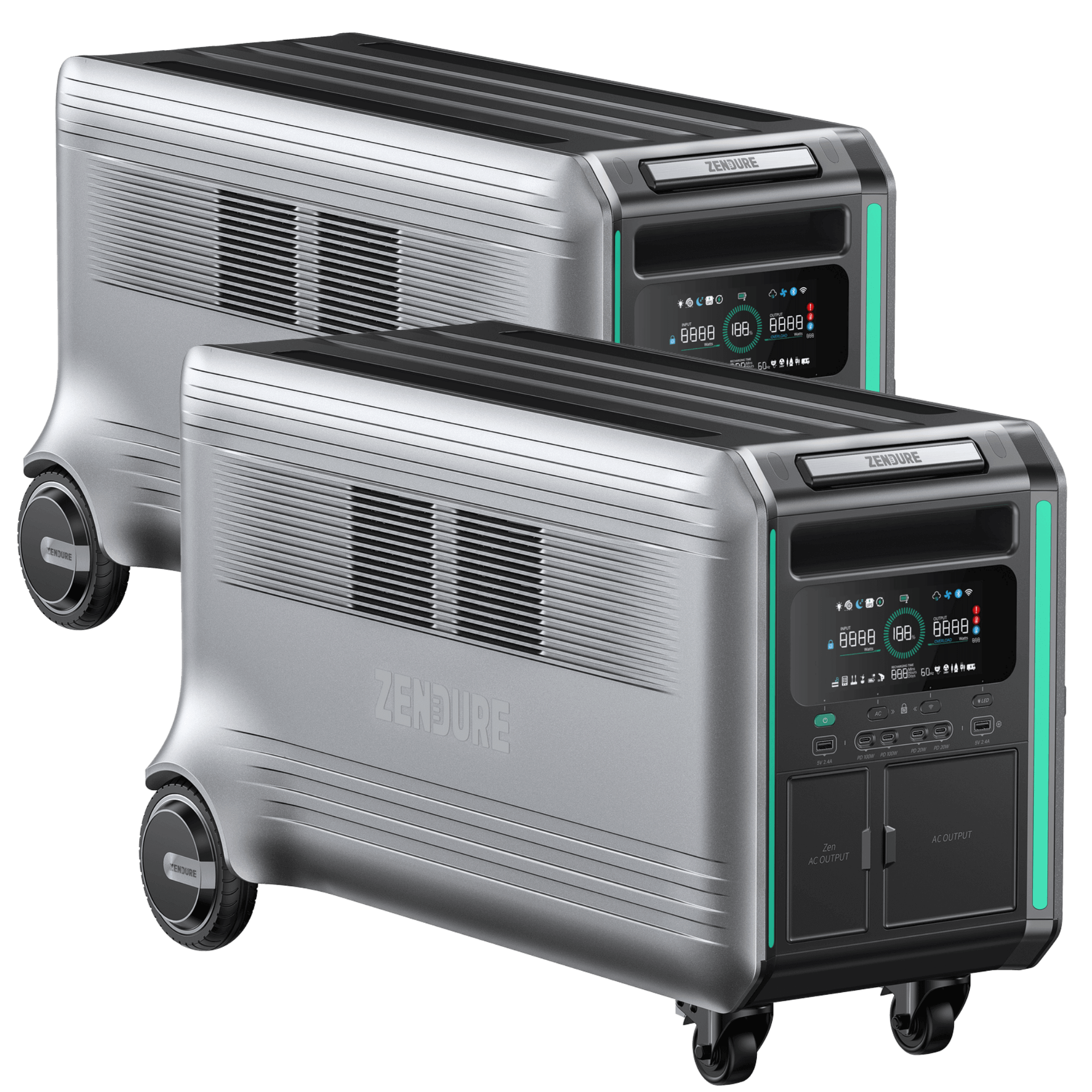
Explore this need in the finder →The exact “V4600*2 / 0 / No” selector option is a two-station Zendure package: two SuperBase V4600 LFP units, no extra Satellite Batteries and no Home Panel. Zendure’s U.S. product JSON captured a two-unit bundle SKU string beginning “2&ZDSBV4600-GY-US”; the source marked it sold out and the SKU formatting is preserved as shown rather than normalized. Each V4600 is 4,608 Wh and 3,800 W rated, so the package contains 9,216 Wh of nameplate batteries across two 121 lb units. That is not the same as one compact 9.2 kWh station.
Two batteries do not automatically make one 7,600 W outlet
Each V4600 has four standard 120 V AC outlets and two Zen AC outlets configurable for 120 V or 240 V; the rated output for each station is 3,800 W. Zendure says two same-chemistry V stations can be connected with a ZenY cable or the Home Panel to reach 7,600 W combined output. This exact option says Home Panel “No,” and the observed SKU string names the two V4600s but not a ZenY cable. Therefore, I treat this package as two separate 3,800 W stations until the buyer separately verifies the required link cable and its exact contents. A 240 V Zen outlet is documented for each station, but that alone does not prove a single, 7,600 W linked plan or a home transfer installation.
Capacity and chemistry favor the V4600 pair’s own use case
The pair doubles the V4600 base storage to 9,216 Wh. That is helpful when two stations can serve separate loads or be connected in an approved system; it does not guarantee runtime because inverter losses, operating conditions and load cycles affect delivered energy. The manual identifies V4600 as LiFePO4 and lists 6,000+ cycles. This is Zendure’s published figure, not a warranty or laboratory measurement. The same-type requirement matters: do not pair the V4600 with V6400/Semi-solid-state units or B6400 batteries. Each V4600 supports up to four B4600 Satellite Batteries separately, but this exact double offer contains zero expansion batteries.
Port and recharge planning still happens per unit
Each station supports up to 3,000 W solar input within 12–150 V DC and 25 A limits, and the manual requires array open-circuit voltage at or below 150 V. Solar panels are sold separately; no panel is named in this offer. The station manual lists AC input up to 1,800 W at 120 V or 3,600 W at 240 V. Each unit also has four USB-C ports, with two rated up to 100 W and two up to 20 W, plus USB-A and DC outputs. The manual gives 126 W combined for the car and DC5521 output group; do not treat the aggregate as an individual port allowance.
Plan for two heavy, wheeled units
The base stations together weigh about 242 lb before accessories, while each weighs about 121 lb and measures roughly 28.7 × 13.6 × 17.4 inches. Each has motorized rear wheels and a pull handle, but moving two large batteries still calls for a route, storage space and safe restraint during transport. The listing does not include a Home Panel, so household circuit integration is not part of this package. If the goal is backup for selected fixed circuits, compare the V4600*2/Home Panel configuration and involve a licensed electrician. A basic station pair can still be useful for separated loads, but do not conflate “two units” with “two-phase home backup.”
Who should buy this exact pair?
It suits a user who wants two same-chemistry, high-capacity stations and can make use of separate outputs or confirm the link accessory needed for a combined system. The V6400 pair stores more energy per unit but uses semi-solid-state batteries and is heavier. If the load never requires two stations, a single V4600 costs less equipment space and avoids managing a second heavy unit. This selector option includes no extra B4600 batteries, no Home Panel and no solar panels. Zendure’s captured stock state was sold out; it is kept as useful model reference, not a promise of current availability.
The exact bundle and selector values come from Zendure’s U.S. SuperBase V page. Battery and output ratings, linking rules, input limits and weight are from Zendure’s U.S. SuperBase V manual, pages 2–3, 6–9 and 11. The review treats the cable as unconfirmed in this exact offer.
Key details at a glance
| Nameplate battery capacity | 9216 Wh |
|---|---|
| Rated AC output | 3800 W |
| Maximum solar input | 3000 W |
| Included panels, combined nameplate | 0 W |
| Maximum USB-C output per port | 100 W |
| Listed weight | 121 lb |
More specifications and setup details
| Compatible extra-battery expansion | Yes |
|---|---|
| 12 V DC output | 126 W |
| Manufacturer UPS transfer figure | 13 ms |
| AC outlet output | Yes |
| USB-C ports | 4 |
| USB-A ports | 2 |
| Battery chemistry | LiFePO4 |
| Expansion battery in this package | No |
| Home Power Panel in this package | No |
| Separate station units in offer | 2 |
| Smart Transfer Switch in this package | No |
| Expansion packs in exact offer | 0 |
| Solar panels in exact offer | 0 |
| Included expansion batteries | 0 units |
Use the exact model’s instructions for operating limits, supplied equipment and version differences.
Sources for this assessment
A useful match starts with the loads that matter.
Use the finder for hard electrical requirements, then check appliance starting behavior, actual run time and the exact package in the full assessment.