
On this page
Your needs, this model
Does it fit your priorities?
Will one V4600 provide at least 4,608 Wh nameplate and 3,800 W rated AC for your planned load?
Zendure rates this exact one-station V4600 option at 4,608 Wh and 3,800 W continuous AC; that does not predict runtime or cover startup spikes above the rated plan.
Explore this need in the finder →Is a documented 240 V Zen AC output important for one appliance?
The manual lists either 120 V or 240 V from the Zen AC outputs, one mode at a time, with 3,800 W total rated output. This is not a Home Panel installation.
Explore this need in the finder →Do you want a compatible battery path but no extra battery in this exact offer?
The V4600 supports up to four B4600 packs per station, sold separately; this exact selector choice is Extra Batteries 0.
Explore this need in the finder →Do you need a car-style 12 V output with the manual’s combined 126 W car/DC5521 ceiling?
The manual lists a car output and gives 126 W as the combined maximum for car and DC5521 outputs, not as a per-port rating.
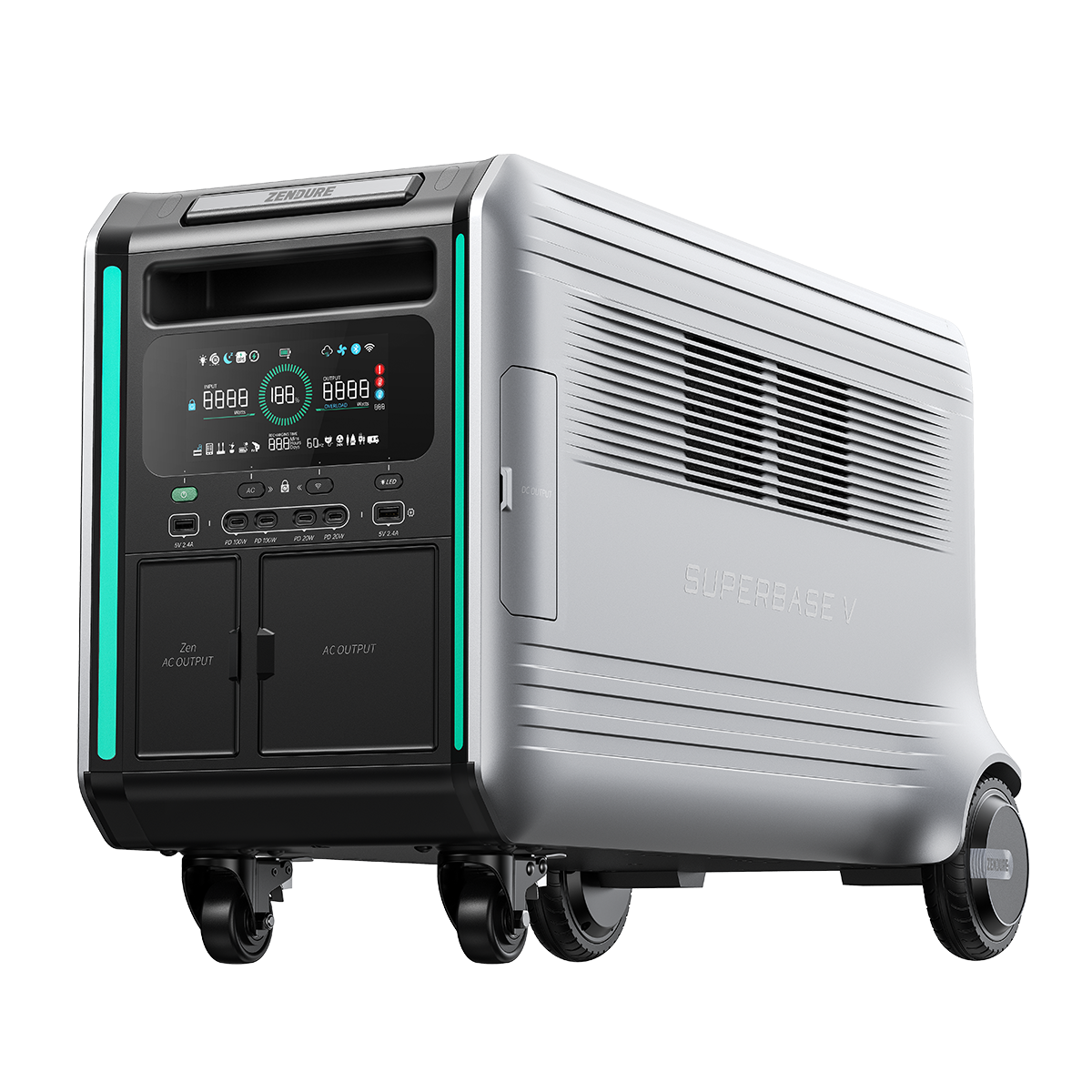
Explore this need in the finder →The Zendure SuperBase V4600 is the LFP version of Zendure’s large, wheeled SuperBase V. This review is for the exact U.S. selector setting “V4600 / 0 / No”: one V4600 station, no Satellite Battery and no Home Panel. Zendure’s captured selector identified SKU ZDSBV4600-GY-US and marked the option sold out; that snapshot is not proof that the model has been discontinued. The manual lists 4,608 Wh of nameplate storage, 3,800 W of rated AC output and 121 lb of weight. This is substantial backup equipment, not a lightweight camping battery.
Choose it for LFP storage and a high continuous-output ceiling
Zendure specifies LFP (LiFePO4) cells for the V4600 and lists 6,000+ cycles in the manual’s cycle-life table. That figure is a manufacturer claim; the manual does not turn it into a guaranteed calendar life, nor does it tell a buyer how much usable energy a particular appliance will receive. The 4,608 Wh is nameplate battery capacity, while 3,800 W is the continuous AC rating. Zendure also describes a 5,000 W peak/AmpUp capability, but the manual cautions that AmpUp is not suitable for every appliance and does not replace the 3,800 W rated limit. Check both running demand and startup behavior rather than treating the peak figure as an everyday target.
Output choices are unusually broad, with port-specific limits
The manual lists four ordinary 120 V AC outlets and two Zendure “Zen AC” outlets that can be configured for either 120 V or 240 V output, one mode at a time. The total rated AC output remains 3,800 W. That gives the V4600 a documented route for a 240 V appliance through the Zen outlet, but it is not the same thing as a wired household backup system. The front also has four USB-C ports—two rated up to 100 W each and two up to 20 W—plus USB-A, a car-style 12 V output, DC5521 and Anderson ports. The manual gives 126 W as the combined maximum for the car outlet and DC5521 ports, so do not count that number as a per-port rating.
Charging and movement require planning
Zendure lists up to 3,000 W of solar input, with a 12–150 V DC input range, 25 A maximum current and a 12–120 V MPPT range. It cautions that the open-circuit voltage must remain at or below 150 V and says panels are sold separately. The captured offer contains no panel, and the station-side cable contents for this exact selector option were not established. AC input is listed at up to 1,800 W on 120 V or 3,600 W on 240 V. Those are maximum input ratings, not a promise that every outlet or circuit can supply them in a home installation.
At 121 lb, the V4600 is heavy to lift. Its rear motorized wheels and pull handle can help move it across a suitable surface, but that feature does not make it an easy unit to carry into a tent or up stairs. The manual says a satellite battery cable is required for expansion, recommends a level surface, and advises keeping the fans unobstructed and the unit dry. It also lists a 13 ms seamless-UPS transfer claim and recommends checking appliance compatibility before using the unit as a UPS; it is not a zero-millisecond guarantee.
Be exact about what the selected package does not include
This SKU is the station-only, zero-extra-battery setting. It does support later expansion with up to four B4600 Satellite Batteries per V4600, but those batteries are not included here. Zendure warns not to mix V4600/LFP and V6400/semi-solid-state battery types. A Home Panel is also not included in this selector option. Two same-type V4600 stations can be connected with Zendure’s ZenY cable or Home Panel for a higher-output system, but neither the cable nor a transfer panel is established as part of this exact offer. Treat a 7,600 W paired setup as a different, properly connected configuration—not a property of this one-station package.
Who should consider this exact V4600 offer?
It fits a buyer who wants one large LFP station, a documented 240 V Zen outlet, high 120 V AC output and a path to add compatible B4600 batteries later. It is a poor match if low lifting weight, included solar panels, a supplied transfer panel, or an already-installed home backup circuit is essential. Zendure’s V6400 offers more nameplate capacity per base unit but uses semi-solid-state cells, weighs more and has a lower published cycle-count figure; choose between them on the actual capacity, chemistry and handling requirements rather than a broad “better battery” claim. If the requirement is 120/240 V service for selected home circuits, review the Home Panel version and arrange a licensed-electrician assessment before relying on it.
Model identity and package options come from Zendure’s U.S. SuperBase V selector. Capacity, chemistry, cycle-life label, weight, ports, input limits, expansion rules and UPS transfer wording are from the SuperBase V6400/4600 U.S. manual, especially pages 2–3 and 6–11. These are manufacturer specifications, not independent load or runtime tests.
Key details at a glance
| Nameplate battery capacity | 4608 Wh |
|---|---|
| Rated AC output | 3800 W |
| Manufacturer surge rating | 5000 W |
| Maximum solar input | 3000 W |
| Included panels, combined nameplate | 0 W |
| Maximum USB-C output per port | 100 W |
More specifications and setup details
| Listed weight | 121 lb |
|---|---|
| Compatible extra-battery expansion | Yes |
| 12 V DC output | 126 W |
| Manufacturer UPS transfer figure | 13 ms |
| AC outlet output | Yes |
| USB-C ports | 4 |
| USB-A ports | 2 |
| Battery chemistry | LiFePO4 |
| Expansion battery in this package | No |
| Home Power Panel in this package | No |
| Separate station units in offer | 1 |
| Smart Transfer Switch in this package | No |
| Expansion packs in exact offer | 0 |
| Solar panels in exact offer | 0 |
| Included expansion batteries | 0 units |
Use the exact model’s instructions for operating limits, supplied equipment and version differences.
Sources for this assessment
A useful match starts with the loads that matter.
Use the finder for hard electrical requirements, then check appliance starting behavior, actual run time and the exact package in the full assessment.