
On this page
Your needs, this model
Does it fit your priorities?
Will 19,314 Wh of nameplate storage from this one-V6400 package serve a 120 V load plan below the station’s 3,800 W continuous AC rating?
The exact selector option includes a V6400 plus 2 matching B6400 packs for 19,314 Wh nameplate. The extra batteries extend storage, not the one station’s 3,800 W AC ceiling.
Explore this need in the finder →Does this exact selector choice include at least 2 compatible B6400 Satellite Batteries?
The saved official selector title is “V6400 / 2 / Yes” (variant 40157856694346); it names 2 matching expansion batteries. SKU is not exposed for this option.
Explore this need in the finder →Do you need this exact offer to include the ten-circuit Home Panel, and will an electrician verify a single-station circuit plan before installation?
The selector says Home Panel Yes. Its own manual specifies ten circuits and professional installation, but the saved evidence does not settle this exact single-station service topology; verify it before relying on backup circuits.
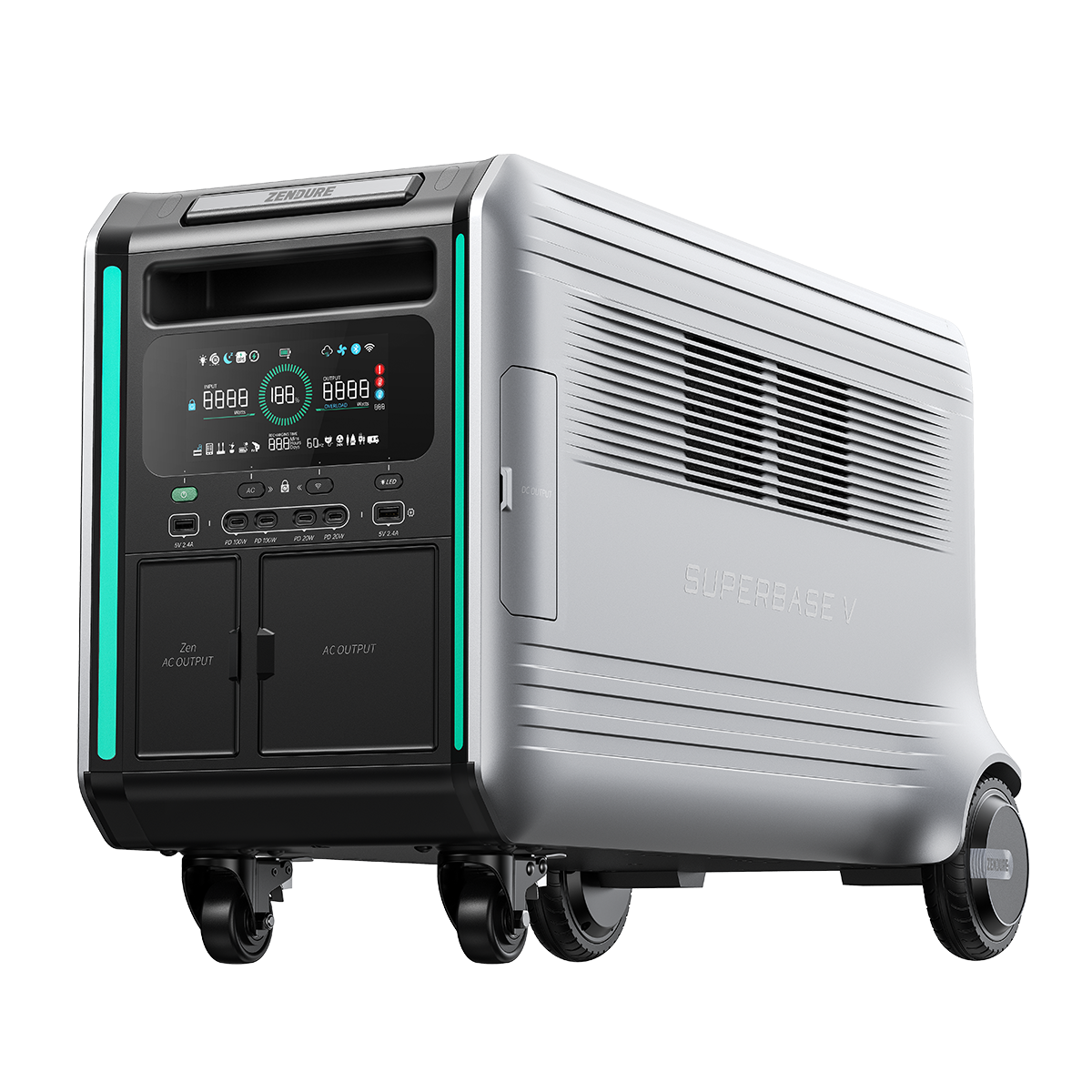
Explore this need in the finder →This selector package is one SuperBase V6400, two matching B6400 Satellite Batteries and the Zendure Home Panel (“V6400 / 2 / Yes”). Together the station and packs are listed at 19,314 Wh nameplate. Home Panel inclusion changes the installation package; it does not add a station inverter. The exact selector offer was marked unavailable in the archived capture, which is not evidence of discontinuation.
Energy capacity stays separate from power
The V6400 base and each B6400 are listed at 6,438 Wh, so two matching packs bring the package to 19,314 Wh. That can extend a backup schedule when the load is within one station’s 3,800 W continuous AC rating. It cannot support an arbitrarily high continuous load just because the capacity number is large. Zendure’s 5,000 W peak figure is not the continuous limit, and nameplate Wh do not equal AC watt-hours at the outlet.
This package is a middle step between the one- and three-B6400 Home Panel offers. Choose the smaller option if the load plan needs only 12,876 Wh; choose three packs only if the higher reserve is useful and the added mass is manageable. The Home Panel can be an expensive, weighty spare if the buyer will use the V6400 only as a portable power station.
Have the electrical topology confirmed
The included Home Panel is specified as a ten-circuit 120/240 V unit, and the manufacturer’s installation documentation calls for a licensed electrician. Zendure’s 7,600 W combined rating applies to its documented two-station arrangement; this offer contains one V6400, so that figure does not apply. The exact single-station circuit topology is not settled by the available evidence. Confirm circuit layout and service with Zendure and a qualified installer before building a backup plan around the panel.
The station’s four ordinary outlets remain 120 V; two Zen outlets support the documented 120/240 V mode. The V6400 has a solar input rated up to 3,000 W within its electrical limits, but no panel is included. The AC charging ceiling varies by voltage, from 1,800 W at 120 V to 3,600 W at 240 V. Keep these station ratings distinct from the Home Panel’s circuit count.
Installation weight and battery matching
At 130 lb for the V6400, 101 lb for each B6400 and roughly 19.4 lb for the Home Panel, the named components total about 351.4 lb before packaging. Moving the station is one decision; moving two separate satellites is another. The equipment needs a suitable floor and a preplanned location, cable paths and installation access. Zendure’s manual also requires the V6400’s matching battery type, not V4600/B4600 packs.
This option is for a buyer who needs both the two-pack storage level and a professionally installed panel, after the one-station topology has been confirmed. If no circuit installation is planned, the no-panel V6400 with two B6400 batteries is simpler. If a larger continuous output is the need, compare a two-station configuration rather than purchasing extra storage packs.
V6400 batteries and Home Panel are distinct choices
The U.S. manual identifies the V6400/B6400 family as semi-solid-state and lists 3,000 cycles in its cycle-life table. It is a manufacturer figure, not an independently tested life or warranty promise. Zendure also cautions against mixing battery types. A third B6400 would add 6,438 Wh of nameplate reserve and about 101 lb; it would not raise the one-station 3,800 W continuous output. Two more compatible battery positions remain under the manual’s four-pack limit.
The Home Panel installation manual describes a ten-circuit, 120/240 V device and requires licensed-electrician installation, but the exact single-station service topology for this offer is not established by the selector. Treat panel inclusion as a reason to plan an installation conversation, not as a promise that every desired circuit or load will work. If the installation cannot be verified, the no-panel two-B6400 package is the clearer local-outlet alternative.
Key details at a glance
| Nameplate battery capacity | 19314 Wh |
|---|---|
| Rated AC output | 3800 W |
| Manufacturer surge rating | 5000 W |
| Maximum solar input | 3000 W |
| Included panels, combined nameplate | 0 W |
| Maximum USB-C output per port | 100 W |
More specifications and setup details
| Listed weight | 130 lb |
|---|---|
| Compatible extra-battery expansion | Yes |
| 12 V DC output | 126 W |
| Manufacturer UPS transfer figure | 13 ms |
| AC outlet output | Yes |
| USB-C ports | 4 |
| USB-A ports | 2 |
| Battery chemistry | Semi-solid-state battery |
| Expansion battery in this package | Yes |
| Home Power Panel in this package | Yes |
| HPP 120/240 V split-phase | Yes |
| Separate station units in offer | 1 |
| Smart Transfer Switch in this package | Yes |
| Expansion packs in exact offer | 2 |
| Solar panels in exact offer | 0 |
| Included expansion batteries | 2 units |
Use the exact model’s instructions for operating limits, supplied equipment and version differences.
Sources for this assessment
A useful match starts with the loads that matter.
Use the finder for hard electrical requirements, then check appliance starting behavior, actual run time and the exact package in the full assessment.