
On this page
Your needs, this model
Does it fit your priorities?
Will 19,314 Wh of nameplate storage from this one-V6400 package serve a 120 V load plan below the station’s 3,800 W continuous AC rating?
The exact selector option includes a V6400 plus 2 matching B6400 packs for 19,314 Wh nameplate. The extra batteries extend storage, not the one station’s 3,800 W AC ceiling.
Explore this need in the finder →Does this exact selector choice include at least 2 compatible B6400 Satellite Batteries?
The saved official selector title is “V6400 / 2 / No” (variant 40159460458570); it names 2 matching expansion batteries. SKU is not exposed for this option.
Explore this need in the finder →Can you supply compatible solar hardware separately for the one-V6400 station’s 3,000 W maximum solar input?
Solar charging is supported up to the station’s specified input window, but this exact selector option contains no solar panel.
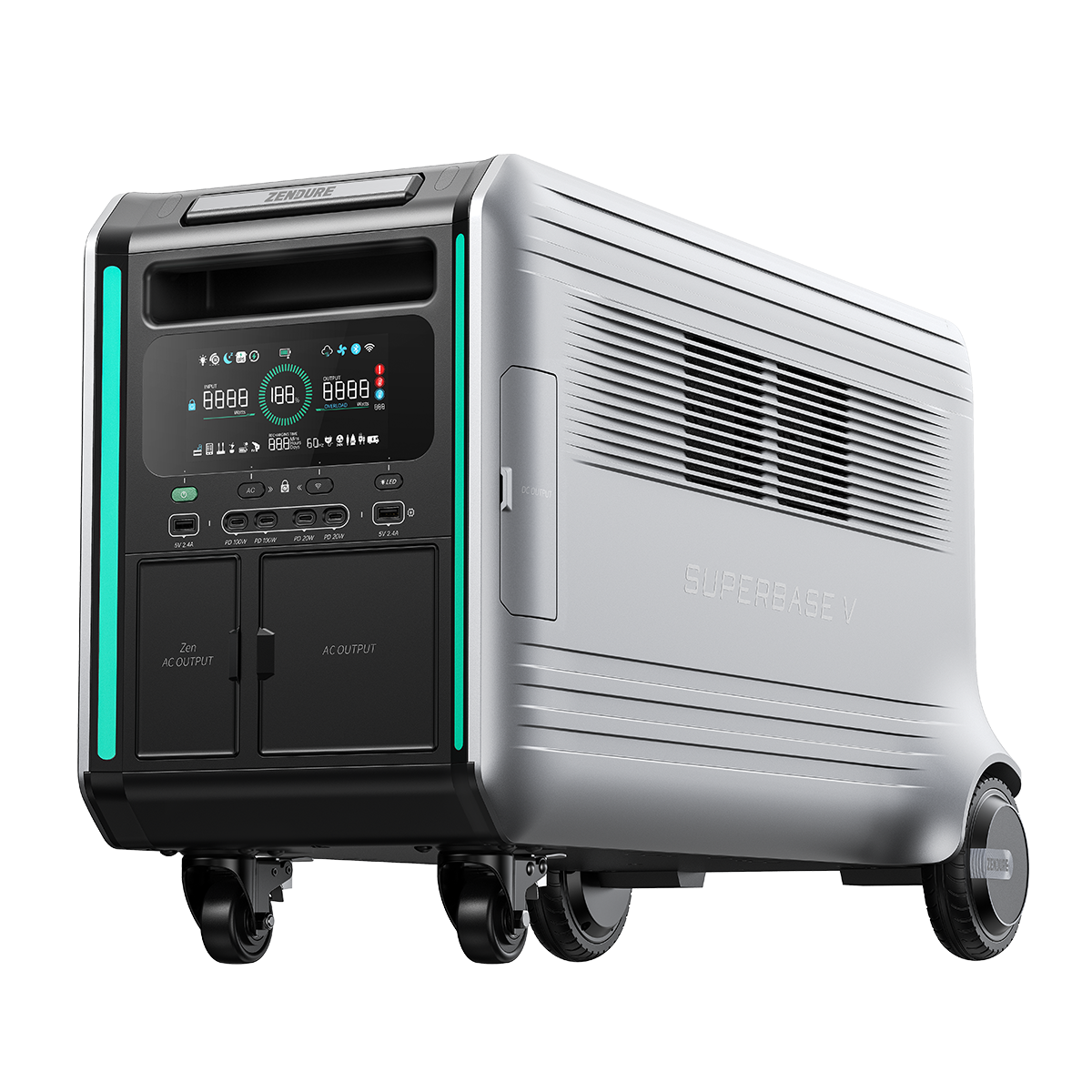
Explore this need in the finder →The exact U.S. selector choice “V6400 / 2 / No” is one SuperBase V6400 with two matching B6400 Satellite Batteries and no Home Panel. The three units have 19,314 Wh of nameplate storage in total. The V6400 remains a single 3,800 W continuous AC station; the extra batteries increase energy capacity, not the output ceiling. The archived selector recorded this exact offer unavailable at capture, not necessarily discontinued.
More reserve, one inverter
The V6400 base is 6,438 Wh and each B6400 adds another 6,438 Wh. This two-pack configuration therefore gives three times the base station’s nameplate capacity. It can suit an extended low-to-moderate load plan, but it does not make a single 240 V appliance or a group of simultaneous loads easier to start than the station’s output specification allows. Treat the 5,000 W peak figure separately from continuous power.
Actual AC energy delivered depends on conversion losses, load pattern, reserve settings and temperature, so 19,314 Wh is not a runtime estimate. The V6400 is also the semi-solid-state SuperBase V variant; the manual warns against mixing the V6400’s matched battery type with V4600/B4600 units. The option includes two B6400 packs. It is not a generic two-battery bundle that can be assembled from any SuperBase V accessory.
Portable power without the Home Panel
This package has no Home Panel and no solar modules. Its four ordinary 120 V outlets and two switchable Zen AC outputs cover different uses; the ordinary sockets are not 240 V. Zendure rates the station’s solar input up to 3,000 W, subject to voltage and current limits. The array, panels and exact station-side solar lead are separate unless a seller explicitly proves otherwise. AC input is rated up to 1,800 W at 120 V and 3,600 W at 240 V.
The station is listed at 130 lb and each B6400 at 101 lb: 332 lb for the named components before packaging. The base has wheels, but two separate battery lifts remain. Make room for the units and connecting cables, and do not treat the package as a routine car-camping battery. The 126 W combined car/DC5521 limit and the manual’s UPS transfer figure are additional details, not substitutes for checking individual device compatibility.
Where it sits in the V range
This bundle falls between the 12,876 Wh one-B6400 package and the 25,752 Wh three-B6400 option while preserving one-station output. That middle step may suit buyers who want materially more reserve without committing to a three-pack’s weight. The highest 32,190 Wh four-pack version uses all four allowed satellite slots; this two-pack version leaves room for two more compatible B6400 batteries later, subject to Zendure’s instructions.
Choose it for a defined longer-duration plan that stays under 3,800 W and can accommodate 332 lb of components. If circuits need transfer, compare a Home Panel offer and have its topology professionally checked. If the limit is wattage, not stored energy, look at the separate two-station path rather than adding batteries.
Choose the V6400 battery family deliberately
Zendure’s manual identifies the V6400/B6400 cells as semi-solid-state and lists a 3,000-cycle figure in the manufacturer’s cycle-life table. That is a published claim, not independent lifespan testing or a warranty guarantee. The same manual prohibits mixing battery types, so the compatible expansion path here is B6400, not V4600/B4600. Two packs give this offer 19,314 Wh; a third adds 6,438 Wh of nameplate capacity and about 101 lb, with no increase to the 3,800 W station output.
This two-pack version also leaves two supported battery positions, but buyers should weigh staged purchases against handling and location requirements. Each additional module is a separate heavy piece. If more storage is useful but the V6400’s weight is already a concern, compare the V4600 family’s different capacity and battery chemistry rather than assuming the largest watt-hour line is automatically the best fit.
Key details at a glance
| Nameplate battery capacity | 19314 Wh |
|---|---|
| Rated AC output | 3800 W |
| Manufacturer surge rating | 5000 W |
| Maximum solar input | 3000 W |
| Included panels, combined nameplate | 0 W |
| Maximum USB-C output per port | 100 W |
More specifications and setup details
| Listed weight | 130 lb |
|---|---|
| Compatible extra-battery expansion | Yes |
| 12 V DC output | 126 W |
| Manufacturer UPS transfer figure | 13 ms |
| AC outlet output | Yes |
| USB-C ports | 4 |
| USB-A ports | 2 |
| Battery chemistry | Semi-solid-state battery |
| Expansion battery in this package | Yes |
| Home Power Panel in this package | No |
| Separate station units in offer | 1 |
| Smart Transfer Switch in this package | No |
| Expansion packs in exact offer | 2 |
| Solar panels in exact offer | 0 |
| Included expansion batteries | 2 units |
Use the exact model’s instructions for operating limits, supplied equipment and version differences.
Sources for this assessment
A useful match starts with the loads that matter.
Use the finder for hard electrical requirements, then check appliance starting behavior, actual run time and the exact package in the full assessment.