
On this page
Your needs, this model
Does it fit your priorities?
Will 32,190 Wh of nameplate storage from this one-V6400 package serve a 120 V load plan below the station’s 3,800 W continuous AC rating?
The exact selector option includes a V6400 plus 4 matching B6400 packs for 32,190 Wh nameplate. The extra batteries extend storage, not the one station’s 3,800 W AC ceiling.
Explore this need in the finder →Does this exact selector choice include at least 4 compatible B6400 Satellite Batteries?
The saved official selector title is “V6400 / 4 / Yes” (variant 40157856759882); it names 4 matching expansion batteries. SKU is not exposed for this option.
Explore this need in the finder →Do you need this exact offer to include the ten-circuit Home Panel, and will an electrician verify a single-station circuit plan before installation?
The selector says Home Panel Yes. Its own manual specifies ten circuits and professional installation, but the saved evidence does not settle this exact single-station service topology; verify it before relying on backup circuits.
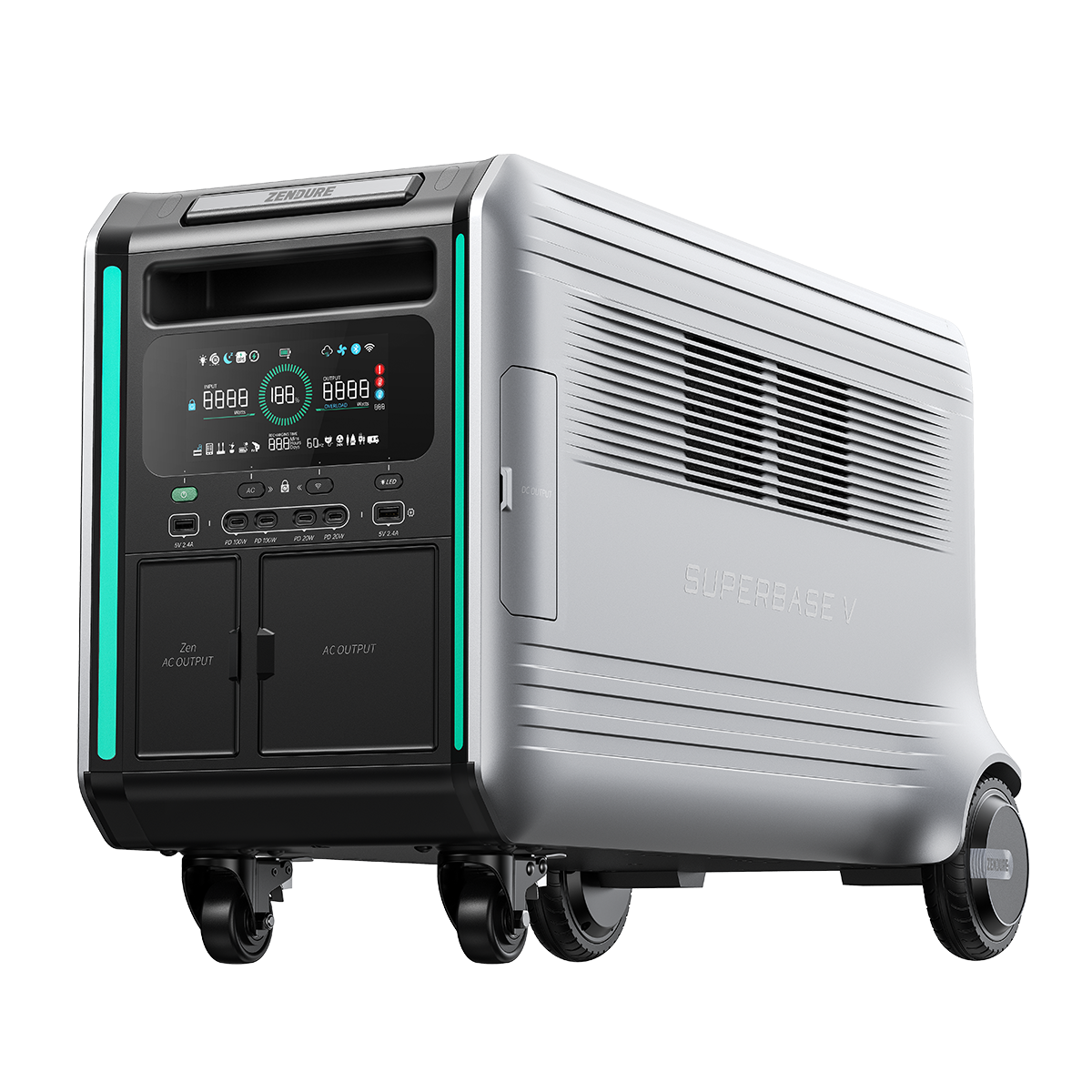
Explore this need in the finder →The Zendure U.S. selector’s “V6400 / 4 / Yes” option combines one SuperBase V6400, four matching B6400 Satellite Batteries and the Home Panel. Station plus satellites are listed at 32,190 Wh nameplate, the one-station maximum. The Home Panel is included, but not a second V6400, so this remains one 3,800 W continuous inverter plan. The capture recorded unavailable; that fact is not a discontinuation notice.
The largest V6400 storage bundle
The V6400 base and four B6400 units each carry a listed 6,438 Wh, giving 32,190 Wh in aggregate. This can be useful for a defined long-duration backup where sustained load remains below the station’s 3,800 W rating. A high energy total cannot raise that continuous limit. The 5,000 W peak/AmpUp number is not appropriate for ordinary appliance load planning, and the nameplate total is not the energy delivered to AC after conversion losses and reserve.
This package has no remaining satellite-battery headroom: the manual allows up to four matched packs per V station. The three-pack Home Panel offer leaves one compatible battery slot free; the four-pack configuration starts at the ceiling. A buyer should only take on the extra 6,438 Wh module if an actual load schedule needs that reserve and the physical installation can manage it.
The Home Panel needs installer confirmation
The included panel is specified as a ten-circuit 120/240 V component, and Zendure’s manual requires professional electrical installation. The documented 7,600 W combined rating applies to two V stations linked through that panel. There is only one station in this selector bundle, so the two-station figure cannot be attributed to this offer. The evidence does not confirm the precise one-station circuit-service topology; get written manufacturer and electrician confirmation before planning circuit backup.
The V6400 itself has four ordinary 120 V outlets and two Zen outlets with documented 120/240 V modes. The Home Panel does not make every receptacle 240 V. Solar charging is rated up to 3,000 W within the input window, but no solar panel is supplied. AC charging tops out at the manual’s voltage-specific ratings. These distinctions matter whether the system is used through its outlets or installed to serve selected circuits.
Installation mass is substantial
The station weighs around 130 lb, each B6400 about 101 lb and the panel about 19.4 lb. The component total is approximately 553.4 lb before packaging. Plan a fixed location, suitable floor, ventilation and a route for the station and each separate battery. The rolling base is not a solution for hauling batteries up stairs. The manual requires the V6400’s matched battery type; do not mix in B4600 packs.
This configuration is for a buyer whose installer has confirmed a one-station Home Panel plan and whose required reserve justifies four B6400s. It is a poor fit if the intended circuit plan is unclear, if output needs exceed one station, or if the equipment cannot be safely staged. The three-pack panel bundle is lighter; the two-station setup is a separate topology that must be evaluated on its own terms.
Maximum reserve and a separate electrical installation
Zendure’s manual identifies the V6400/B6400 battery family as semi-solid-state, publishes a 3,000-cycle figure, and warns not to mix battery types. This is a manufacturer table claim, not an independently measured lifetime or warranty term. The four-pack offer reaches the single-station expansion ceiling; choosing three instead saves around 101 lb and 6,438 Wh while retaining one matched-pack position. Neither option raises the 3,800 W continuous output.
The Home Panel is included as equipment, but the seller record does not establish a complete installation service or the exact circuit topology for one V6400. The panel manual calls for a licensed electrician and states its own ten-circuit, 120/240 V ratings. Have the installer and Zendure confirm the one-station arrangement against your home panel and circuit list before purchase. If no fixed backup is required, the no-panel four-pack avoids buying panel hardware you may not use.
Key details at a glance
| Nameplate battery capacity | 32190 Wh |
|---|---|
| Rated AC output | 3800 W |
| Manufacturer surge rating | 5000 W |
| Maximum solar input | 3000 W |
| Included panels, combined nameplate | 0 W |
| Maximum USB-C output per port | 100 W |
More specifications and setup details
| Listed weight | 130 lb |
|---|---|
| Compatible extra-battery expansion | Yes |
| 12 V DC output | 126 W |
| Manufacturer UPS transfer figure | 13 ms |
| AC outlet output | Yes |
| USB-C ports | 4 |
| USB-A ports | 2 |
| Battery chemistry | Semi-solid-state battery |
| Expansion battery in this package | Yes |
| Home Power Panel in this package | Yes |
| HPP 120/240 V split-phase | Yes |
| Separate station units in offer | 1 |
| Smart Transfer Switch in this package | Yes |
| Expansion packs in exact offer | 4 |
| Solar panels in exact offer | 0 |
| Included expansion batteries | 4 units |
Use the exact model’s instructions for operating limits, supplied equipment and version differences.
Sources for this assessment
A useful match starts with the loads that matter.
Use the finder for hard electrical requirements, then check appliance starting behavior, actual run time and the exact package in the full assessment.