
On this page
Your needs, this model
Does it fit your priorities?
Will 32,190 Wh of nameplate storage from this one-V6400 package serve a 120 V load plan below the station’s 3,800 W continuous AC rating?
The exact selector option includes a V6400 plus 4 matching B6400 packs for 32,190 Wh nameplate. The extra batteries extend storage, not the one station’s 3,800 W AC ceiling.
Explore this need in the finder →Does this exact selector choice include at least 4 compatible B6400 Satellite Batteries?
The saved official selector title is “V6400 / 4 / No” (variant 40159460524106); it names 4 matching expansion batteries. SKU is not exposed for this option.
Explore this need in the finder →Can you supply compatible solar hardware separately for the one-V6400 station’s 3,000 W maximum solar input?
Solar charging is supported up to the station’s specified input window, but this exact selector option contains no solar panel.
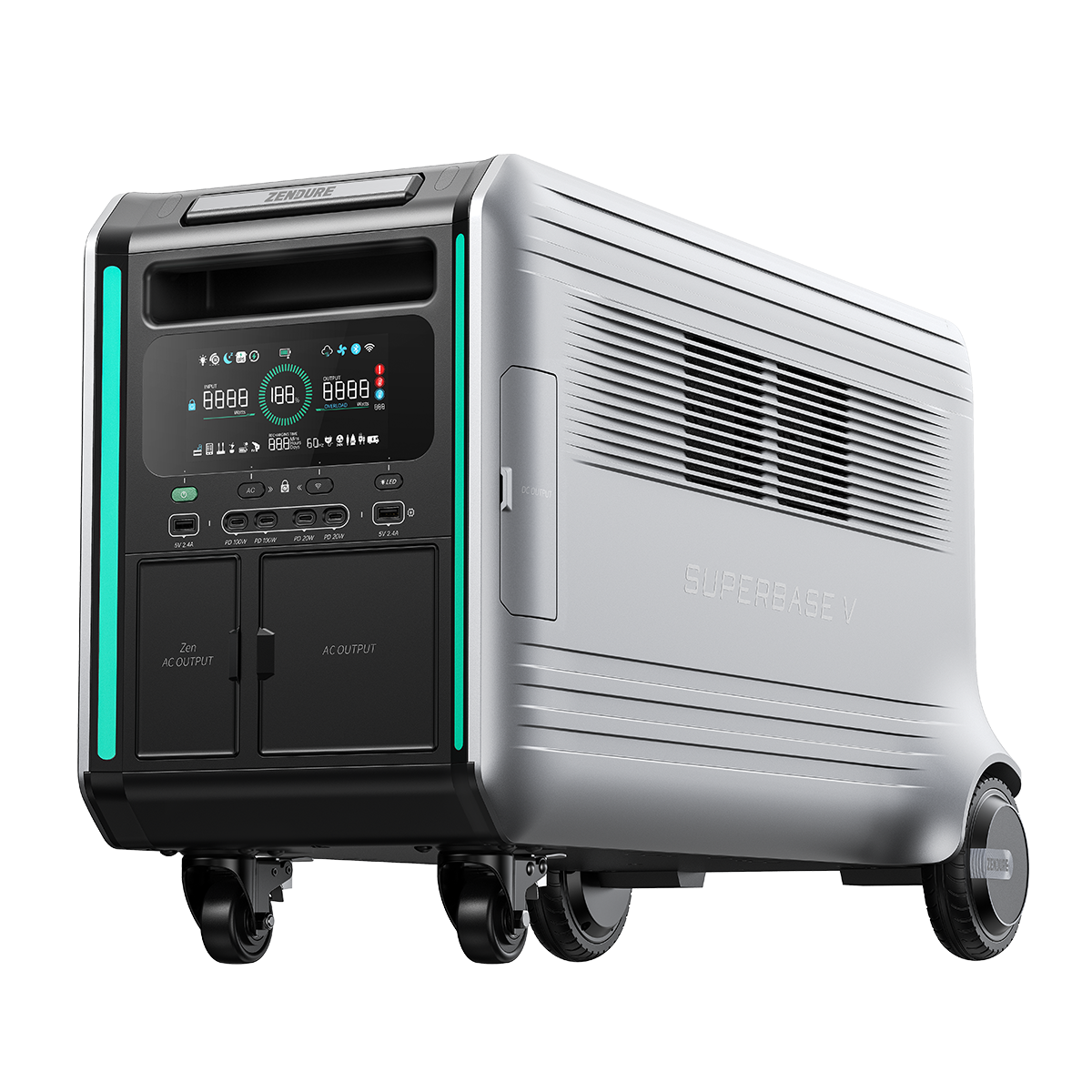
Explore this need in the finder →This U.S. offer is the “V6400 / 4 / No” selector configuration: one SuperBase V6400, four matching B6400 Satellite Batteries and no Home Panel. The station and batteries total 32,190 Wh nameplate, Zendure’s listed one-station expansion maximum. The station is still rated for 3,800 W continuous AC. The archived selector showed the option unavailable at capture, not necessarily discontinued.
Maximum one-station capacity
The V6400 base and each B6400 are listed at 6,438 Wh, so four satellites plus the base reach 32,190 Wh. This package offers the most nominal storage in the single-V6400 selector options. That is relevant for a long-duration load plan whose continuous draw stays below 3,800 W. It does not make larger loads compatible: the manufacturer’s 5,000 W peak figure is not a continuous output rating.
The largest capacity number is not the same as 32,190 Wh delivered to AC devices. Conversion losses, reserve settings, load profile and temperature affect usable energy. The four-pack selection also fills the manual’s one-station limit of four compatible satellite batteries. A three-pack package leaves one slot open for later; a two-pack package has a lower weight and capacity. This is an all-at-once commitment to the maximum, not a staged expansion path.
One station and no fixed circuit panel
Four ordinary receptacles provide 120 V, while the two Zen outlets have documented 120/240 V selections. The offer excludes a Home Panel, so it does not include the ten-circuit transfer component or its required professional installation. If a wired backup is the goal, evaluate the exact panel-included option and confirm its topology; do not assume a large battery count provides a home transfer path.
Solar input is rated up to 3,000 W within the station’s voltage/current limits, but this package does not supply solar panels. AC input is up to 1,800 W at 120 V or 3,600 W at 240 V. A 126 W combined car/DC5521 limit and the manufacturer’s UPS transfer claim are also specific conditions, not general compatibility guarantees. Check a device’s actual charging and switching requirements.
Heavy equipment, matched battery type
The base weighs about 130 lb and each B6400 about 101 lb: roughly 534 lb of named hardware before packaging. Four separate battery modules are easier to stage than a single 534 lb object, but each still needs a plan for lifting and cable connections. The station has wheels for appropriate surfaces, not stairs or repeated transport. The V6400’s matched B6400 chemistry also matters; the manual says not to mix the V6400 type with V4600/B4600 batteries.
This offer makes sense only if the buyer has a load plan for its storage, can place over half a ton of components, and prefers local outlets without the Home Panel included. For less weight, look at three or two B6400s. For more AC power rather than longer reserve, compare the source-documented two-station architecture. Do not let “maximum capacity” stand in for an appliance-by-appliance plan.
There is no fifth B6400 position
The SuperBase V manual identifies the V6400/B6400 battery family as semi-solid-state, lists a 3,000-cycle manufacturer claim, and says not to mix battery types. The figure is not independent durability testing or a warranty promise. This four-pack package is at the station’s documented expansion limit; stepping down to three saves about 101 lb and 6,438 Wh but leaves one supported B6400 position open for later. Either version keeps the same 3,800 W continuous AC ceiling.
Four batteries make this the maximum-capacity single-base choice, not the least complicated one. The base and every satellite must still be moved and placed, and this exact option contains no Home Panel. If home circuits need a wired backup, evaluate the panel-included selection and verify the one-station design with an electrician. A larger capacity total cannot replace that installation decision.
Key details at a glance
| Nameplate battery capacity | 32190 Wh |
|---|---|
| Rated AC output | 3800 W |
| Manufacturer surge rating | 5000 W |
| Maximum solar input | 3000 W |
| Included panels, combined nameplate | 0 W |
| Maximum USB-C output per port | 100 W |
More specifications and setup details
| Listed weight | 130 lb |
|---|---|
| Compatible extra-battery expansion | Yes |
| 12 V DC output | 126 W |
| Manufacturer UPS transfer figure | 13 ms |
| AC outlet output | Yes |
| USB-C ports | 4 |
| USB-A ports | 2 |
| Battery chemistry | Semi-solid-state battery |
| Expansion battery in this package | Yes |
| Home Power Panel in this package | No |
| Separate station units in offer | 1 |
| Smart Transfer Switch in this package | No |
| Expansion packs in exact offer | 4 |
| Solar panels in exact offer | 0 |
| Included expansion batteries | 4 units |
Use the exact model’s instructions for operating limits, supplied equipment and version differences.
Sources for this assessment
A useful match starts with the loads that matter.
Use the finder for hard electrical requirements, then check appliance starting behavior, actual run time and the exact package in the full assessment.